Free CII R03 Mock Exam Questions with Answers (2026)
Try 5 free R03 practice questions with answers and explanations — covering personal allowances, NIC, tax avoidance rules and SDLT calculations. Test yourself before the real exam.
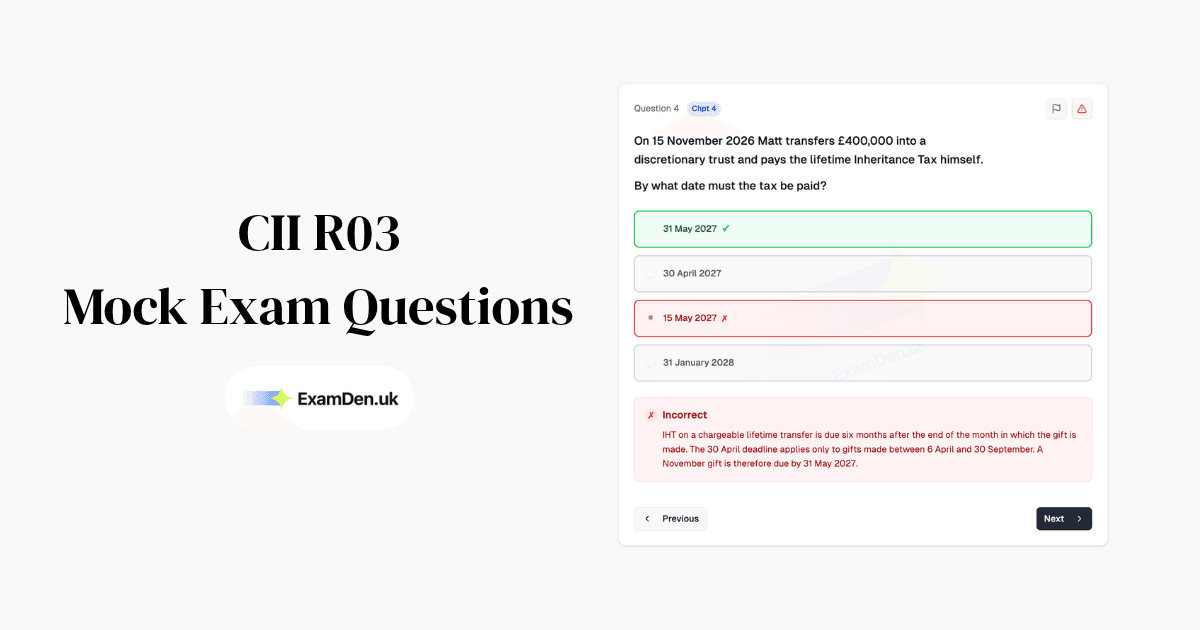
Looking for free CII R03 practice questions? Here are 5 exam-style questions covering a range of learning outcomes, with answers and detailed explanations.
The questions include both standard MCQs and a multiple-response question, just like the real R03 exam. Try each one, then click to reveal the answer and explanation.
📝 R03 Exam Quick Facts
- 50 questions in 1 hour: 39 standard MCQs + 11 multiple-response
- Pass mark: 65% (at least 33 out of 50)
- Multiple-response questions: LO2 (7) and LO3 (4) — marked all-or-nothing
- Syllabus: UK tax system, taxation of investments, tax planning, and applying tax knowledge to investment advice
---
Question 1: LO2 — Savings and Dividend Allowances
Callum earns a salary of £48,000 a year. He also receives interest from corporate bonds and dividends from UK listed shares.
Regarding his personal savings allowance and dividend allowance, Callum should know that
A. Any part of his dividend allowance he does not use can be set against gains he makes when selling his shares
B. Using either allowance does not increase the size of his basic-rate band
C. As long as his bond interest and dividends together stay below £3,000 a year, none of that income will be taxed
D. Both allowances are withdrawn in any year in which his combined interest and dividends exceed £5,000
Click to reveal answer
✓ Correct Answer: B
Using either allowance does not increase the size of his basic-rate band.
Income within either allowance is taxed at 0% but still counts towards the rate bands, so neither allowance extends the basic-rate band. The allowances cannot be used against capital gains and are not withdrawn because interest or dividends exceed a set amount (only an additional-rate taxpayer loses the personal savings allowance entirely). Combined they shelter at most £1,500 (£1,000 PSA + £500 dividend allowance) for a basic-rate taxpayer, so £3,000 of income can still be taxable.
This type of question tests whether you understand how the allowances interact with tax bands — a core R03 concept.
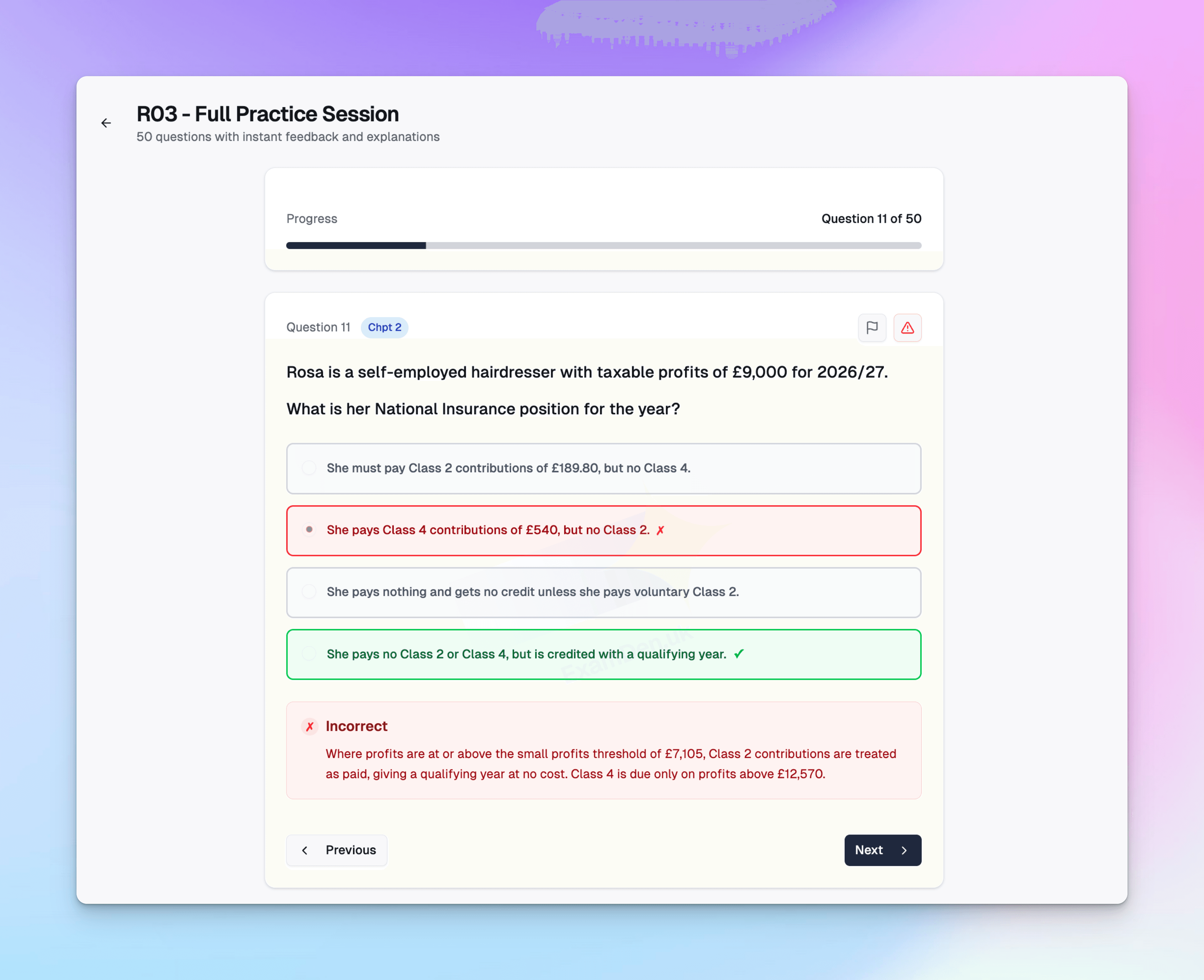
On ExamDen.uk, every question comes with a detailed explanation, like the sample question above
Question 2: LO1 — Personal Allowance Tapering (Calculation)
Ella earns a salary of £108,000 and has no other income. In 2026/27 she pays £4,800 net (£6,000 gross) into her personal pension.
What personal allowance is Ella entitled to for 2026/27?
A. £0
B. £8,570
C. £11,570
D. £12,570
Click to reveal answer
✓ Correct Answer: C
Ella's personal allowance is £11,570.
The personal allowance falls by £1 for every £2 of adjusted net income above £100,000. Adjusted net income is income less gross personal pension contributions.
Step 1: Adjusted net income = £108,000 − £6,000 = £102,000
Step 2: Reduction = (£102,000 − £100,000) ÷ 2 = £1,000
Step 3: Personal allowance = £12,570 − £1,000 = £11,570
This is a classic R03 calculation. Know the method: deduct gross pension from income to get adjusted net income, then reduce the personal allowance by £1 for every £2 above £100,000.
Question 3: LO1 — National Insurance Contributions
Vale Media Ltd makes several payments to its employee, Ruth, in 2026/27.
Which of them is subject to employee's Class 1 National Insurance?
A. A £3,000 performance bonus paid through the payroll
B. Employer contributions of £5,000 into her workplace pension
C. A statutory redundancy payment when her post is closed
D. Mileage allowance of 45p a mile for 2,000 business miles
Click to reveal answer
✓ Correct Answer: A
A £3,000 performance bonus paid through the payroll.
Bonuses are earnings for Class 1 NIC purposes and are subject to employee's National Insurance when paid through the payroll. Employer pension contributions, statutory redundancy pay and mileage payments within the approved rate are all exempt from employee's Class 1 NIC.
Knowing which payments attract NIC — and which are exempt — is a core LO1 topic.
On ExamDen.uk, practise one learning outcome at a time, then sit a full mock in the real question count and time limit
🎯 Practise Like the Real Exam
ExamDen.uk tracks your score by learning outcome so you see exactly where you're losing marks. No more guessing which topics to revise.
Start R03 Practice →Question 4: LO3 — Tax Avoidance and HMRC Powers (Multiple Response)
More than one option is correct. Select all that apply.
Kieran's adviser is explaining how HMRC challenges tax-planning schemes.
Which of the following statements are correct?
A. The GAAR applies only to Income Tax
B. Under the Ramsay principle, a preordained series of transactions can be taxed by reference to its end result
C. The general anti-abuse rule (GAAR) can counteract tax advantages from abusive arrangements
D. Tax avoidance is a criminal offence in the same way as tax evasion
E. A taxpayer using a scheme registered under DOTAS must show its reference number on their tax return
Click to reveal answer
✓ Correct Answers: B, C and E
The Ramsay principle, the GAAR and DOTAS reporting all apply.
The GAAR targets abusive arrangements across the main taxes, not just Income Tax — so A is wrong. Promoters must disclose schemes under DOTAS, and users must quote the scheme reference number on their tax return. The Ramsay principle lets the courts look through artificial steps to tax the end result.
Tax evasion is illegal; tax avoidance is not a criminal offence, though HMRC can challenge it — so D is wrong.
This is a multiple-response question — R03 has 11 of these. They're marked all-or-nothing: selecting B and C but missing E would score zero.
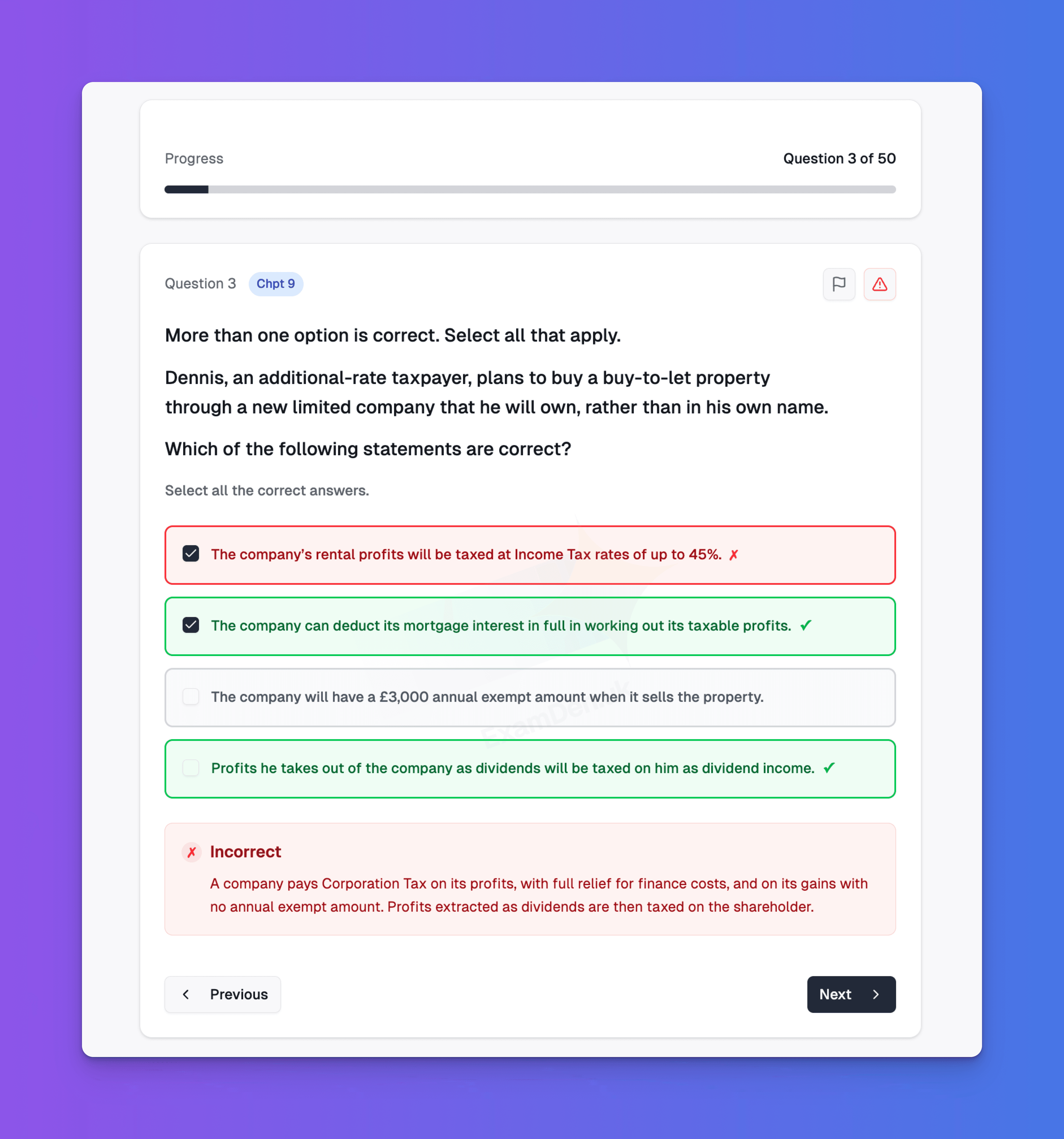
On ExamDen.uk, timed mocks use the same question count, time limit and pass mark as the real exam
Question 5: LO4 — SDLT Calculation
Rowena sells her home and buys a new main residence in England for £1,200,000. She owns no other property and is not a first-time buyer.
How much Stamp Duty Land Tax is payable?
A. £50,000
B. £63,750
C. £120,000
D. £123,750
Click to reveal answer
✓ Correct Answer: B
The total SDLT is £63,750.
Residential SDLT is charged on the slice of the price in each band:
Step 1: £125,001 to £250,000 at 2% = £2,500
Step 2: £250,001 to £925,000 at 5% = £33,750
Step 3: £925,001 to £1,200,000 at 10% = £27,500
Step 4: Total = £2,500 + £33,750 + £27,500 = £63,750
SDLT calculations are a staple of R03's LO4. Know the bands, remember that the first £125,000 is at 0% for non-first-time buyers, and practise until you can work through the steps quickly.
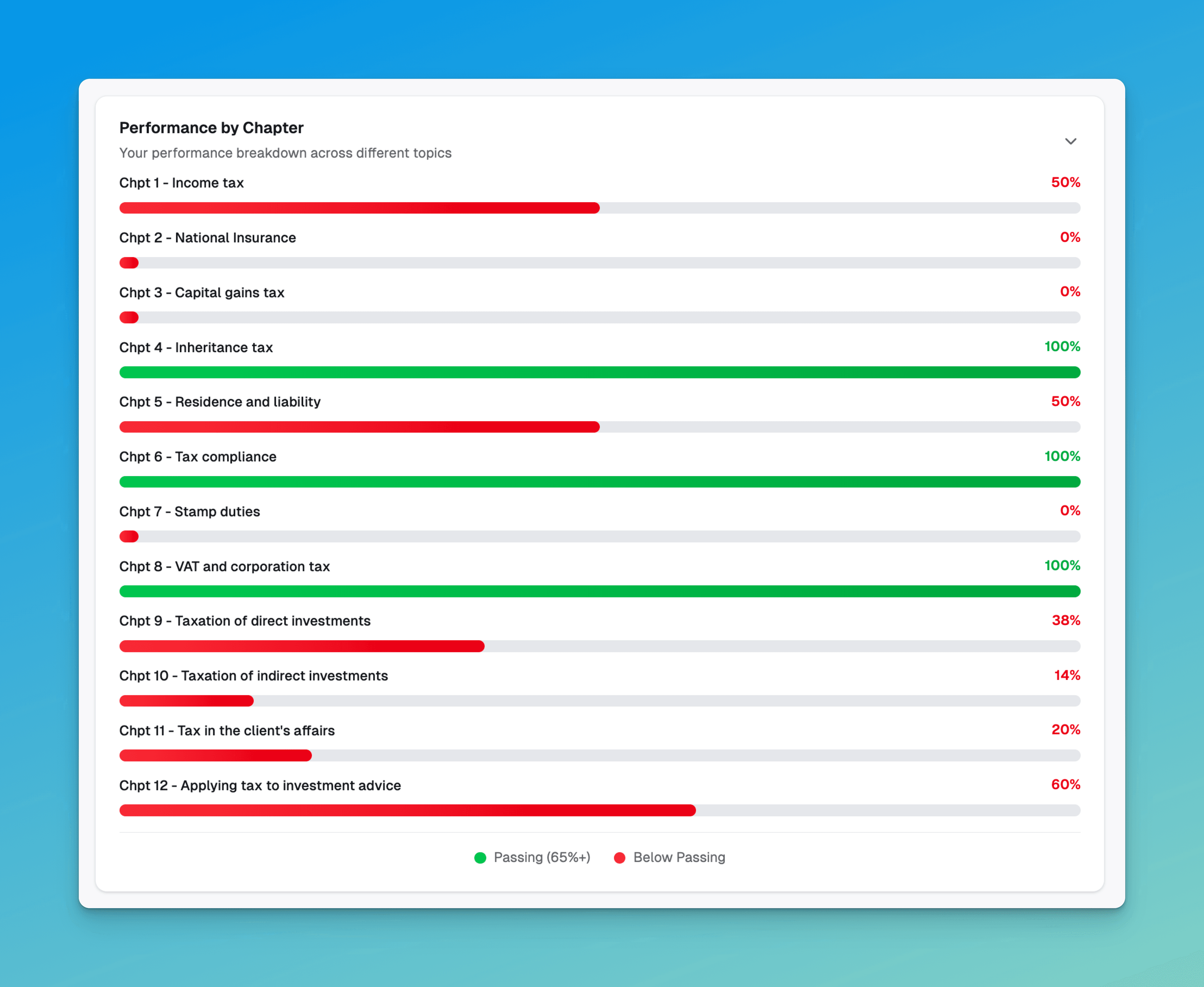
On ExamDen.uk, a timed mock shows your score against the 65% pass mark, and which learning outcomes are below it
How Did You Do?
| Score | What it means |
|---|---|
| 4–5 correct | Strong foundation — you're getting to grips with R03. Focus on timed practice with a larger question set. |
| 2–3 correct | Good start, but some areas need work. Check which learning outcomes you got wrong and revise those. |
| 0–1 correct | More study needed. Review the material before attempting mocks — see our R03 study guide. |
These 5 questions are a small sample. The real R03 exam has 50 questions across 4 learning outcomes, and the only way to know if you're ready is to take a full timed mock.
Want More Practice?
ExamDen's R03 question bank has hundreds of exam-style questions — standard MCQs and multiple-response questions marked all-or-nothing — timed mocks in the real CII format, and AI that pinpoints which learning outcomes to revise.
For a full study plan, see our complete R03 study guide. If you were searching for past papers, read why the CII doesn't release them, and what to use instead.
R03 Practice Questions FAQs
Ready to Put This Strategy Into Action? 💯
Liked these questions? Practise with hundreds more, including multiple-response questions marked all-or-nothing, with timed mocks and AI that tracks your weak areas.

The ExamDen.uk Team
ExamDen.uk builds exam-style question banks and timed mocks for CeMAP, Cert CII and CII R01–R05, helping UK professionals prepare for their financial services exams.