How to Pass CII IF1 (2026): Study Guide and Exam Tips
A practical guide to passing CII IF1 — covering the exam format, all 14 learning outcomes, the 70% pass mark, core insurance principles you need to know and common mistakes.
IF1 — Insurance, Legal and Regulatory — is the foundation unit of the Cert CII (Certificate in Insurance). It covers the basic principles of insurance, how the insurance market works, the core legal doctrines (insurable interest, good faith, indemnity, subrogation, proximate cause) and the regulatory framework that governs insurance business in the UK.
IF1 is a 100-question exam. Every question is a standard MCQ — pick one from four, one mark each. There are no multiple-response questions and no complex calculations. The pass mark is 70%, meaning you need at least 70 correct and can only get 30 wrong.
Most candidates sit IF1 first because it provides the legal and regulatory grounding that every other Cert CII unit builds on. If you're new to insurance, this is where you start.
📋 IF1 Quick Summary
- 100 standard MCQs in 2 hours: no multiple-response questions
- Pass mark: 70% (at least 70 out of 100)
- Heaviest learning outcomes: LO11 (15 questions) — regulation, LO4 (14) — the insurance market
- On-demand exam: book almost any day, sit at a test centre or online with a remote invigilator
- Covers: risk, insurance principles, contract and agency, insurable interest, good faith, proximate cause, indemnity, subrogation, regulation, consumer protection and CII Code of Ethics
IF1 Exam Format
IF1 has 100 questions in 2 hours — 72 seconds per question on average. That's the same rate per question as CII Diploma exams like R01.
All 100 questions are standard multiple-choice (pick one from four). There are no multiple-response questions — every question is worth one mark, and there's no all-or-nothing marking.
The pass mark is 70%. With 100 questions you need at least 70 correct, meaning you can get 30 wrong. No marks are deducted for incorrect answers, so always attempt every question.
While no questions require complex calculations, you're allowed to bring a silent, non-programmable calculator. Pay close attention to words in bold (maximum, minimum, main, normally) and capitalised negatives (NOT, CANNOT).
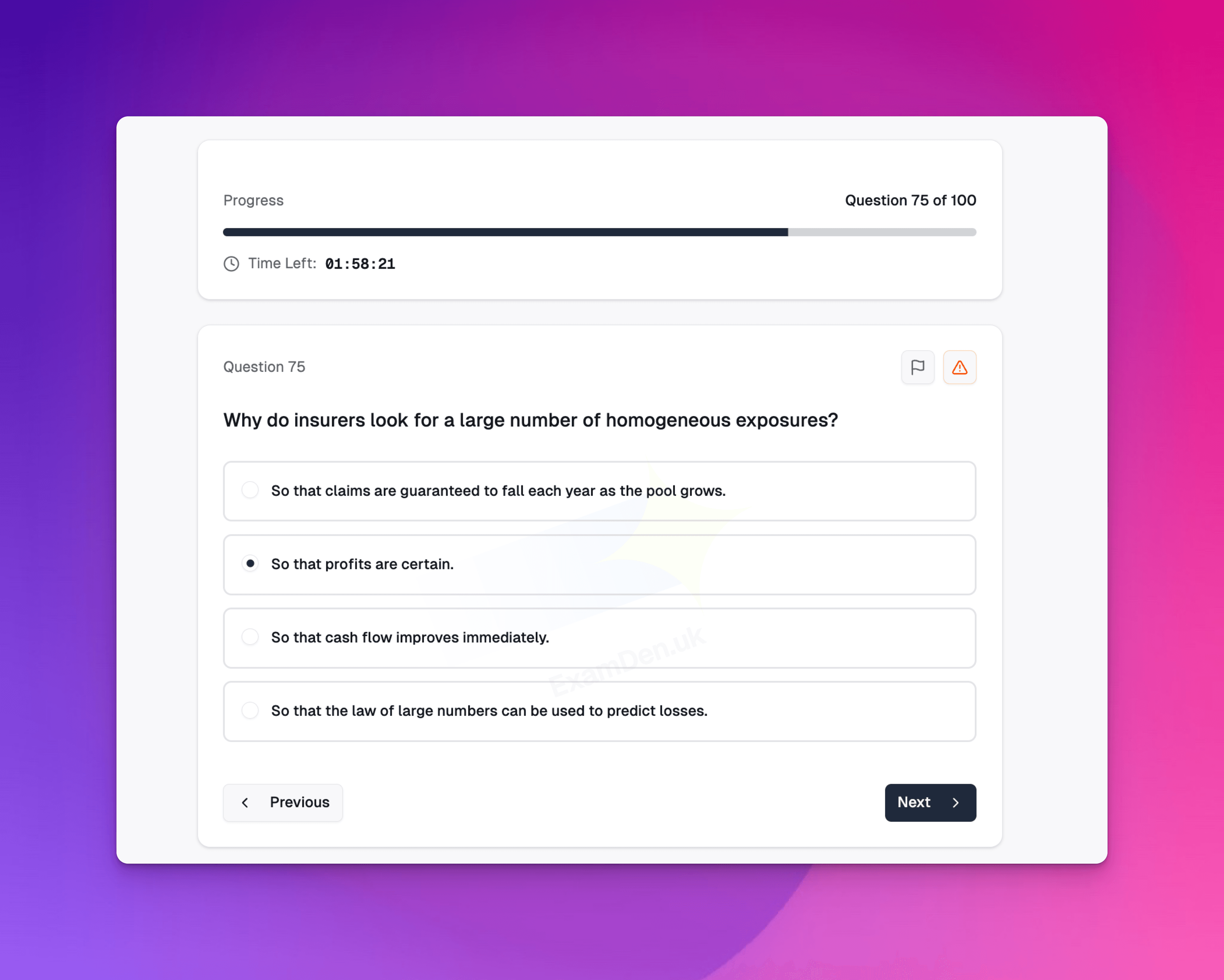
On ExamDen.uk, timed mocks use the same question count, time limit and pass mark as the real IF1 exam
Question Distribution by Learning Outcome
| LO | Topic | Questions | % of exam |
|---|---|---|---|
| 11 | Regulatory and legal requirements | 15 | 15% |
| 4 | Insurance market structure | 14 | 14% |
| 7 | Good faith | 11 | 11% |
| 1 | Nature and features of risk | 9 | 9% |
| 5 | Contract and agency | 9 | 9% |
| 3 | Main features of insurance | 8 | 8% |
| 9 | Indemnity | 7 | 7% |
| 12 | Consumer protection and dispute resolution | 6 | 6% |
| 6 | Insurable interest | 5 | 5% |
| 10 | Contribution and subrogation | 4 | 4% |
| 13 | Consumer complaints | 4 | 4% |
| 14 | CII Code of Ethics | 4 | 4% |
| 2 | Risk management application | 2 | 2% |
| 8 | Proximate cause | 2 | 2% |
IF1 has 14 learning outcomes — the most of any Cert CII exam. Three LOs dominate: LO11 (regulation, 15 questions), LO4 (insurance market, 14 questions) and LO7 (good faith, 11 questions). Together they make up 40% of the exam.
---
LO11: Regulatory and Legal Requirements — 15 Questions
LO11 is the biggest learning outcome and covers the regulatory framework for insurance business.
What it tests:
- FCA regulation. The FCA's role, objectives, principles for businesses, conduct of business rules. The difference between authorised firms and appointed representatives.
- Senior Managers and Certification Regime (SM&CR). Senior management functions, certification functions, conduct rules. How SM&CR applies to insurance firms.
- Individual conduct rules. The rules that apply to all certified employees — acting with integrity, being open with regulators, paying due regard to customers' interests.
- Insurance Distribution Directive (IDD). Product governance, demands and needs, suitability requirements, conflicts of interest, remuneration disclosure.
- Anti-money laundering. AML obligations for insurance firms, customer due diligence, suspicious activity reports, the role of the MLRO.
- Data protection. GDPR principles, lawful bases for processing, data subject rights, the role of the DPO.
Study approach: LO11 is regulation-heavy. Focus on the FCA's principles, the SM&CR conduct rules, and AML requirements — these come up repeatedly. Understand the difference between rules (mandatory) and guidance (expected but not legally binding).
LO4: Insurance Market Structure — 14 Questions
What it tests:
- Market participants. Insurers, reinsurers, Lloyd's of London, brokers, managing general agents (MGAs), loss adjusters, actuaries. Know each role.
- Lloyd's market. The structure of Lloyd's — syndicates, managing agents, members' agents, the Corporation of Lloyd's. How Lloyd's differs from company market insurers.
- Distribution channels. Direct sales, brokers, comparison websites, bancassurance, affinity schemes. How insurance reaches the consumer.
- Reinsurance. Why insurers reinsure, types of reinsurance (facultative, treaty, proportional, non-proportional), retrocession.
- Market trends. Consolidation, InsurTech, the shift to digital distribution, the impact of regulation on market structure.
Study approach: LO4 is the most factual learning outcome. Make a list of every market participant and their role. Lloyd's is a perennial exam topic — know the structure, how policies are written, and how Lloyd's differs from the company market.
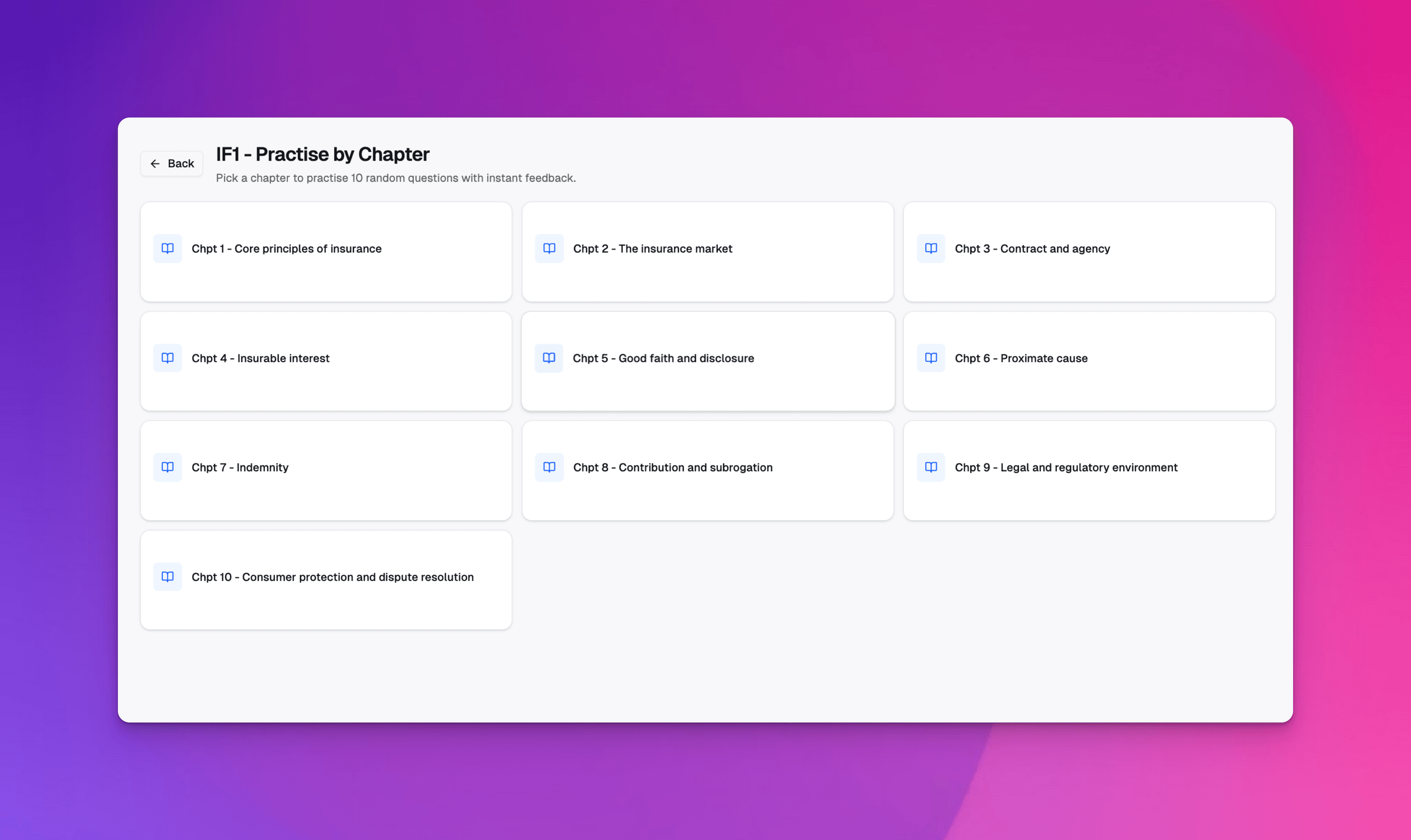
On ExamDen.uk, practise one learning outcome at a time, then sit a full mock in the real question count and time limit
LO7: Good Faith — 11 Questions
What it tests:
- The duty of fair presentation. Under the Insurance Act 2015, the insured must make a fair presentation of the risk — disclosing every material circumstance they know or ought to know.
- Material facts. What counts as material: anything that would influence a prudent insurer's decision to accept the risk or set the terms.
- Remedies for non-disclosure. The insurer's remedies depend on whether the non-disclosure was deliberate/reckless or innocent. The Insurance Act 2015 introduced proportionate remedies.
- Warranties and conditions. The difference between warranties and conditions. The Insurance Act 2015 changed the effect of breach of warranty — it now suspends cover rather than discharging the insurer.
- Basis of the contract clauses. These are now prohibited under the Insurance Act 2015.
Study approach: The Insurance Act 2015 is central to LO7. Know the before-and-after: what the law was under the Marine Insurance Act 1906 versus what it is now under the 2015 Act. The proportionate remedies for non-disclosure are a common exam question.
LO1: Nature and Features of Risk — 9 Questions
What it tests:
- Risk classification. Pure risk vs speculative risk. Fundamental risk vs particular risk. Insurable vs non-insurable risks.
- Features of insurable risk. What makes a risk insurable: large number of similar exposures, fortuitous loss, definite and measurable, not catastrophic, calculable probability, economically feasible premium.
- Risk identification. Methods of identifying risk: physical inspection, checklists, flow charts, financial analysis.
- Hazard. Moral hazard vs physical hazard vs morale hazard. How each affects the risk.
Study approach: LO1 sets the foundations. The risk classification questions are straightforward but you need the definitions memorised. Know the difference between moral hazard (dishonesty) and morale hazard (carelessness).
LO5: Contract and Agency — 9 Questions
What it tests:
- Essential elements of a contract. Offer, acceptance, consideration, capacity, legality, intention to create legal relations.
- Insurance contract formation. Proposal, quotation, cover note, policy. When the contract is formed. Conditions precedent.
- Agency. The agent's authority (actual, apparent, implied, ratified). The duties of an agent to the principal. The concept of binding authority.
- Utmost good faith in contract formation. The pre-contractual duty and how it interacts with the contract.
Study approach: Agency law is tested heavily in IF1. Know the different types of authority and give yourself examples: a broker's apparent authority to bind cover, an underwriter's actual authority within their binding limit.
LO3: Main Features of Insurance — 8 Questions
What it tests:
- Function of insurance. Risk transfer, risk pooling, the law of large numbers, how premiums relate to expected losses.
- Types of insurance. Life vs general, long-term vs short-term, personal vs commercial. First-party vs third-party cover.
- Insurance products. A broad overview: motor, property, liability, marine, aviation, cyber, life, health. Know the purpose of each class.
- Policy structure. The proposal form, policy schedule, insuring clause, conditions, exclusions, endorsements.
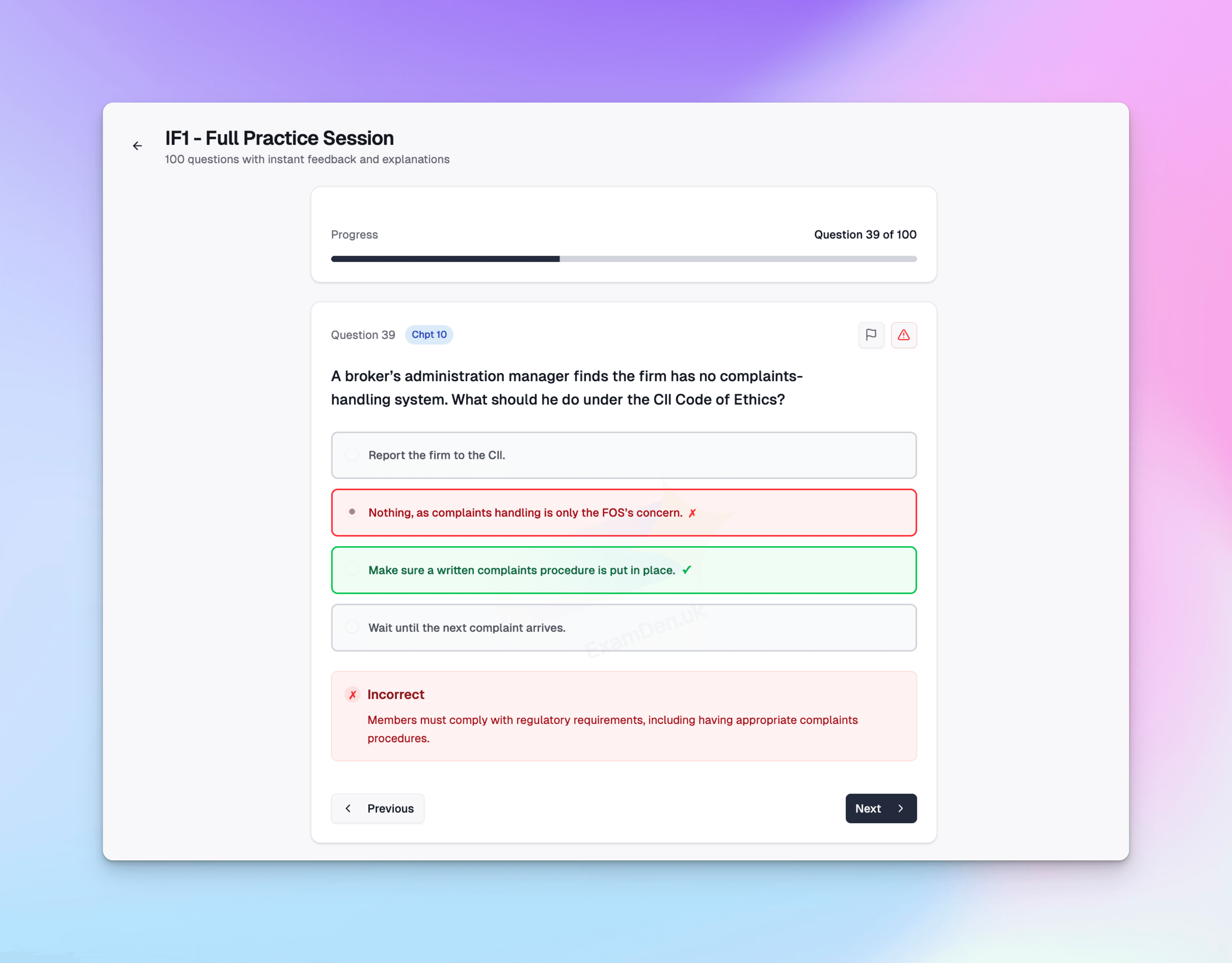
On ExamDen.uk, every question comes with a detailed explanation linked to the relevant learning outcome
🎯 Practise Like the Real Exam
ExamDen.uk tracks your score by learning outcome so you see exactly where you're losing marks. No more guessing which topics to revise.
Start IF1 Practice →Common Mistakes That Cost Marks
1. Treating IF1 as "easy" because it's the first unit.
IF1 is foundational, but 14 learning outcomes across 100 questions is a lot of ground. Candidates who skim the syllabus and rely on work experience often get caught by the legal doctrines (LO6–LO10) or the regulatory detail (LO11).
2. Confusing the six insurance principles.
Insurable interest, good faith, proximate cause, indemnity, contribution and subrogation — each is a distinct legal doctrine with specific rules. The exam tests the differences, not just the definitions. Make sure you can explain when each principle applies and what happens when it's breached.
3. Ignoring the Insurance Act 2015 changes.
The 2015 Act changed the duty of disclosure, the effect of breach of warranty and the remedies for non-disclosure. Many study texts still reference the old Marine Insurance Act 1906 rules. Know what changed and why.
4. Rushing through 100 questions.
Two hours feels generous, but 100 questions is a lot. Candidates who rush often misread the bold or capitalised words (NOT, CANNOT, most, minimum). Read every question carefully — the question is testing whether you noticed the qualifier.
5. Skipping the small LOs.
LO2 (risk management, 2 questions), LO8 (proximate cause, 2 questions), LO10 (contribution and subrogation, 4 questions), LO13 (complaints, 4 questions) and LO14 (CII Code of Ethics, 4 questions) carry 16 questions between them. At a 70% pass mark, those 16 marks could decide whether you pass or fail.
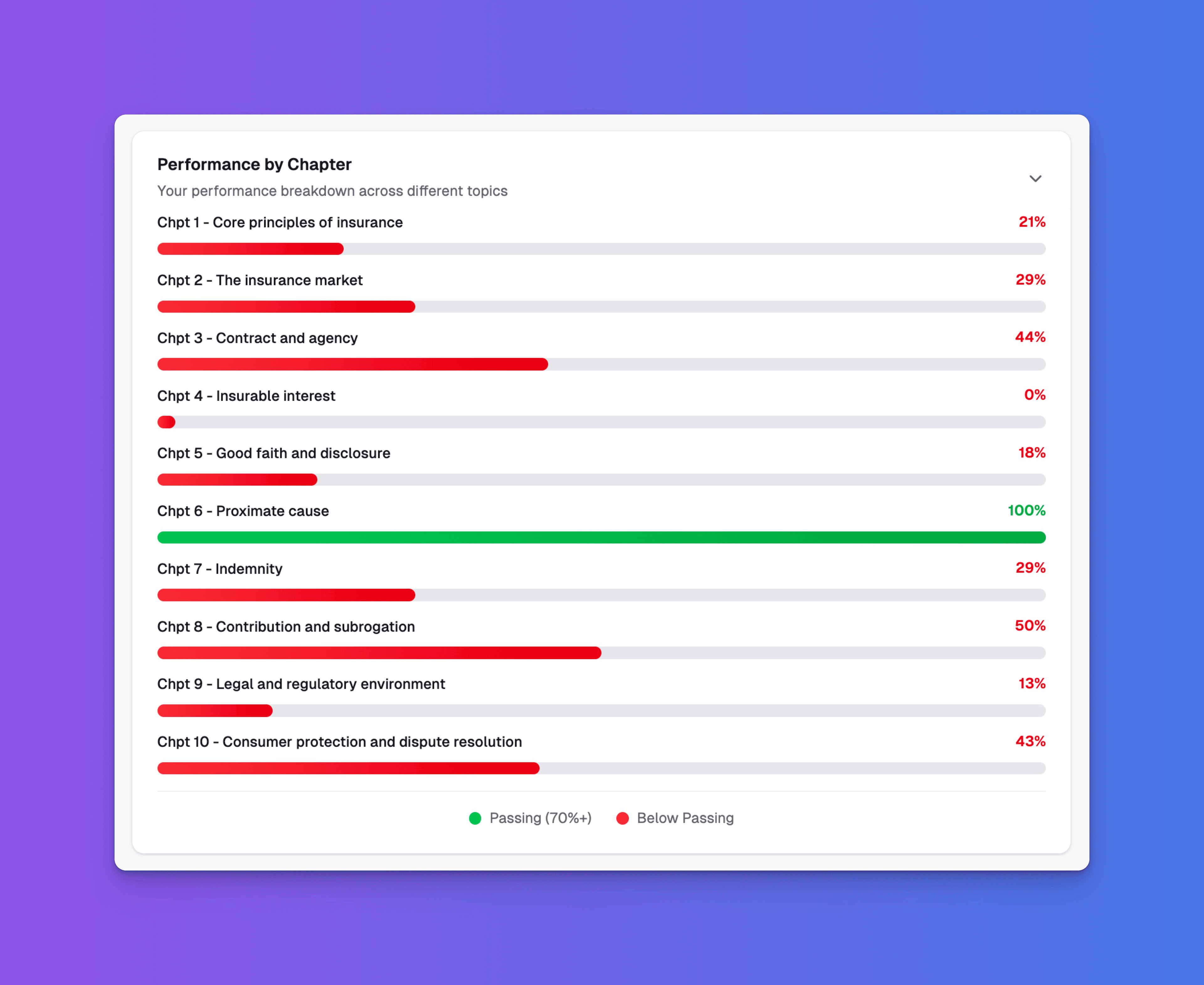
On ExamDen.uk, a timed mock shows your score against the 70% pass mark, and which learning outcomes are below it
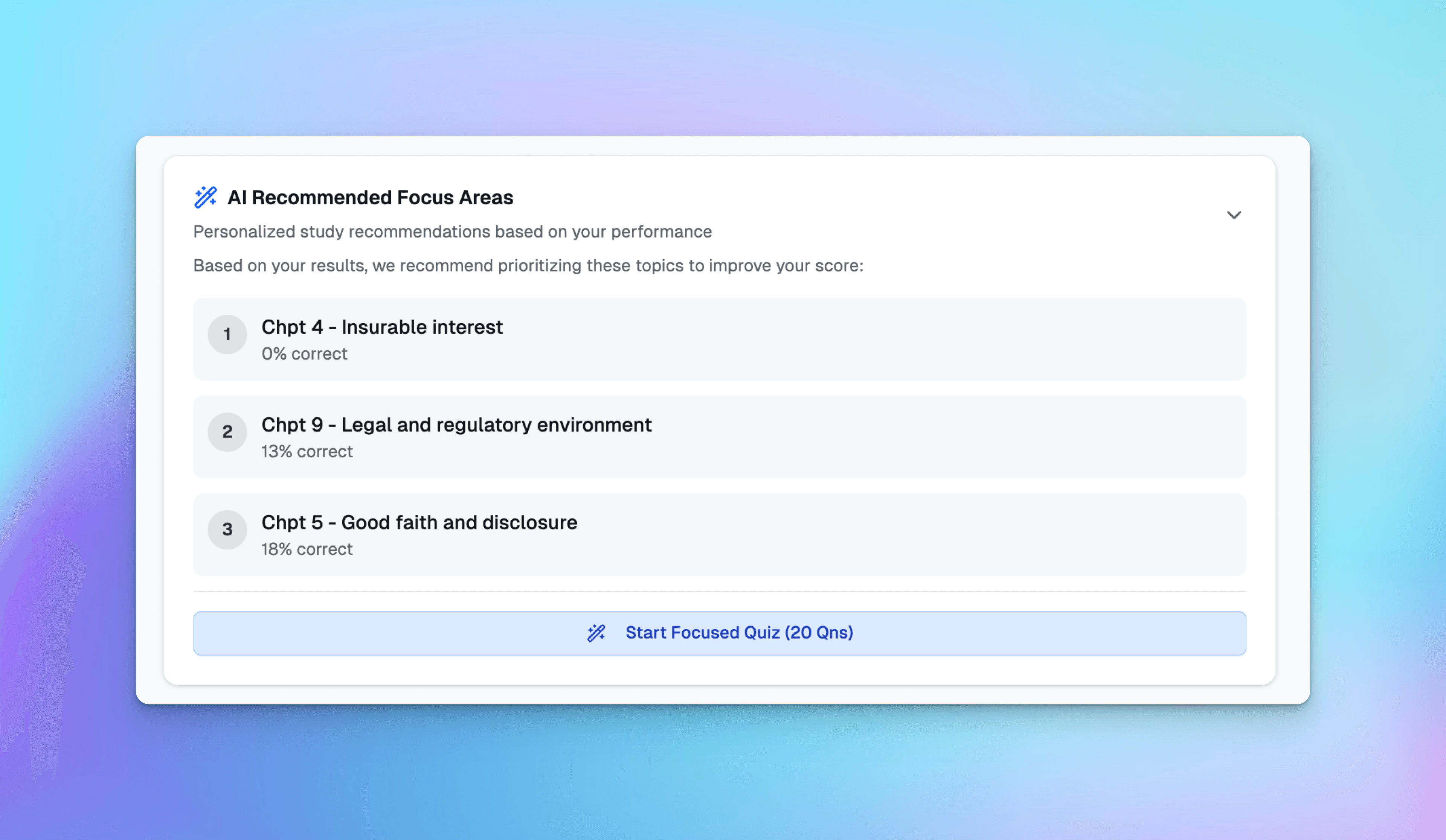
On ExamDen.uk, those weak learning outcomes become a short focus list for your next revision session
How IF1 Fits Into the Cert CII
IF1 is one of the core units of the CII Certificate in Insurance (Cert CII). The Cert CII requires candidates to pass a combination of units from the IF and I series:
- IF1 — Insurance, Legal and Regulatory (this unit)
- IF2 — General Insurance Business
- IF3 — Insurance Underwriting Process
- IF4 — Insurance Claims Handling Process
- IF5 — Motor Insurance Products
- IF6 — Household Insurance Products
- I10 — Insurance Broking Fundamentals
- I11 — Introduction to Risk Management
IF1 is the natural starting point. The legal principles (insurable interest, good faith, indemnity, subrogation) and the regulatory framework (FCA, SM&CR, IDD) appear across every other Cert CII unit. Studying IF1 first gives you the vocabulary and framework for the rest. Most candidates move on to IF2 (General Insurance Business) next, which applies these principles to real insurance products and claims.
Start Practising
The fastest way to know whether you're ready for IF1 is to take a timed mock. ExamDen's IF1 question bank has hundreds of exam-style questions — timed mocks in the real CII format, and AI that pinpoints which learning outcomes you need to work on.
Want to try a few questions first? Here are 5 free IF1 mock questions with answers. If you're looking for past papers, read why the CII doesn't release them, and what to use instead.
For registration, fees and booking, see our guide to registering for CII exams.
CII IF1 FAQs
Ready to Put This Strategy Into Action? 💯
Practise with exam-style IF1 questions, timed mocks and AI that shows you which learning outcomes to revise.

The ExamDen.uk Team
ExamDen.uk builds exam-style question banks and timed mocks for CeMAP, Cert CII and CII R01–R05, helping UK professionals prepare for their financial services exams.