How to Pass CII R05 (2026): Study Guide and Exam Tips
A practical guide to passing CII R05 — covering the exam format, all 10 learning outcomes, the 70% pass mark, protection products you need to know and common mistakes.
R05 — Financial Protection — is the final unit of the CII Diploma in Regulated Financial Planning. It covers life assurance, income protection, critical illness, long-term care, business protection and the tax treatment of protection products.
R05 is different from R01–R04 in two important ways. First, it has no multiple-response questions — all 50 questions are standard MCQs. Second, the pass mark is 70%, five percentage points higher than the other diploma units. The simpler question format is offset by a tighter margin for error.
If you've passed R03 and R04, some of the tax and pension-based content will be familiar. R05 adds the protection layer: which products exist, how they work, how they're taxed, and how to match them to a client's needs.
📋 R05 Quick Summary
- 50 standard MCQs in 1 hour: no multiple-response questions
- Pass mark: 70% (at least 35 out of 50)
- Heaviest learning outcome: LO4 (8 questions) — life assurance and pension-based policies
- On-demand exam: book almost any day, sit at a test centre or online with a remote invigilator
- Covers: life assurance, income protection, critical illness, long-term care, business protection, state benefits and tax
R05 Exam Format
R05 has 50 questions in 1 hour — 72 seconds per question on average. That's the same rate as every other R0 unit.
All 50 questions are standard multiple-choice (pick one from four). There are no multiple-response questions. This is unique among the diploma units — R01–R04 all have MR questions marked all-or-nothing.
The pass mark is 70%. With 50 questions, you need at least 35 correct — you can only get 15 wrong. That's a tighter margin than R03 or R04 (which allow 17 wrong at 65%). Each wrong answer costs 2% of your total.

On ExamDen.uk, timed mocks use the same question count, time limit and pass mark as the real R05 exam
Question Distribution by Learning Outcome
| LO | Topic | Questions | % of exam |
|---|---|---|---|
| 4 | Life assurance and pension-based policies | 8 | 16% |
| 5 | Taxation of protection policies | 6 | 12% |
| 6 | Income protection insurance | 6 | 12% |
| 7 | Critical illness insurance | 6 | 12% |
| 9 | Other insurance-based protection | 6 | 12% |
| 10 | Evaluate needs and select solutions | 6 | 12% |
| 1 | Consumer and retail market factors | 3 | 6% |
| 2 | Protection planning needs and sources | 3 | 6% |
| 3 | State benefits for financial protection | 3 | 6% |
| 8 | Long-term care insurance | 3 | 6% |
R05 has the most learning outcomes of any diploma unit (10). LO4 is the biggest with 8 questions. Five LOs (LO5, LO6, LO7, LO9, LO10) carry 6 questions each — together they make up 60% of the exam.
---
LO4: Life Assurance and Pension-Based Policies — 8 Questions
LO4 is the biggest learning outcome and covers the core protection products.
What it tests:
- Term assurance. Level term, decreasing term, increasing term, renewable term, convertible term. Know the key features and when each is suitable.
- Whole of life assurance. Standard whole of life, universal whole of life, unit-linked and with-profits variants. Reviewable vs guaranteed premiums.
- Endowment policies. Unit-linked and with-profits endowments. Their declining role in the market.
- Pension-based death benefits. Lump sum death benefits and dependants' pensions from DB and DC schemes. How pension death benefits interact with standalone life assurance.
- Underwriting. The underwriting process, medical and non-medical limits, pre-existing conditions, exclusions. How underwriting affects premiums and terms.
- Claims. The claims process, proof of death, contestability periods, fraud.
Study approach: LO4 is product-heavy. Make a comparison table of each product type: term, whole of life, endowment. For each, note the key features, who it's suitable for, and the tax treatment. The underwriting and claims content often catches candidates who focus only on product features.
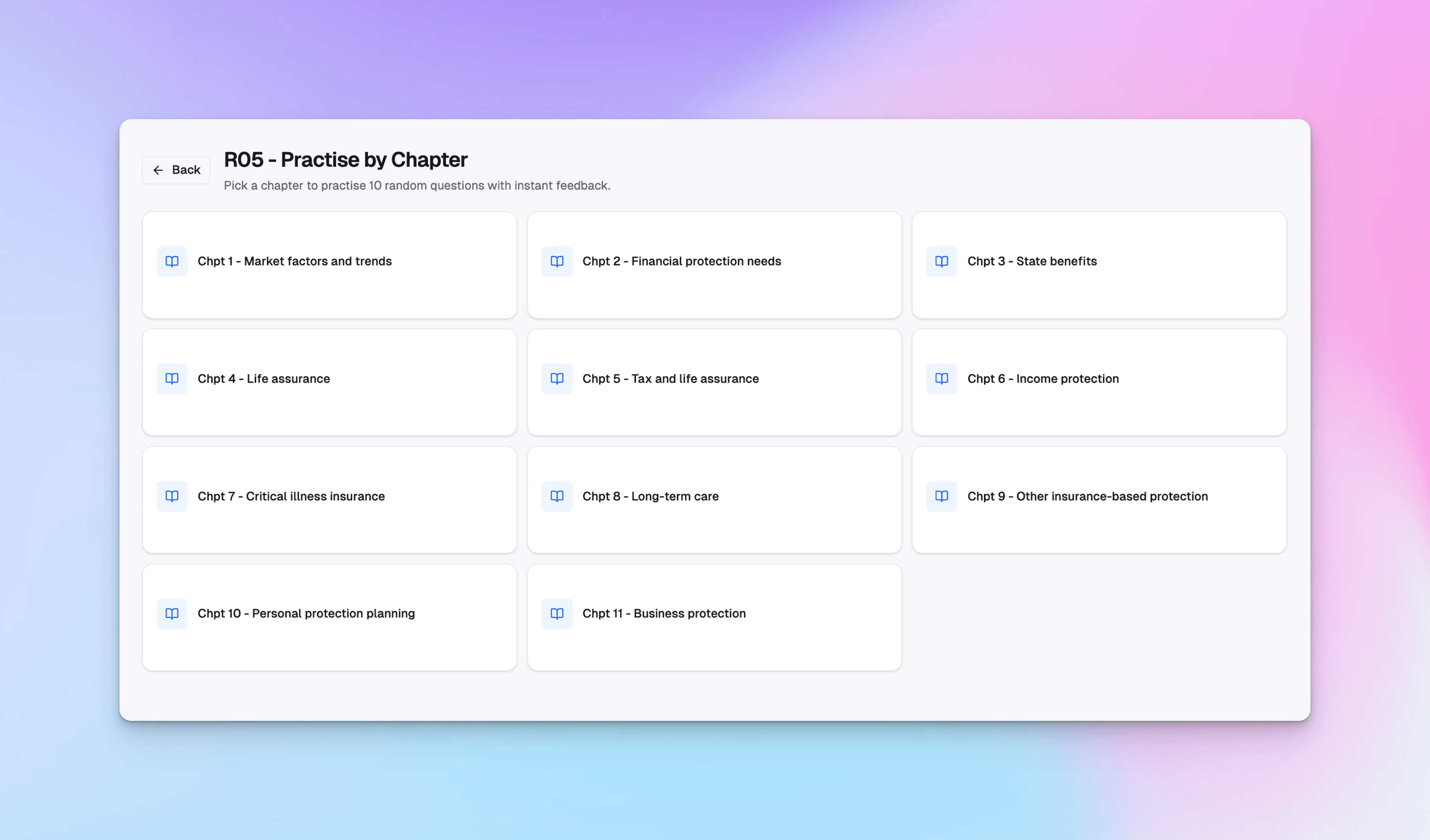
On ExamDen.uk, practise one learning outcome at a time, then sit a full mock in the real question count and time limit
LO5: Taxation of Protection Policies — 6 Questions
What it tests:
- Qualifying vs non-qualifying policies. The conditions a policy must meet to be a qualifying policy (minimum term, regular premiums, sum assured rules). Why it matters for tax.
- Onshore bond taxation. Chargeable events (surrender, maturity, death, excess withdrawal, assignment for money). The 5% cumulative withdrawal allowance. Top-slicing relief. The 20% basic-rate credit — a higher-rate taxpayer pays only the excess.
- Offshore bond taxation. No basic-rate credit (no UK tax paid within the fund). The full gain is taxed at the policyholder's marginal rate. Top-slicing relief still applies.
- Tax on protection payouts. Life assurance payouts are generally tax-free if paid under a qualifying policy or in trust. Income protection benefits are taxed as income if the employer pays the premium.
- Trust taxation. How placing a policy in trust affects the tax treatment for IHT planning.
Study approach: The onshore bond gain calculation is a common exam question. Know the 20% credit: a higher-rate taxpayer pays 40% − 20% = 20% on the gain. Practise until automatic.
LO6: Income Protection Insurance — 6 Questions
What it tests:
- Types of income protection. Long-term income protection (pays until retirement, return to work or death), short-term income protection, accident sickness and unemployment (ASU).
- Key features. Deferred periods, benefit limits (typically 50–65% of pre-incapacity earnings), own occupation vs any occupation vs suited occupation definitions. Indexation of benefits.
- Tax treatment. Individual policies: premiums not tax-deductible, benefits tax-free. Employer-paid: premiums a business expense, benefits taxable as income through PAYE.
- Underwriting. Occupation classes, medical history, hazardous activities. How occupation affects premiums.
- Claims. The definition of incapacity, the deferred period, proportionate benefit, rehabilitation support.
LO7: Critical Illness Insurance — 6 Questions
What it tests:
- How CI differs from income protection. CI pays a tax-free lump sum on diagnosis of a specified condition. Income protection pays regular income during incapacity. The two serve different needs.
- Covered conditions. The ABI model definitions, the core conditions (cancer, heart attack, stroke), additional conditions, severity thresholds. Children's CI cover.
- Standalone vs accelerated. Standalone CI pays separately from any life cover. Accelerated CI shares the sum assured with the life cover — if CI is claimed, the life cover reduces or ends.
- Underwriting and exclusions. Pre-existing conditions, family medical history, moratorium vs full medical underwriting.
LO10: Evaluate Needs and Select Solutions — 6 Questions
What it tests:
- Needs analysis. Identifying a client's protection priorities: income replacement, mortgage repayment, family provision, business continuity.
- Quantifying need. Calculating the sum assured or income required — taking into account existing provision (state benefits, employer benefits, savings).
- Business protection. Keyperson insurance, share protection (cross-option agreements), partnership protection. How each is arranged and the suitability for different business structures.
- Suitability. Matching products to needs. Why term assurance suits a mortgage but whole of life suits an IHT liability. Why income protection is more important than CI for an employed person with dependants.
- Reviews. When and why protection plans should be reviewed — life events, changes in income, business changes.
Study approach: LO10 is evaluative. The questions present a client or business scenario and ask which product or arrangement is most suitable. You need to know all the product types from LO4–LO9 and be able to apply them.
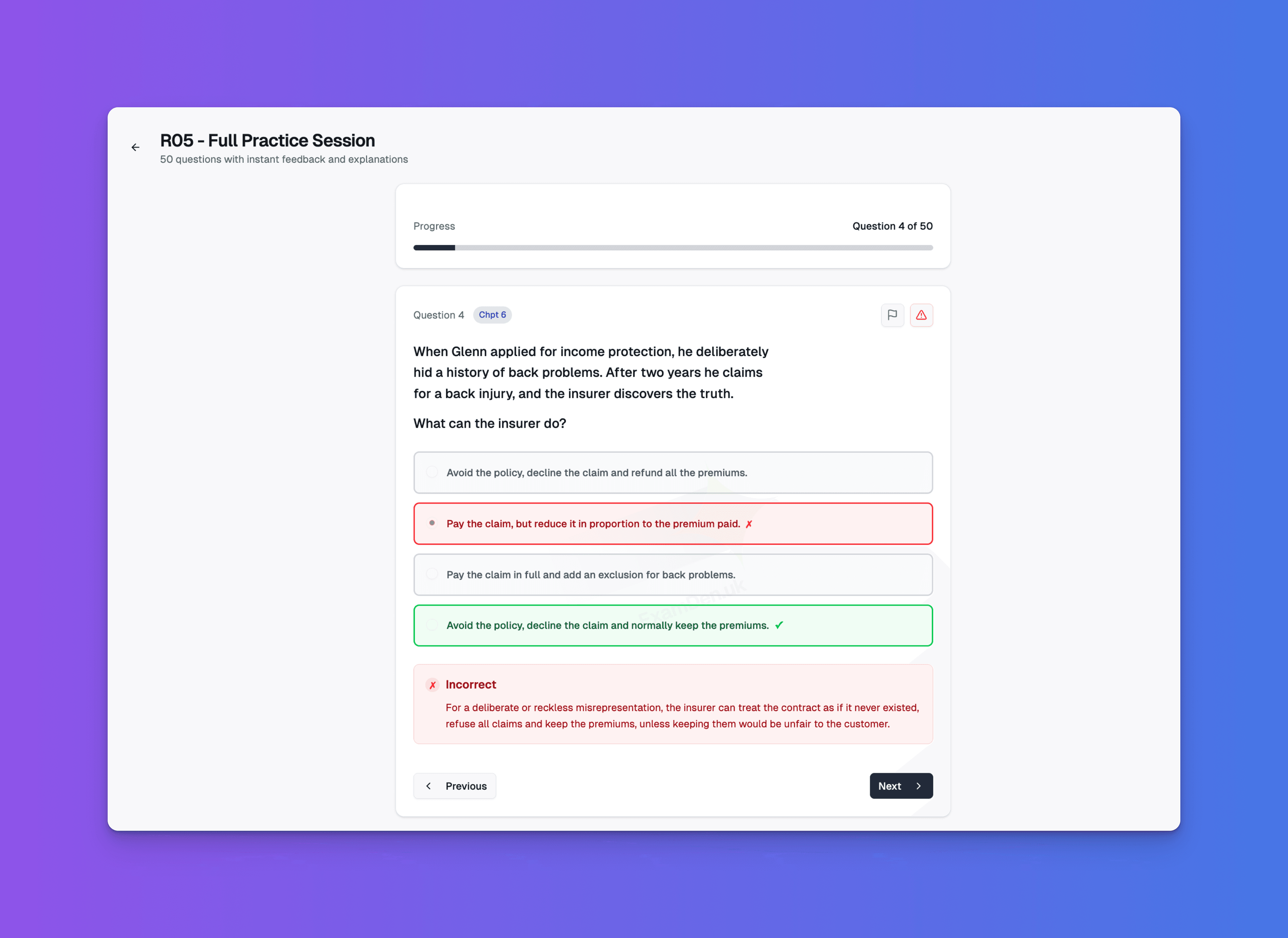
On ExamDen.uk, every question comes with a detailed explanation linked to the relevant learning outcome
🎯 Practise Like the Real Exam
ExamDen.uk tracks your score by learning outcome so you see exactly where you're losing marks. No more guessing which topics to revise.
Start R05 Practice →Common Mistakes That Cost Marks
1. Underestimating the 70% pass mark.
R05's higher pass mark means you can only get 15 questions wrong (vs 17 for R03/R04). Candidates who studied to the same level as R03 or R04 sometimes fail R05 because they didn't account for the tighter margin.
2. Confusing similar products.
Income protection, critical illness, accident sickness and unemployment — these are different products with different triggers, benefits and tax treatments. Candidates who blur the distinctions lose marks on comparison questions.
3. Getting the bond tax calculation wrong.
The onshore bond gain with the 20% credit is one of the most common exam questions. Higher-rate taxpayer pays 40% − 20% = 20% on the gain. Offshore bonds have no credit, so the full gain is taxed at the marginal rate. Practise both.
4. Ignoring business protection.
LO9 and LO10 test business protection: keyperson insurance, share protection, partnership protection. These are practical topics that some candidates skip because they focus on personal protection. Together they carry up to 12 questions.
5. Skipping the small LOs.
LO1, LO2, LO3 and LO8 have 3 questions each — 12 questions total (24% of the exam). They're straightforward factual topics. Candidates who skip them throw away easy marks that could make the difference at a 70% pass mark.
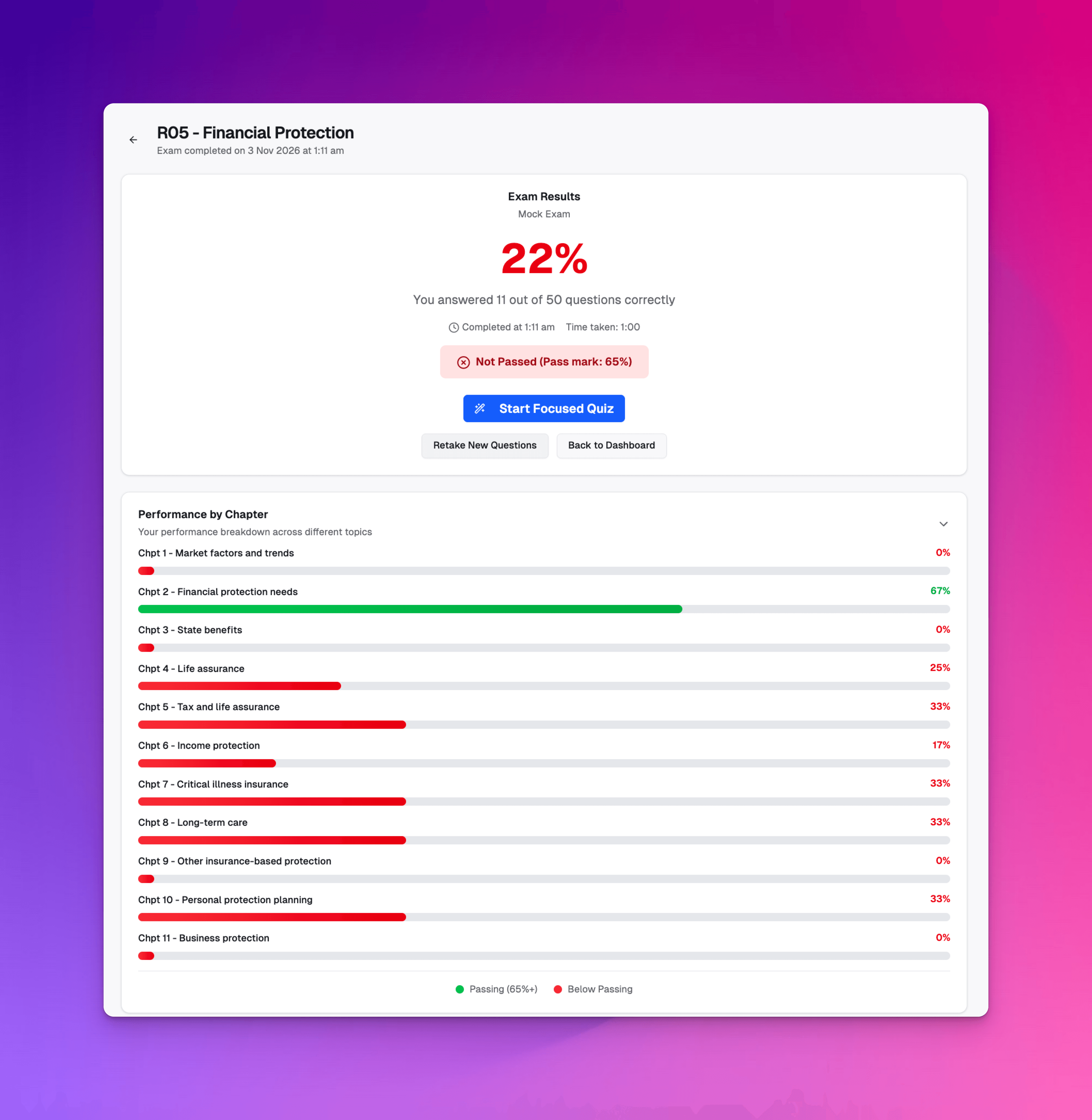
On ExamDen.uk, a timed mock shows your score against the 70% pass mark, and which learning outcomes are below it
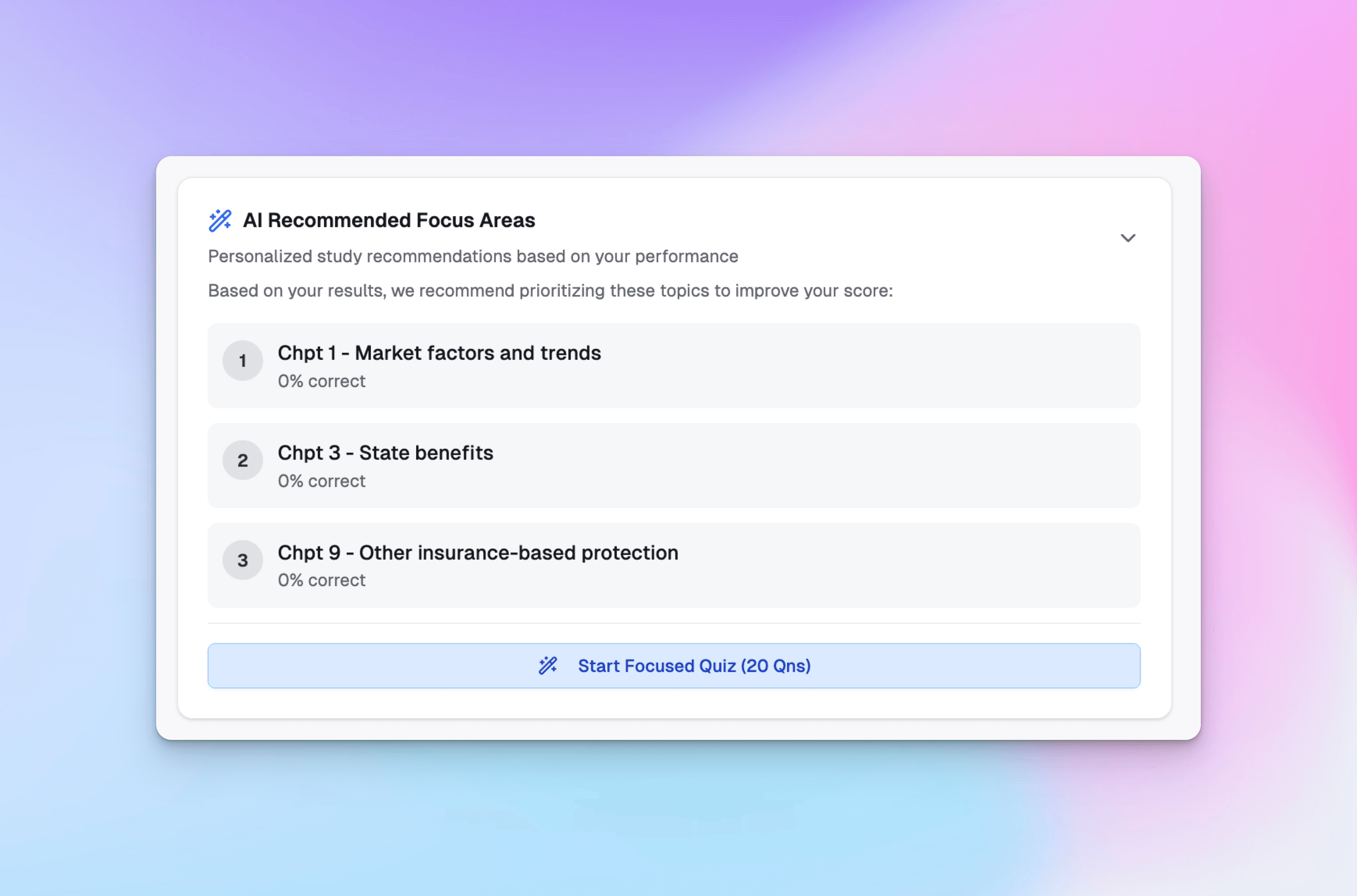
On ExamDen.uk, those weak learning outcomes become a short focus list for your next revision session
How R05 Fits Into the Diploma
R05 is one of five units in the CII Diploma in Regulated Financial Planning:
- R01 — Financial Services, Regulation and Ethics
- R02 — Investment Principles and Risk
- R03 — Personal Taxation
- R04 — Pensions and Retirement Planning
- R05 — Financial Protection (this unit)
Most candidates sit R05 last. The regulatory knowledge from R01, the investment principles from R02, the tax framework from R03 and the pension knowledge from R04 all feed into R05's coverage of protection products, their tax treatment and how they fit into a client's financial plan.
For registration, fees and booking, see our guide to registering for CII exams.
Start Practising
The fastest way to know whether you're ready for R05 is to take a timed mock. ExamDen's R05 question bank has hundreds of exam-style questions — timed mocks in the real CII format, and AI that pinpoints which learning outcomes you need to work on.
Want to try a few questions first? Here are 5 free R05 mock questions with answers. If you're looking for past papers, read why the CII doesn't release them, and what to use instead.
CII R05 FAQs
Ready to Put This Strategy Into Action? 💯
Practise with exam-style R05 questions, timed mocks and AI that shows you which learning outcomes to revise.

The ExamDen.uk Team
ExamDen.uk builds exam-style question banks and timed mocks for CeMAP, Cert CII and CII R01–R05, helping UK professionals prepare for their financial services exams.