CII R02 Revision Guide (2026): Learning Outcomes and Exam Tips
A learning-outcome-by-learning-outcome revision guide for CII R02. Covers what each LO tests, the question weighting, where the 28 multiple-response questions sit and the key calculations.
This guide walks through each of R02's 9 learning outcomes — what they test, how many questions they carry, and what to focus your revision on. Use it alongside the CII study text to target the areas that will have the biggest impact on your score.
If you haven't read the overall study strategy yet, start with our R02 study guide. If you're wondering how hard the exam actually is, see Is R02 Hard?. This revision guide assumes you've already covered the material and are now preparing for the exam.
📋 R02 at a Glance
- 100 questions: 72 standard + 28 multiple-response
- 2 hours — 72 seconds per question on average
- Pass mark: 65%
- Multiple-response questions: LO1 (11), LO6 (7) and LO9 (10)
Question Distribution by Learning Outcome
| LO | Topic | Standard MCQ | Multiple Response | Total | % of exam |
|---|---|---|---|---|---|
| 1 | Asset classes | 17 | 11 | 28 | 28% |
| 6 | Investment products | 15 | 7 | 22 | 22% |
| 7 | Investment advice process | 11 | 0 | 11 | 11% |
| 9 | Performance of investments | 0 | 10 | 10 | 10% |
| 8 | Investment planning | 8 | 0 | 8 | 8% |
| 3 | Investment theories | 7 | 0 | 7 | 7% |
| 2 | Macro-economic environment | 6 | 0 | 6 | 6% |
| 5 | Types of risk | 5 | 0 | 5 | 5% |
| 4 | Time value of money | 3 | 0 | 3 | 3% |
LO1 and LO6 together make up 50 of 100 questions — half the exam. LO9 is entirely multiple-response. These three deserve the most revision time.
---
LO1: Asset Classes — 28 Questions (17 Standard + 11 Multiple Response)
The largest outcome by far. You need detailed knowledge of each asset class.
Key areas to revise:
- Equities. Ordinary shares, preference shares, rights issues, scrip dividends, dividend cover, dividend yield, P/E ratio. Know the difference between income and growth stocks, and how market capitalisation affects risk.
- Bonds. Gilts, corporate bonds, index-linked gilts, convertible bonds. The inverse relationship between bond prices and interest rates is heavily tested. Know the calculations: running yield, simplified redemption yield, interest yield.
- Property. Direct vs indirect property investment. REITs, property unit trusts, advantages and disadvantages. Liquidity risk in property.
- Cash and money markets. Bank deposits, certificates of deposit, Treasury bills, commercial paper, money market funds. Know the difference between short-term and standard money market funds.
- Alternative investments. Hedge funds, private equity, commodities, infrastructure, structured products. Key features, risks and how they correlate with traditional asset classes.
- Correlation. How asset classes move relative to each other and why diversification works. Positive, negative and zero correlation.
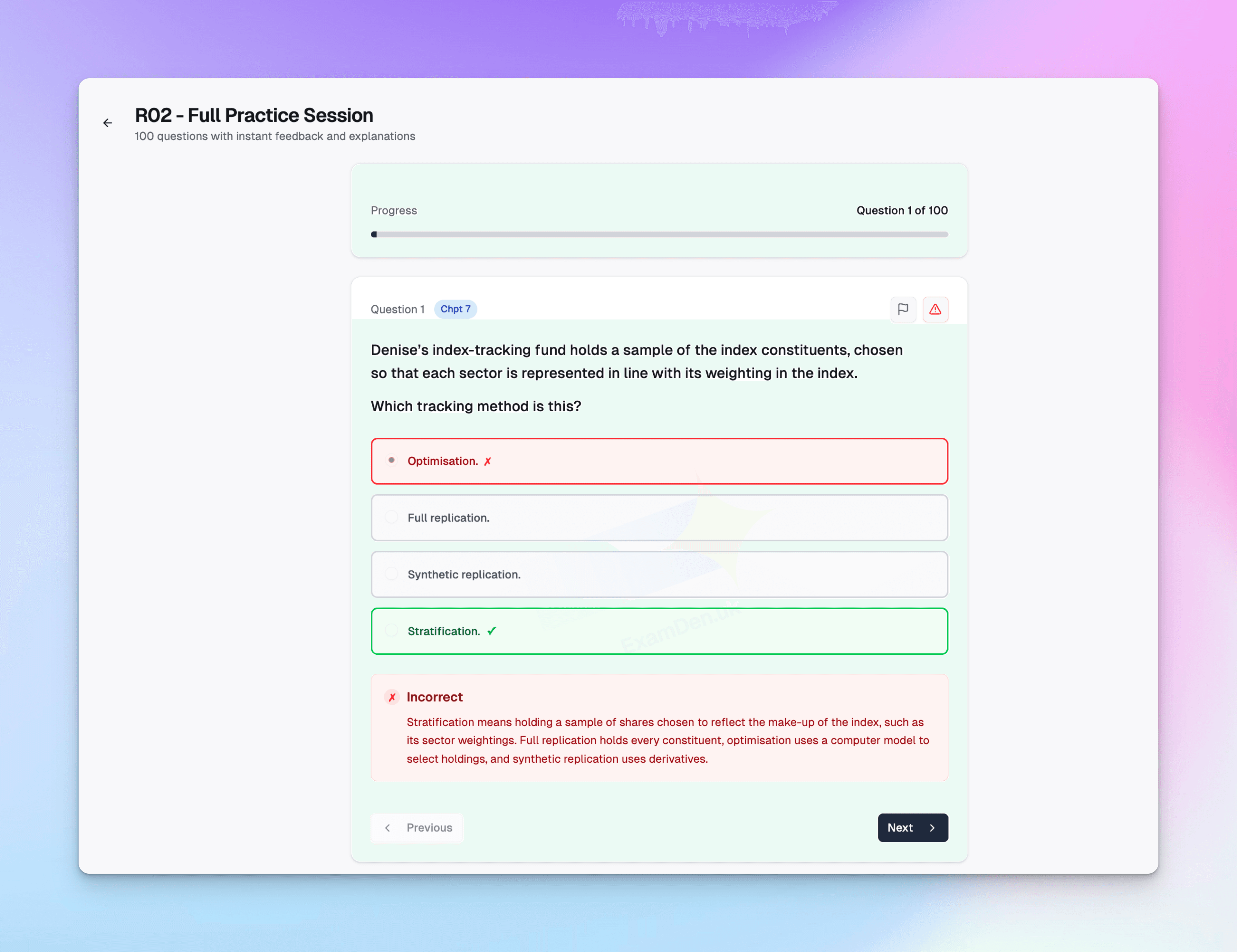
On ExamDen.uk, every question comes with a clear explanation linked to the relevant learning outcome
💡 Revision tip: for bond calculations, make a formula card with running yield, simplified redemption yield and interest yield. Do at least 10 practice calculations for each one. If you can't do a redemption yield in under a minute, you need more practice.
LO6: Investment Products — 22 Questions (15 Standard + 7 Multiple Response)
Key areas to revise:
- Collective investment schemes. Unit trusts vs OEICs — pricing, trading, structure, charges. Investment trusts — discount/premium to NAV, gearing, share buybacks. ETFs — passive tracking, trading on exchange, tracking error.
- Tax wrappers. ISAs (cash, stocks and shares, Lifetime, Junior) — contribution limits, tax advantages, transfers. Investment bonds — chargeable events, top-slicing relief, assignment. Pensions — the link to R04 content.
- Platforms. How platforms work, charges, the advised vs non-advised distinction, re-registration.
- Structured products. Structured deposits vs structured investments. Capital protection, participation rates, counterparty risk.
Multiple-response focus: the 7 MR questions in LO6 often ask which statements about a product are correct. Know the key distinguishing features of each product type — the differences between unit trusts and OEICs, or between structured deposits and structured investments, are classic MR questions.
LO7: The Investment Advice Process — 11 Questions
Key areas to revise:
- Attitude to risk. Risk profiling tools, the difference between attitude to risk and capacity for loss. Know why they must be assessed separately.
- Suitability. What makes a recommendation suitable, record-keeping requirements, the difference between advised and non-advised.
- Asset allocation. Strategic vs tactical asset allocation, the role of each asset class in a portfolio.
- Client reviews. Ongoing review requirements, rebalancing triggers.
LO9: Performance of Investments — 10 Questions (All Multiple Response)
Every question in LO9 is multiple-response. This makes it the highest-risk learning outcome in R02.
Key areas to revise:
- Return measurement. Money-weighted vs time-weighted returns — know when each is appropriate and how they differ.
- Benchmarking. Appropriate benchmarks for different portfolio types, benchmark selection criteria.
- Risk-adjusted measures. Sharpe ratio (excess return per unit of total risk), alpha (return above/below what CAPM predicts), beta (sensitivity to market movements), information ratio, standard deviation.
- The impact of charges. How annual management charges, platform fees and transaction costs affect long-term returns.
💡 Revision tip: for LO9, practise interpreting the measures, not just calculating them. "What does a negative alpha tell you?" is as likely as "Calculate the Sharpe ratio."
🎯 Practise Like the Real Exam
ExamDen.uk tracks your score by learning outcome so you see exactly where you're losing marks. No more guessing which topics to revise.
Start R02 Practice →LO8: Investment Planning Principles — 8 Questions
Key areas to revise:
- Portfolio construction. Modern Portfolio Theory in practice — how diversification reduces unsystematic risk.
- Rebalancing. Calendar-based vs threshold-based rebalancing, the costs and benefits of each approach.
- Pound-cost averaging. How regular investment smooths out purchase prices, and when it's advantageous.
- Life-stage investing. How asset allocation changes with age, time horizon and objectives.
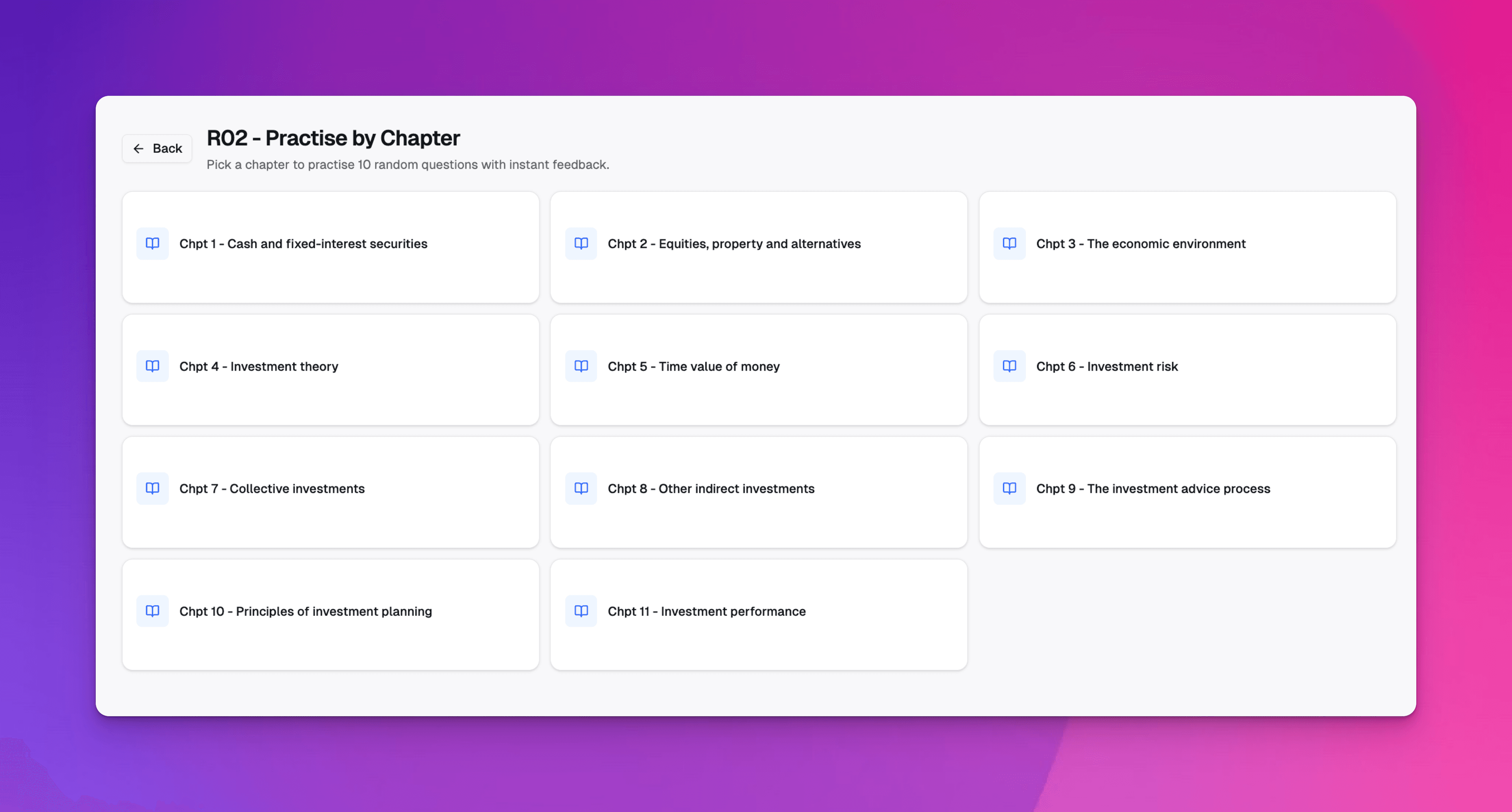
On ExamDen.uk, practise by learning outcome to find your weak spots before you take a full mock
LO3: Investment Theories — 7 Questions
Key areas to revise:
- Modern Portfolio Theory (MPT). Efficient frontier, the role of correlation in portfolio construction, assumptions and limitations.
- Efficient Market Hypothesis (EMH). Weak, semi-strong and strong forms. What each form implies about whether active management can outperform.
- Capital Asset Pricing Model (CAPM). The relationship between risk and expected return, beta, the security market line. Assumptions and limitations.
- Behavioural finance. Common biases (loss aversion, anchoring, herding, overconfidence) and how they challenge EMH.
LO2: Macro-Economic Environment — 6 Questions
Key areas to revise:
- Interest rates. How changes in Bank Rate affect bond prices, equity valuations, savings and mortgages.
- Inflation. The impact on different asset classes, real vs nominal returns, index-linked investments.
- The business cycle. Which asset classes tend to perform well in each phase (recovery, expansion, slowdown, recession).
- Fiscal and monetary policy. How government spending, taxation and central bank actions affect markets.
- Exchange rates. The impact of currency movements on overseas investments.
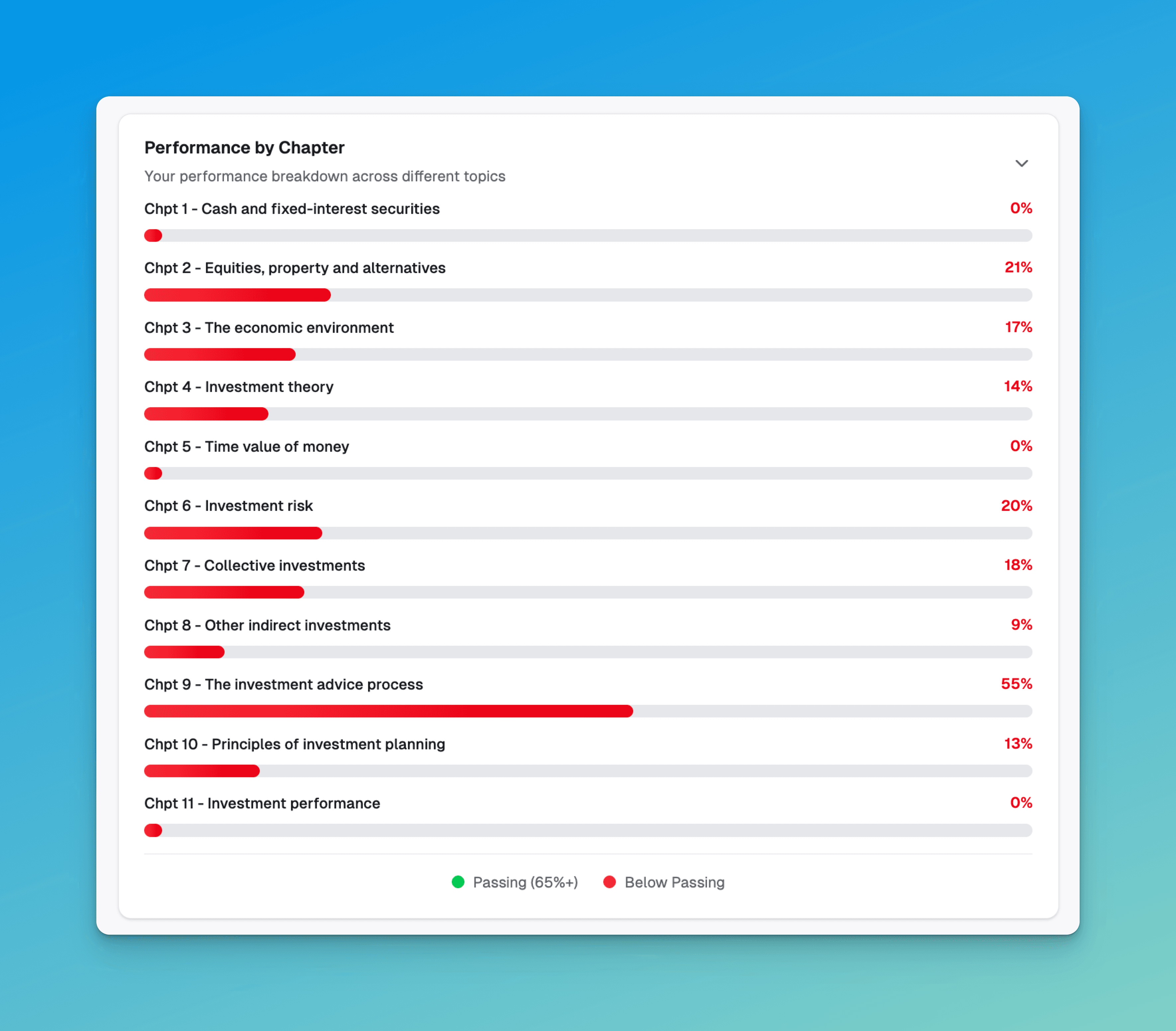
On ExamDen.uk, a mock result shows which learning outcomes are below the 65% line, so you revise those instead of the whole study text
LO5: Types of Risk — 5 Questions
Key areas to revise:
- Systematic vs unsystematic risk. Systematic (market) risk cannot be diversified away. Unsystematic (specific) risk can be reduced through diversification.
- Specific risk types. Market risk, credit risk, liquidity risk, inflation risk, currency risk, interest rate risk, counterparty risk. Know the definition of each and which asset classes are most exposed.
LO4: Time Value of Money — 3 Questions
Key areas to revise:
- Compound interest. FV = PV × (1 + r)^n. Be able to do this on paper.
- Present value. The reverse of compound interest — discounting future cash flows.
- Real vs nominal returns. The simplified formula: real return ≈ nominal return − inflation. And the precise formula using (1 + nominal) ÷ (1 + inflation) − 1.
- The effect of charges. How annual charges compound and reduce the terminal value of an investment.
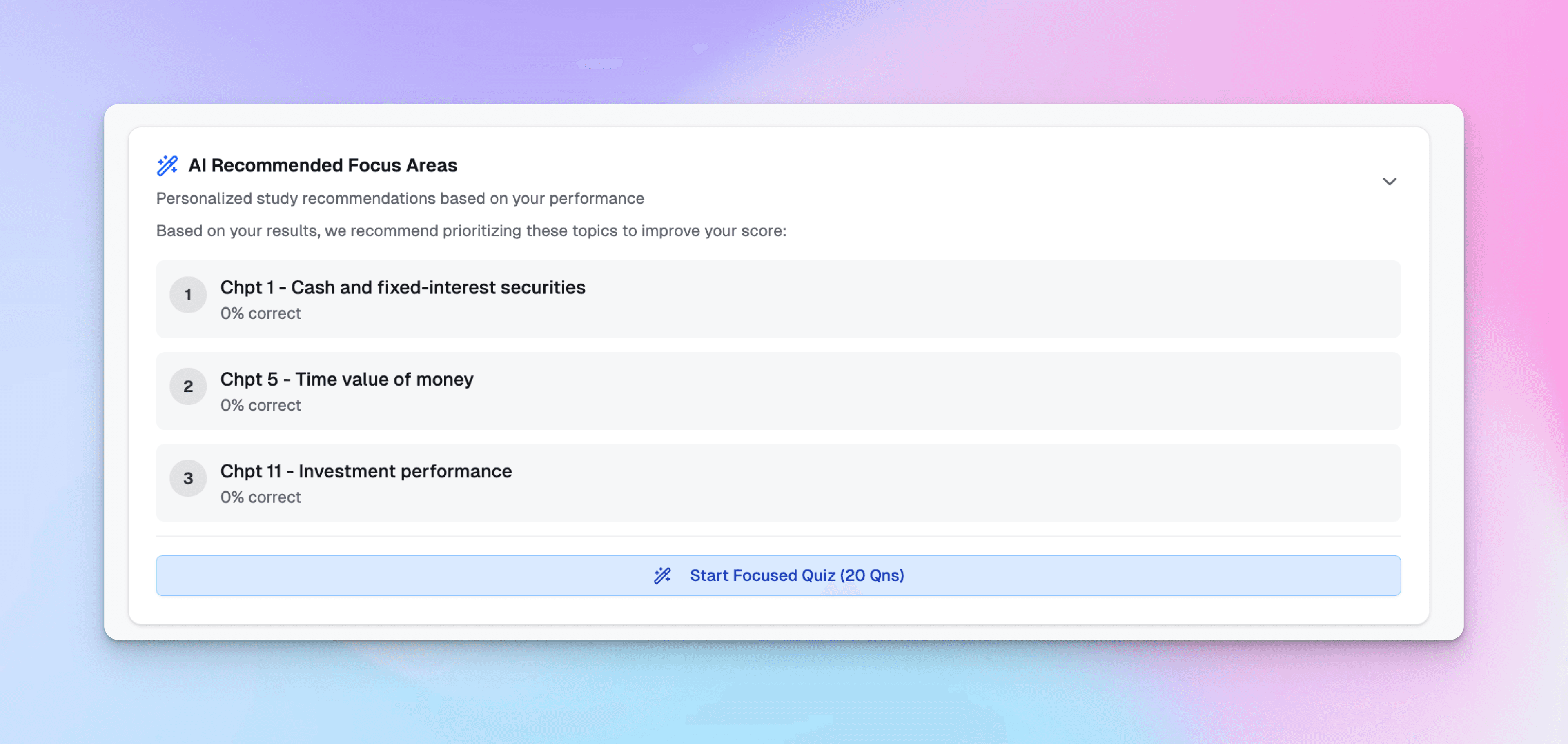
On ExamDen.uk, the focus list after a mock shows which learning outcomes to revise first
Exam Day Tips
- Do the calculations early. If you know the formulae, calculation questions are free marks. Don't leave them until the end when you're rushed.
- Read every word carefully. The CII uses bold for emphasis (maximum, minimum, normally) and capitals for negatives (NOT, CANNOT). Missing these changes the answer.
- Don't dwell. If a question is taking too long, flag it and move on. Come back after you've answered everything else.
- Check your multiple-response answers. R02 has 28 of these — more than any other R0 unit. Before submitting, double-check that you've selected all the options you intended.
- Use remaining time to review. Go through every question again. Changing one wrong answer to a correct one could be the difference between passing and failing.
Ready to Test Yourself?
Try these 5 free R02 mock questions to see the question style. When you're ready for full exam simulation, ExamDen's R02 question bank has 500+ questions, timed mocks and AI that tracks your progress by learning outcome.
R02 Revision FAQs
Ready to Put This Strategy Into Action? 💯
Test your revision. Take a timed R02 mock with 500+ exam-style questions and see which learning outcomes need more work.

The ExamDen.uk Team
ExamDen.uk builds exam-style question banks and timed mocks for CeMAP, Cert CII and CII R01–R05, helping UK professionals prepare for their financial services exams.