CeMAP 1 Study Guide: How to Pass FRE1 and FRE2
A detailed guide to CeMAP 1 (FSRE) — what FRE1 and FRE2 cover, why Module 1 is the hardest, how to handle the case studies, and which learning outcomes trip people up.
CeMAP 1 is where most candidates hit their first wall. LIBF's own FAQ describes it as "often considered the most challenging module", and candidates consistently report that the regulation and legal content in FRE1 is harder than they expected.
The good news: it's not unpredictably hard. The difficulty comes from the volume of regulatory detail and the abstract nature of the content — FCA permissions, consumer credit rules, AML processes. If you approach it with a clear plan and enough practice, it's entirely passable.
This guide covers what FRE1 and FRE2 test, how the case studies work, and where candidates most commonly lose marks.
📋 CeMAP 1 at a Glance
- Module name: FSRE (Financial Services, Regulation and Ethics)
- Two units: FRE1 and FRE2, each 40 questions in 1 hour
- Format: 25 standalone MCQs + 3 case studies with 5 questions each
- Pass mark: 28/40 (70%) per unit
- Key change: FSRE replaced the old UKFR from 30 September 2025
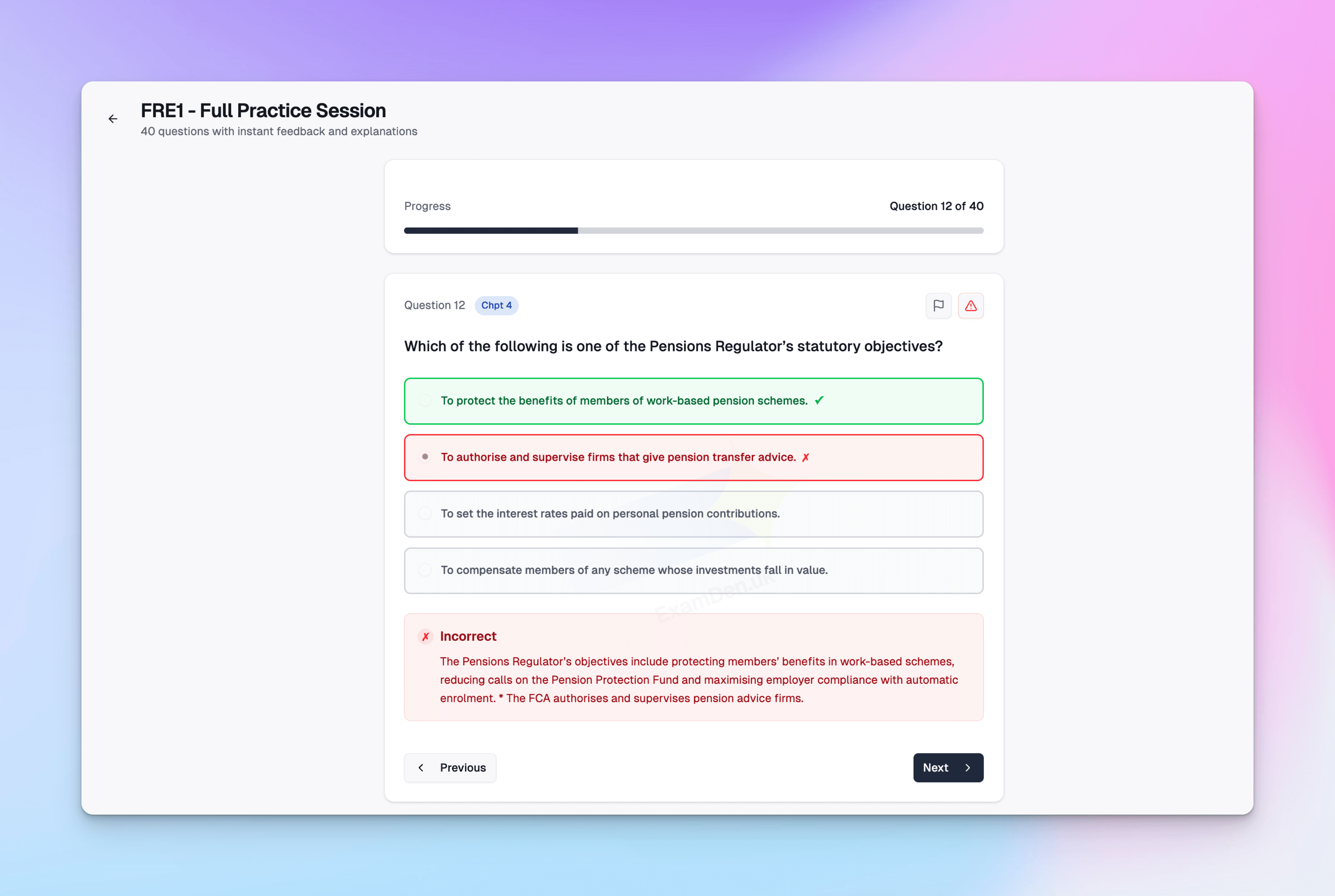
On ExamDen.uk, you see the explanation straight away, tied to the learning outcome
What Makes CeMAP 1 Different
CeMAP 2 and 3 are about mortgages — the products, the process, the advice. CeMAP 1 is about the regulatory and legal framework that sits around everything. If you're going into this expecting it to feel like a mortgage qualification, FRE1 in particular will catch you off guard.
The content covers things like:
- How the FCA and PRA are structured and what each one regulates
- The difference between regulated and unregulated activities
- Consumer credit exemptions
- Anti-money laundering processes and suspicious activity reports
- Legal concepts: contract law, duty of care, negligence
- The FCA's 12 Principles for Businesses (including the Consumer Duty as Principle 12)
It's dry, abstract and detail-heavy. The kind of material where you can read a chapter, think you've understood it, and then get the questions wrong because you mixed up two similar-sounding rules.
FRE1: Industry, Regulation and Key Parties
FRE1 covers 5 learning outcomes:
| LO | Topic |
|---|---|
| 1 | The UK financial services industry in its European and international context |
| 2 | How the retail consumer is served by the financial services industry |
| 3 | Legal concepts relevant to financial advice |
| 4 | The development of financial services regulation |
| 5 | The responsibilities and approach of the FCA and PRA |
Where candidates lose marks on FRE1
Based on training-provider reports, the most common weak areas are:
- FCA permissions and regulated activities — what requires authorisation and what doesn't. The boundaries between regulated mortgage contracts, consumer credit and exempt activities are tested in detail.
- Consumer credit exemptions — which activities are exempt and why. This is a topic that sounds simple but has a lot of specific rules.
- AML processes — the difference between internal and external suspicious activity reports, customer due diligence tiers, and who has which responsibilities.
- Suitability rules — when and how a firm must assess suitability, and what "suitable" actually means under MCOB and FCA rules.
⚠️ A common mistake: treating FRE1 like a product exam. It's a regulation exam. You're being tested on the legal and regulatory framework, not on mortgage products. Save the product knowledge for MRT1 and MRT2.
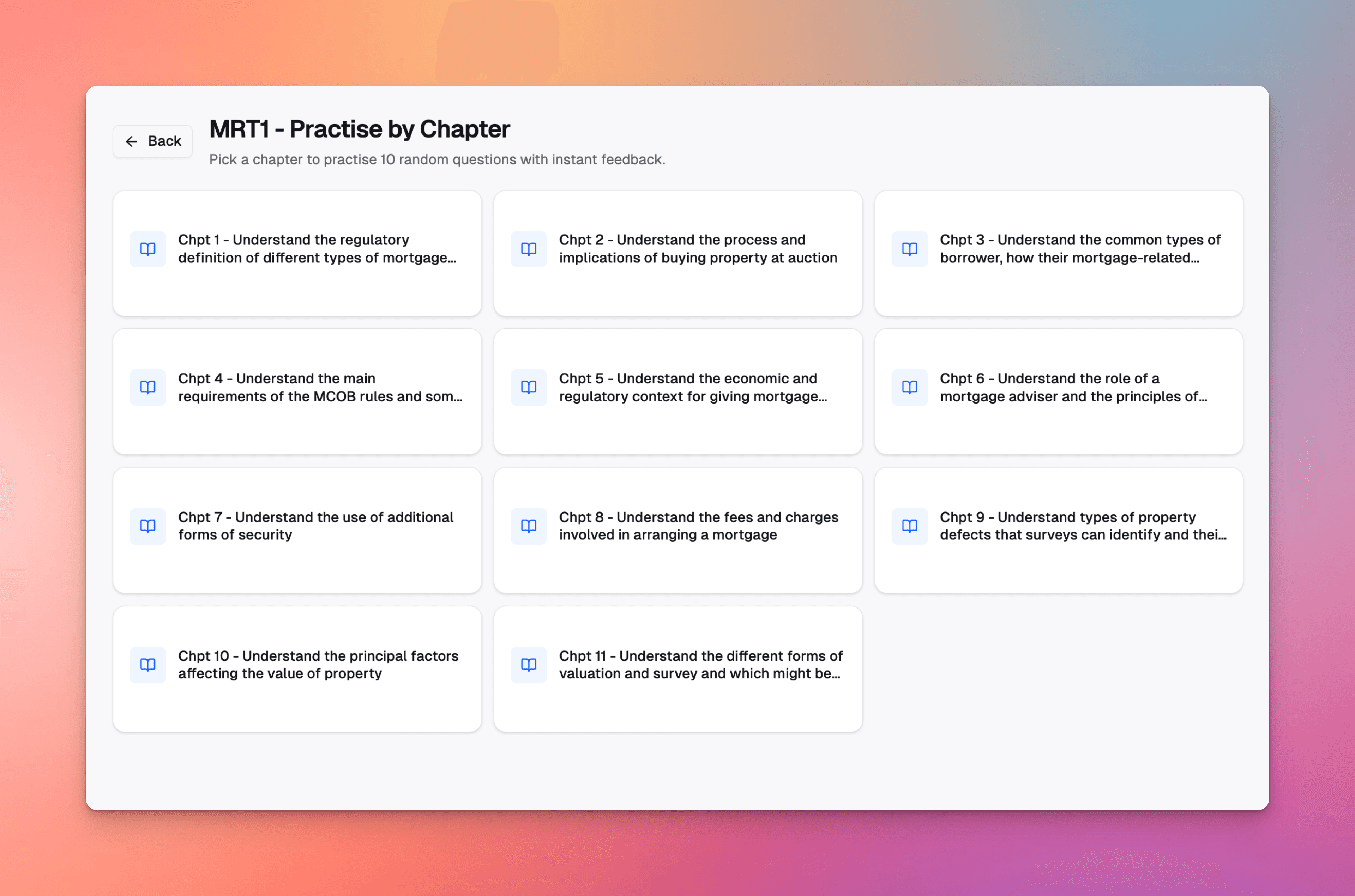
On ExamDen.uk, practise FRE1 one chapter at a time before you move on to FRE2
FRE2: Skills, Principles and Ethical Behaviours
FRE2 covers 3 learning outcomes:
| LO | Topic |
|---|---|
| 6 | The skills required when advising clients |
| 7 | Applying regulatory principles to client relationships for fair and ethical outcomes |
| 8 | Ethical principles in professional behaviour and judgements |
FRE2 is shorter and more applied than FRE1. The ethical and professional skills content was added as part of the FSRE restructure — the old UKFR didn't cover this.
The case studies in FRE2 tend to present scenarios where an adviser faces an ethical dilemma or a regulatory question in a client meeting. You need to identify the correct course of action based on the regulatory principles, not just what "feels right".
How the Case Studies Work
Both FRE1 and FRE2 include 3 case studies with 5 questions each — that's 15 of your 40 marks, or more than a third of the paper.
Each case study presents a short scenario — perhaps a client seeking mortgage advice, an adviser dealing with a regulatory situation, or a firm handling a compliance issue. You then answer 5 multiple-choice questions about that scenario.
Tips for the case studies
- Read the scenario before looking at the questions. Understand the situation first — who's involved, what the facts are, what the issue is.
- Answer from the scenario, not from memory. The facts in the case study are there for a reason. If a question asks what the adviser should do, the answer will be grounded in the specific details provided.
- In FRE1 case studies, look for the regulatory issue. Is it a permissions question? A suitability question? An AML question? Identifying the type of issue helps you find the right answer.
- In FRE2 case studies, look for the ethical issue. What principle is at stake? Is it fair treatment, suitability, conflict of interest, or something else?
- Don't rush. You have 90 seconds per question on average, which includes reading time for the case study. Budget about 5 minutes per case study (1 minute to read, 4 minutes for the 5 questions).
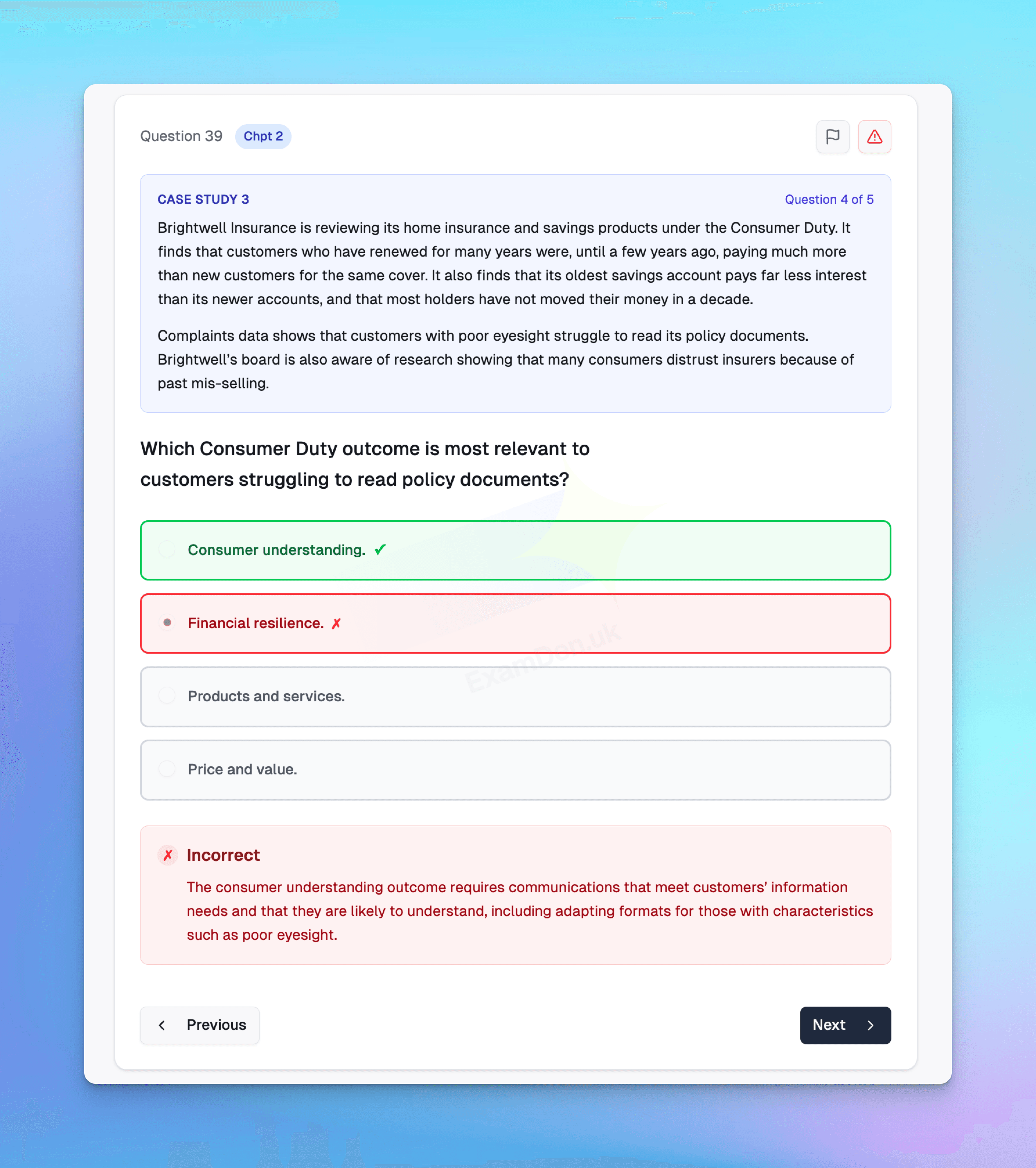
On ExamDen.uk, CeMAP 1 practice includes case-study questions in the same format as the real exam
Study Strategy for CeMAP 1
Week-by-week plan (12 hours/week)
| Week | Focus |
|---|---|
| 1–2 | FRE1 LO1–LO3: industry structure, consumer services, legal concepts |
| 3–4 | FRE1 LO4–LO5: regulation development, FCA/PRA approach |
| 5 | FRE1 timed mocks and case-study practice. Sit FRE1 when scoring 75%+ |
| 6–7 | FRE2 LO6–LO8: skills, principles, ethics |
| 8 | FRE2 timed mocks and case-study practice. Sit FRE2 when scoring 75%+ |
Key study habits
- Don't just read — test yourself. After each learning outcome, answer practice questions on that topic before moving on. This is far more effective than re-reading.
- Make a regulation cheat sheet. FCA vs PRA responsibilities, regulated vs unregulated activities, AML tiers, suitability requirements. Write them out in your own words.
- Practise case studies separately. The skill of reading a scenario and identifying the regulatory or ethical issue is different from the skill of recalling facts. You need to practise both.
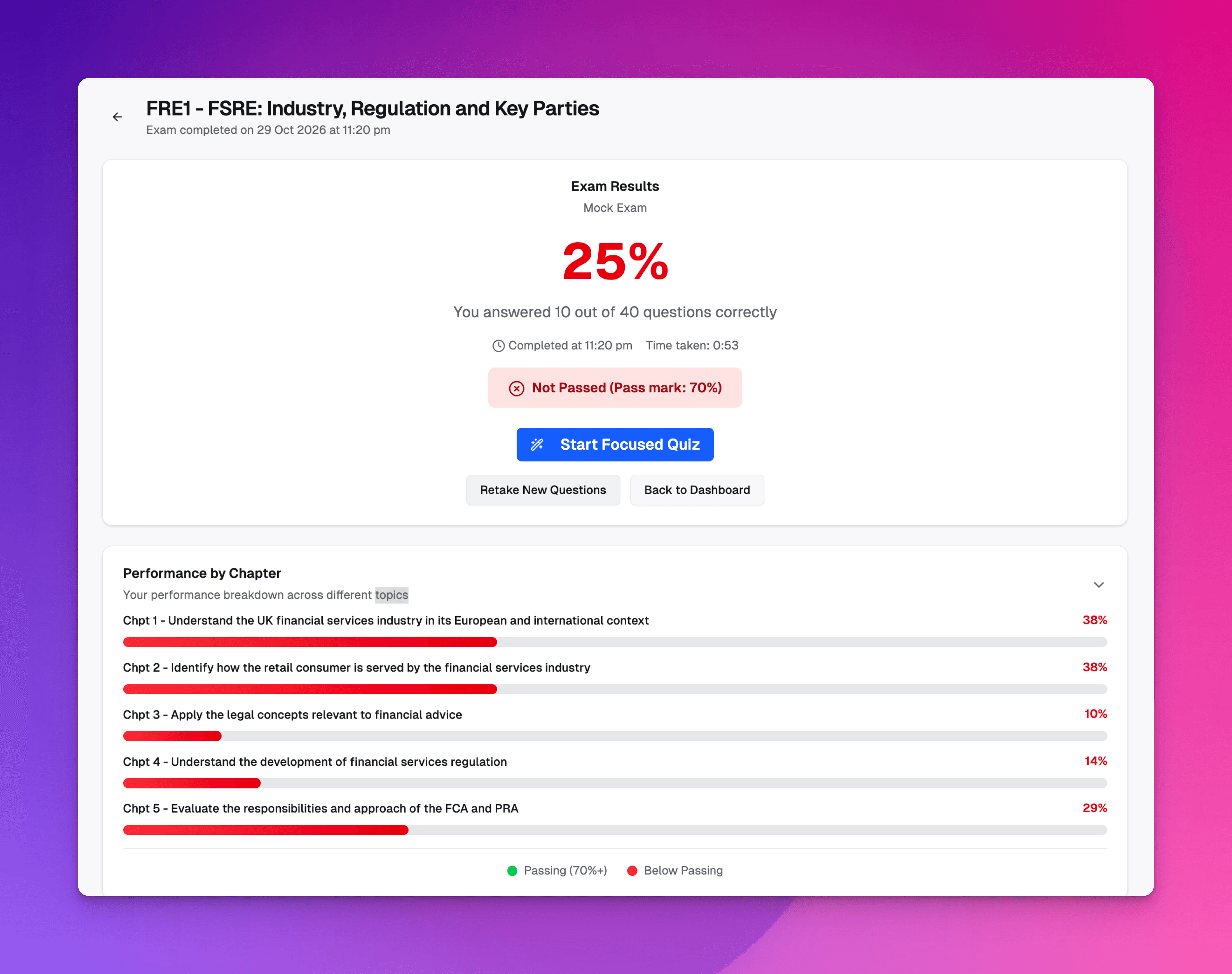
On ExamDen.uk, a timed mock shows your score against the 70% pass mark, and which chapters are below it
For the full picture across all three modules, see our complete CeMAP study guide.
CeMAP 1 Links to DipFA
CeMAP 1 uses the FSRE module — the same module that appears in LIBF's Diploma in Financial Advice (DipFA). This means:
- If you pass FRE1 and FRE2 for CeMAP, those passes count towards DipFA. You won't need to sit them again.
- If you already hold DipFA with an FSRE pass, you can apply for an exemption from CeMAP 1.
This is worth knowing if you're planning a longer career path that includes both mortgage and financial advice qualifications.
Ready to Practise?
The FRE1 and FRE2 question banks on ExamDen cover all 8 learning outcomes with exam-style questions, case-study practice and timed mocks in the real LIBF format.
CeMAP 1 FAQs
Ready to Put This Strategy Into Action? 💯
Practise FRE1 and FRE2 with case-study questions, timed mocks and AI that pinpoints your weakest learning outcomes.

The ExamDen.uk Team
ExamDen.uk builds exam-style question banks and timed mocks for CeMAP, Cert CII and CII R01–R05, helping UK professionals prepare for their financial services exams.