How to Pass CeMAP: Complete Study Guide for CeMAP 1, 2 and 3
A practical guide to passing all five CeMAP units — FRE1, FRE2, MRT1, MRT2 and ASEW/ASSC — covering exam format, pass marks, study order, timing and the most common mistakes candidates make.

CeMAP — the LIBF Certificate in Mortgage Advice and Practice — is the most widely held qualification for UK mortgage advisers. It meets the FCA's education standard, is Ofqual-regulated at RQF Level 3 and sits at the heart of the Mortgage Adviser apprenticeship.
If you're studying for CeMAP right now, you're on the new structure that launched in September 2025. This guide covers exactly what the new exams look like, how to approach each module, and how to build a study plan that gets you through all five units.
📋 Quick Summary
- 5 units across 3 modules: FRE1, FRE2 (CeMAP 1), MRT1, MRT2 (CeMAP 2) and ASEW/ASSC (CeMAP 3)
- Pass mark: 70% on every unit — no exceptions
- On-demand exams: sit each unit whenever you're ready, online with remote invigilation
- Study first: CeMAP 1 is widely seen as the hardest module, but CeMAP 3 catches people who can't apply what they've learned
- Mock exams are non-negotiable: reading the material isn't enough — you need to practise under timed conditions before you sit each unit
What Is CeMAP?
CeMAP qualifies you to give mortgage advice in the UK. It's awarded by LIBF (the London Institute of Banking & Finance, now part of Walbrook Institute London) and consists of three modules:
- CeMAP 1 (FSRE) — Financial Services, Regulation and Ethics. Two papers: FRE1 and FRE2.
- CeMAP 2 (MORT) — Mortgages. Two papers: MRT1 and MRT2.
- CeMAP 3 — Assessment of Mortgage Advice Knowledge. One paper: ASEW (England & Wales) or ASSC (Scotland).
You don't need any prior qualifications to register, but you do need to be able to study at Level 3 in English. There's no required study order, though LIBF recommends completing CeMAP 2 before you attempt CeMAP 3.
CeMAP Exam Format at a Glance
Every unit is multiple-choice. No written answers, no essays. But not every unit is straightforward MCQs — FRE1, FRE2 and ASEW/ASSC include case studies where you read a scenario and answer questions based on the facts you're given.
| Unit | Module | Questions | Time | Pass Mark |
|---|---|---|---|---|
| FRE1 | CeMAP 1 | 25 MCQs + 3 case studies (40 total) | 1 hour | 28/40 (70%) |
| FRE2 | CeMAP 1 | 25 MCQs + 3 case studies (40 total) | 1 hour | 28/40 (70%) |
| MRT1 | CeMAP 2 | 50 MCQs | 1 hour | 35/50 (70%) |
| MRT2 | CeMAP 2 | 40 MCQs | 1 hour | 28/40 (70%) |
| ASEW/ASSC | CeMAP 3 | 6 case studies × 10 MCQs (60 total) | 2 hours | 42/60 (70%) |
Every unit also awards merit at 80% and distinction at 90%, though the qualification itself is graded pass/fail.
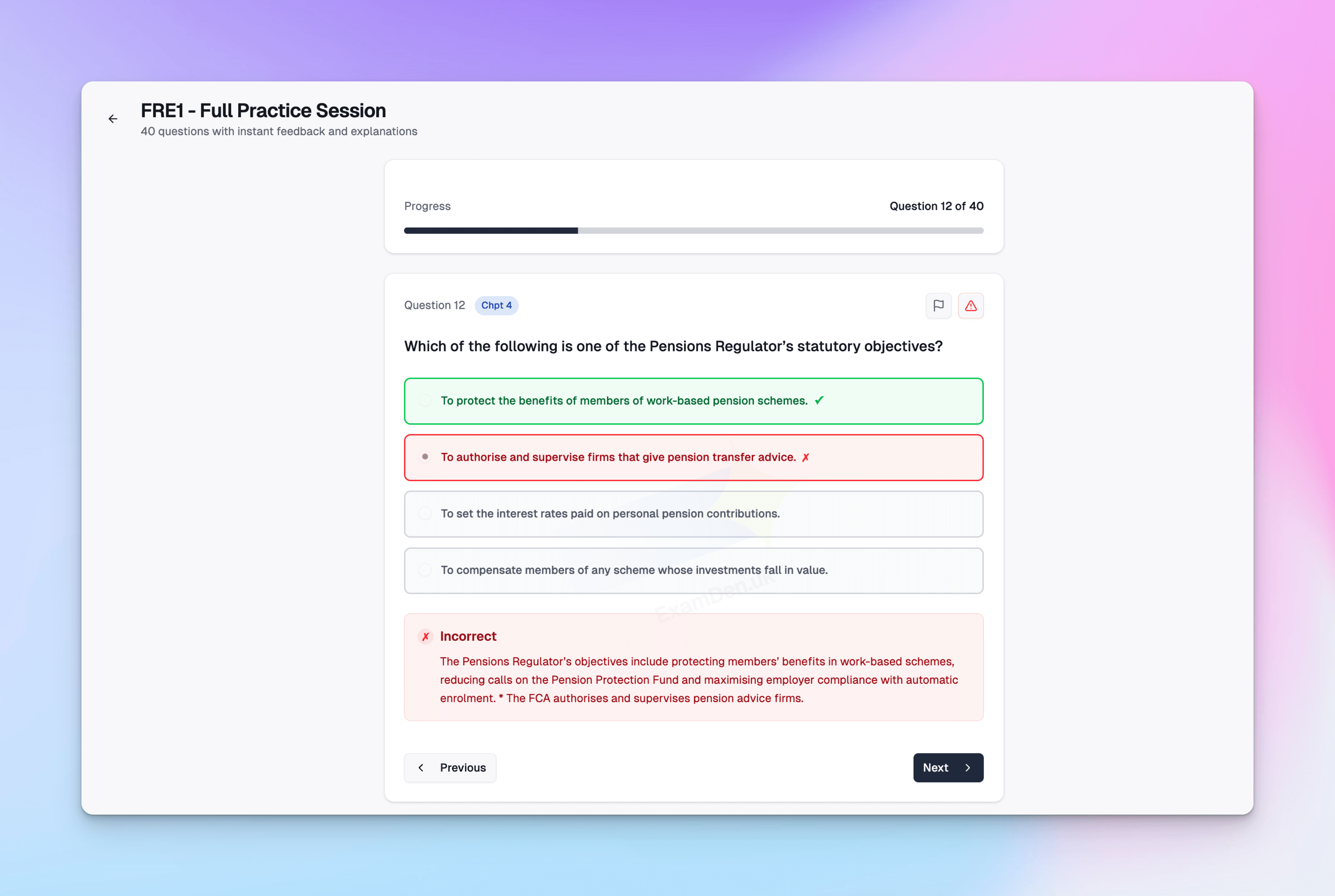
On ExamDen.uk, every question comes with a clear explanation linked to the relevant learning outcome
Time per question
This matters more than people think. MRT1 gives you just 72 seconds per question — the tightest of any CeMAP unit. FRE1, FRE2 and MRT2 give you 90 seconds. ASEW/ASSC is more generous at 2 minutes per question, but you'll need it — the case studies require careful reading before you can answer.
| Unit | Seconds per Question |
|---|---|
| MRT1 | 72 sec |
| FRE1, FRE2, MRT2 | 90 sec |
| ASEW/ASSC | 120 sec |
⏱️ Time management tip: if you're consistently running out of time on practice papers, that's a sign you're thinking too hard about individual questions. In the real exam, flag anything you're unsure about and come back to it.
What Changed in September 2025
LIBF restructured CeMAP from 30 September 2025. If you're reading older guides or forum posts, they'll describe a different exam. Here's what changed:
CeMAP 1 had the biggest overhaul. The old module was called UKFR and had two units (ITFS and UKFS) of 50 MCQs each, sat together in a 2-hour exam. The new module is FSRE — the same module used in LIBF's Diploma in Financial Advice (DipFA). FRE1 and FRE2 are each 40 questions in 1 hour, and both include case studies. The scope is wider too, adding professional ethics, skills and economic context that the old UKFR didn't cover.
CeMAP 2 was simplified. The old module had four units (MLPP, MAPP, MRPP, MAPC) sat together over 2 hours. Now it's just MRT1 and MRT2, each sat separately in 1 hour.
CeMAP 3 kept the same format — 6 case studies of 10 questions over 2 hours.
How you sit the exams changed completely. There are no more Pearson VUE test centres. All exams are taken online through LIBF's Brightspace platform with remote invigilation. You sit each unit separately, whenever you're ready, at any time. We go into the full detail on booking and logistics in our guide to booking CeMAP.
⚠️ Watch out for outdated information: if a guide mentions UKFR, ITFS, UKFS, MLPP, MAPP, MRPP, MAPC or Pearson VUE test centres, it's describing the old CeMAP. The old exams ended in January 2026, and UKFR was fully withdrawn after 16 July 2026.
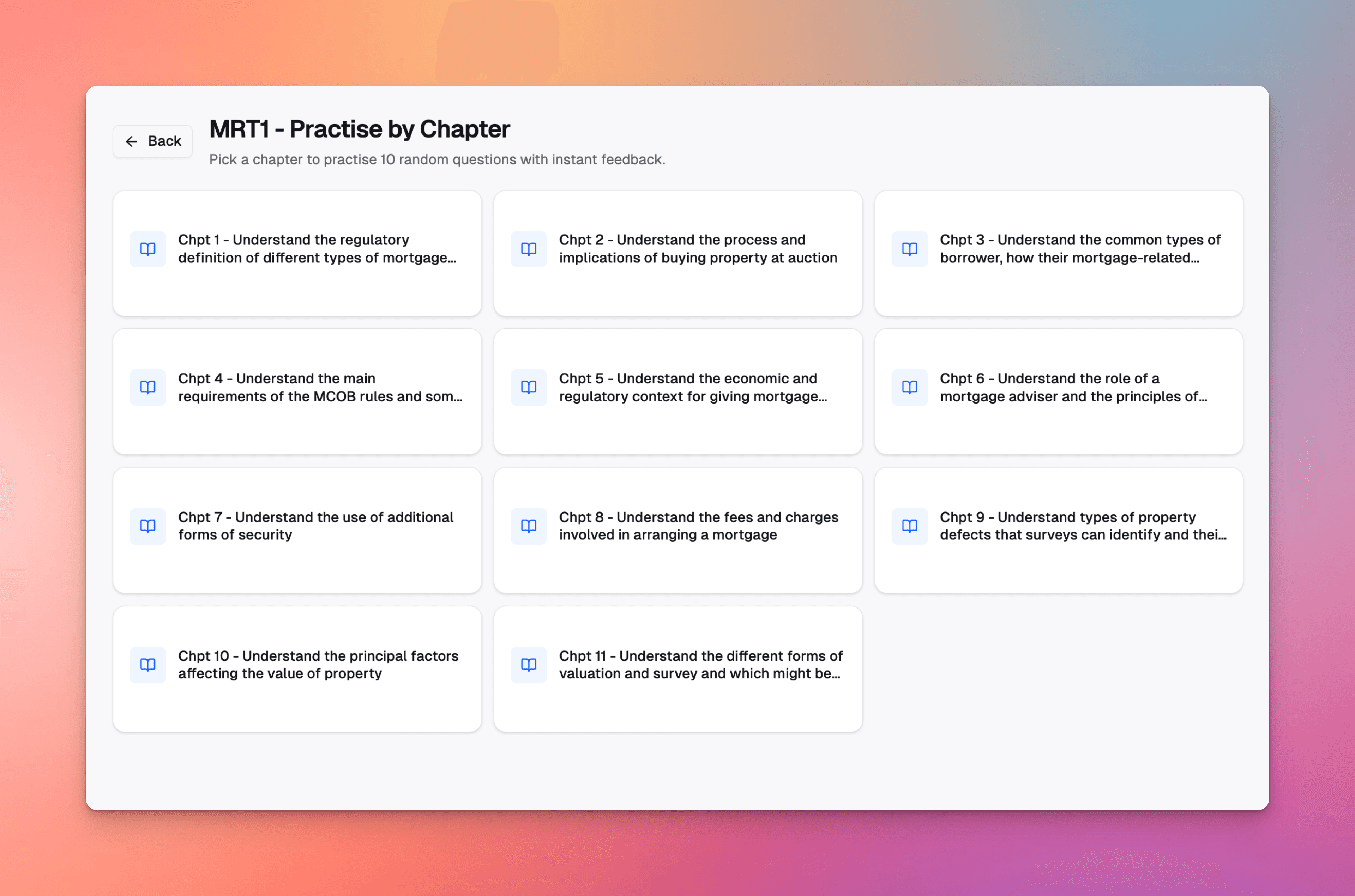
On ExamDen.uk, practise one chapter at a time, then sit a full mock in the real question count and time limit
CeMAP Pass Marks
Every unit needs 70% to pass. There's no compensation between units — you can't offset a weak FRE1 with a strong FRE2. Each one stands on its own.
| Unit | Questions | Pass (70%) | You Can Get Wrong |
|---|---|---|---|
| FRE1 | 40 | 28 | 12 |
| FRE2 | 40 | 28 | 12 |
| MRT1 | 50 | 35 | 15 |
| MRT2 | 40 | 28 | 12 |
| ASEW/ASSC | 60 | 42 | 18 |
Twelve wrong answers on a 40-question paper sounds like plenty — until you hit a run of questions on a topic you didn't revise properly. On FRE1, if you're weak on two learning outcomes, that could easily cost you 10 marks.
Most training providers suggest you should only sit a unit when you're consistently scoring 75–80% or above on timed practice papers. That gives you a buffer for the questions that are worded differently from what you've practised.
Study Order: Which Module Should You Start With?
LIBF doesn't require any particular order, but most candidates follow this sequence:
- CeMAP 1 first — FRE1 then FRE2. Get the regulation and legal framework out of the way. It's the hardest module for most people, and passing it early builds confidence.
- CeMAP 2 second — MRT1 then MRT2. The mortgage-specific content. More practical and tangible than CeMAP 1.
- CeMAP 3 last — ASEW or ASSC. This is synoptic — it draws heavily on CeMAP 2 content. Don't attempt it until you've passed MRT1 and MRT2.
Some candidates prefer to start with CeMAP 2 because it's more directly relevant to their day job. That's fine — just don't sit CeMAP 3 until you've covered the CeMAP 2 material.
Module-by-Module: What to Expect
CeMAP 1 — FSRE (FRE1 and FRE2)
CeMAP 1 is widely considered the hardest module, and LIBF's own FAQ confirms this. The content is regulation-heavy and abstract — FCA permissions, consumer credit exemptions, suitability rules and AML processes. It's the kind of material where you can read a chapter and feel like you understood it, then fail to answer the questions correctly because the detail didn't stick.
FRE1 covers the UK financial services industry, how consumers are served, legal concepts and how the FCA and PRA regulate the market. Five learning outcomes, 25 standalone MCQs plus 3 case studies.
FRE2 covers professional skills, applying regulatory principles and ethical behaviour. Three learning outcomes, same format as FRE1.
We cover CeMAP 1 in detail — learning outcomes, case-study strategy and common weak spots — in our CeMAP 1 (FRE1 and FRE2) study guide.
💡 Don't skip the case studies in FRE1 and FRE2. They're worth 15 marks each — more than a third of the paper. The case studies test whether you can spot the regulatory or ethical issue in a real-world scenario, not just recall a definition.
CeMAP 2 — MORT (MRT1 and MRT2)
CeMAP 2 is the practical module. It covers mortgage contracts, borrower types, MCOB rules, affordability, property valuations, product types, arrears and repossession.
MRT1 is the denser paper: mortgage law, practice and application across 11 learning outcomes. At 50 questions in 60 minutes, it's also the unit with the tightest time pressure. Know your calculations — LTV ratios, repayment vs interest-only, early repayment charges — because working them out from scratch under timed conditions is where people lose marks.
MRT2 covers further advances, remortgages, debt consolidation, arrears and lender remedies, and the different types of mortgage products. Six learning outcomes, 40 questions in 60 minutes.
We go deeper on both units in our CeMAP 2 (MRT1 and MRT2) study guide.
CeMAP 3 — ASEW/ASSC
CeMAP 3 is entirely case-study based. You get 6 client scenarios — each with 10 questions — over 2 hours. The scenarios test mortgage advice in context: recommending products, applying MCOB rules, explaining protection, and handling the property purchase process.
ASEW covers England and Wales. ASSC covers Scotland (Scottish property law, missives, sequestration, the Mortgage Rights (Scotland) Act 2001). You sit whichever version matches where you'll be advising.
The common trap is answering from general knowledge instead of from the specific facts in the scenario. Several answers will look plausible, but only the one supported by the case-study details is correct. We break down the approach in our CeMAP 3 case study guide.
How Long Does CeMAP Take?
LIBF's official total qualification time is 250 hours. In practice, how long it takes depends on your background and how much time you can study each week.
- Training-provider estimates: 120–150 hours of actual study, or roughly 6–8 weeks for CeMAP 1 alone.
- Self-study: most candidates take 3–6 months for all three modules, studying around 10–15 hours a week.
- Intensive courses: some providers run 2-week classroom courses per module. After the course, you still need time to revise and practise before sitting the exam.
Registration periods are 18 months if you register for the full CeMAP package, or 12 months per module if you register separately. Since the exams are on demand, there's no external deadline pushing you — which can be both a benefit and a risk. Set your own deadlines.
We cover booking, fees and exam-day logistics in detail in our guide to booking CeMAP.
Study Tips That Actually Work
1. Use the free specimen papers
LIBF now offers a free specimen paper for each unit. Use them — but don't use them too early. Save them for a realistic timed run once you've covered all the material.
Looking for more practice beyond the specimen? Try these 6 free CeMAP mock questions, or see our guide on CeMAP past papers and what to use instead.
2. Practise under timed conditions
Reading the study text and highlighting passages feels productive, but it doesn't prepare you for the time pressure. The only way to know if you're ready is to sit a full, timed mock and see your score.
ExamDen's CeMAP question banks are timed in the real LIBF format — 40 questions in 60 minutes for FRE1, 50 in 60 for MRT1, and so on — so you're practising the same pacing you'll face in the exam.
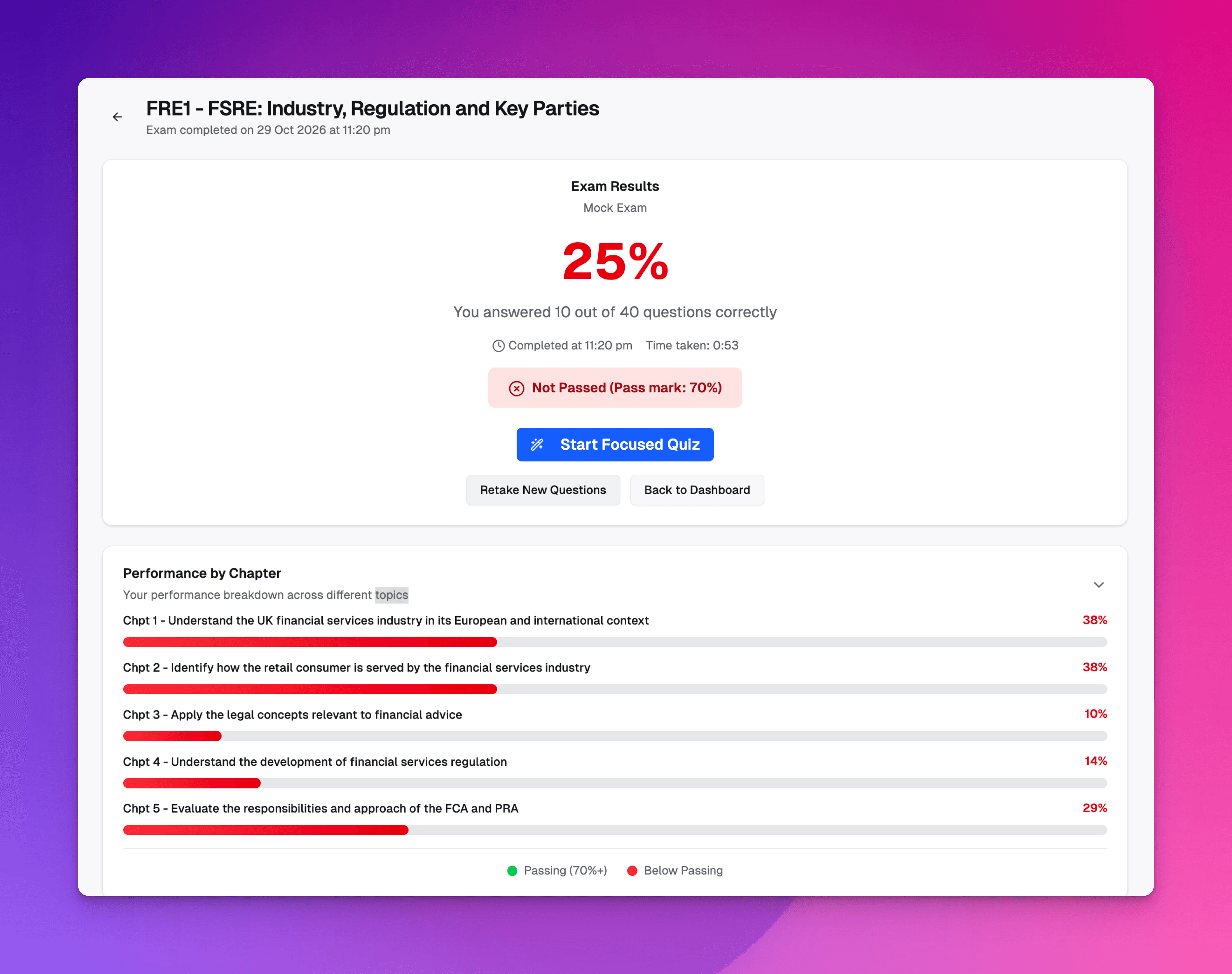
On ExamDen.uk, a timed mock shows your score against the 70% pass mark, and which chapters are below it
3. Focus on weak areas, not comfortable ones
After each practice session, look at which learning outcomes you scored lowest on. It's tempting to revise the topics you already know well, but your score improves fastest when you target your weakest areas.
If you've already sat and failed a unit, LIBF provides a feedback analysis on MyLIBF that shows you where you lost marks. Use it.
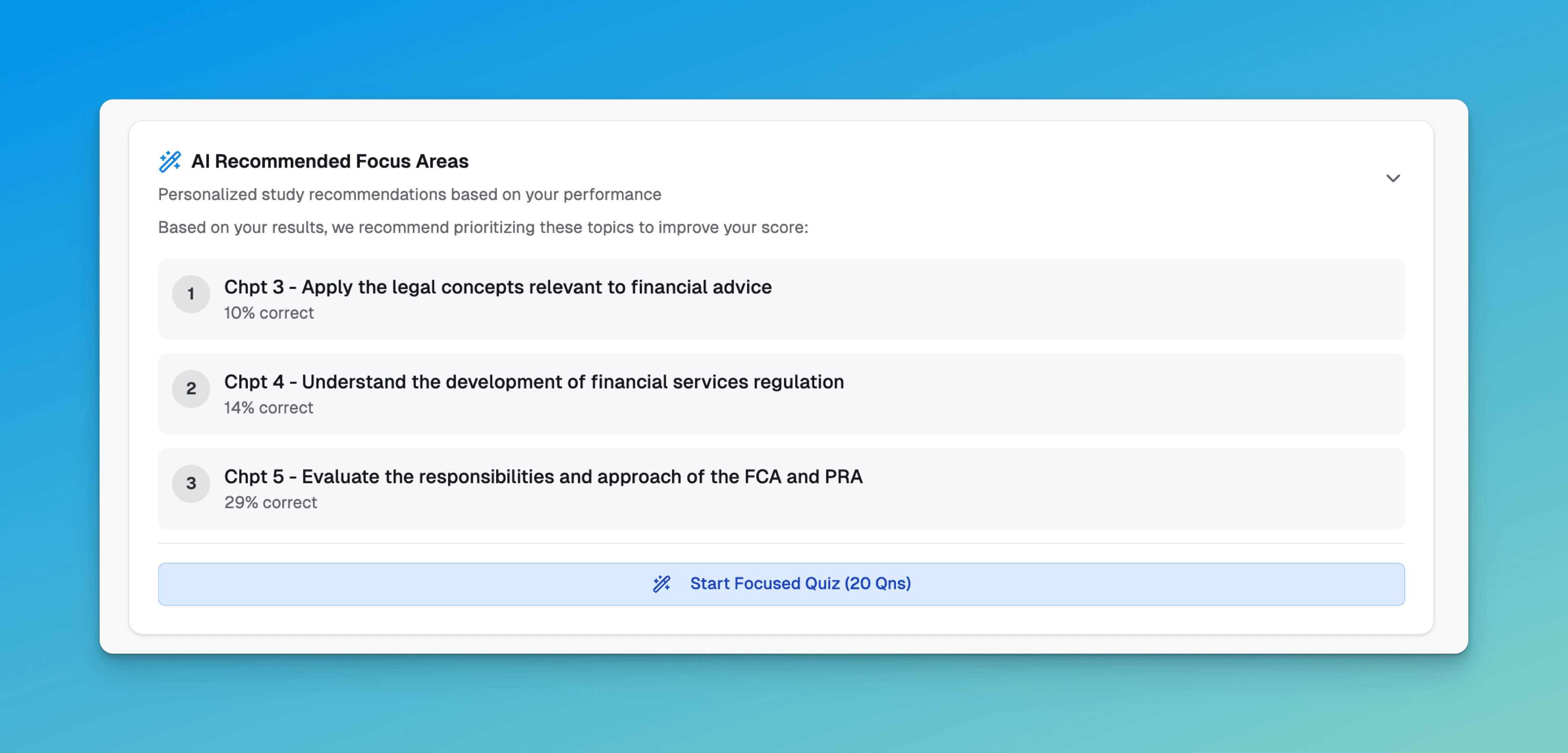
On ExamDen.uk, the focus list after a mock shows which learning outcomes to revise first
4. Practise calculations separately
For MRT1 and MRT2, dedicate specific study sessions to calculations: loan-to-value ratios, affordability assessments, early repayment charges, stamp duty thresholds. These are mechanical — once you know the method, you'll get them right every time. But if you haven't practised, you'll waste time working them out under pressure.
5. For case studies, answer from the scenario
This applies to FRE1, FRE2 and especially CeMAP 3. Read the case study carefully, identify the relevant facts, and answer based on what the scenario tells you — not what you think a good adviser would do in general. The examiners are testing whether you can apply the rules to a specific client's circumstances.
6. Set your own exam dates
With on-demand exams, there's no external deadline. This is a double-edged sword. Many candidates drift after a failed attempt because there's no booked exam date pushing them forward. Pick a target date for each unit and work backwards from it.
Common Mistakes to Avoid
Underestimating CeMAP 1. People expect a mortgage qualification to be about mortgages, then get blindsided by the weight of regulation in FRE1. The FCA permissions regime, consumer credit exemptions, and AML requirements are dense and testable. Read more in Is CeMAP Hard?
Re-reading the entire study text for a resit. If you've failed a unit, go straight to your MyLIBF feedback analysis. It tells you which learning outcomes you were weakest on. Target those areas, don't start from page one.
Running out of time on MRT1. At 50 questions in 60 minutes, MRT1 has the tightest timing of any CeMAP unit. If you haven't practised under timed conditions, you'll feel it.
Answering CeMAP 3 from memory. The case studies give you specific client details — income, property value, circumstances. The correct answer depends on those details, not on general principles. Read the scenario, then answer.
Relying on outdated materials. Any guide or question bank that mentions UKFR, ITFS, UKFS, MLPP, MAPP, MRPP, MAPC or Pearson VUE is describing the old CeMAP. Make sure whatever you're using reflects the new structure.
Assuming you need an ALSP course. Training courses are helpful but optional. LIBF even warns about non-ALSP and fake training providers. You can self-study with the official materials and practice exams — what matters is that you do enough timed practice to know you're ready.
What Comes After CeMAP?
Once you pass all five units, you receive a digital certificate and MLIBF membership. You're then qualified to give mortgage advice in the UK.
If you want to go further:
- CeRER adds equity release advising to your scope
- CeMAP Diploma (Level 4, £550) is the next step for experienced advisers
- DipFA shares the FSRE module with CeMAP 1, so your FRE1 and FRE2 passes can count towards it
Start Practising
The fastest way to know whether you're ready for each unit is to take a timed mock. ExamDen's CeMAP question banks cover all five units with 500+ exam-style questions each, timed mocks in the real LIBF format, and AI that pinpoints the learning outcomes you need to work on.
CeMAP FAQs
Ready to Put This Strategy Into Action? 💯
Practise with 500+ exam-style questions per unit, timed mocks in the real LIBF format, and AI that shows you exactly which learning outcomes to revise.

The ExamDen.uk Team
ExamDen.uk builds exam-style question banks and timed mocks for CeMAP, Cert CII and CII R01–R05, helping UK professionals prepare for their financial services exams.