CII I10 Revision Guide (2026): Learning Outcomes and Exam Tips
CII I10 revision guide: all 6 learning outcomes explained with question counts, priority topics and exam tips for the Insurance Broking Fundamentals exam.
This I10 revision guide covers every learning outcome in the exam, in order of question weight. Use it during your final revision to check that you've covered each topic and know where to focus your remaining study time.
For a broader study plan and common mistakes, see our complete I10 study guide. For practice questions, try these 6 free I10 mock questions.
📋 I10 Exam Recap
- 75 questions in 2 hours — 65 standalone MCQs + 2 case studies × 5 questions
- Pass mark: 70% (at least 53 out of 75)
- 6 learning outcomes
- LO1–LO5 → Section A (standalone MCQs); LO6 → Section B (case studies)
---
LO2: Role and Responsibilities — 20 Questions (27%)
The largest learning outcome. It covers the full scope of what an insurance broker does.
- Demands and needs. Establishing the client's requirements before recommending a product. The demands and needs statement. The difference between advised sales (personal recommendation based on analysis) and non-advised sales (information only, client decides).
- Placement. Presenting the risk to the market. Open market placement vs schemes/facilities. Obtaining quotations, comparing terms, negotiating cover. The slip in the London market.
- Documentation. Cover notes (temporary evidence of cover), certificates of insurance, policy summaries, IPIDs (Insurance Product Information Documents). What must be provided, when, and in what format.
- Renewals. Invitation to renew, reviewing cover adequacy, mid-term adjustments. FCA renewal pricing rules: clear disclosure of previous and new premium, no price walking.
- Claims. The broker's role: notifying the insurer, gathering information, progress chasing, claims advocacy. The broker does not settle claims — the insurer does.
- Up-selling vs cross-selling. Up-selling: increasing the cover on an existing product. Cross-selling: offering a different product. Both must meet demands and needs.
- Wholesale and retail. Retail brokers deal directly with clients. Wholesale/London brokers access specialist markets. Lloyd's brokers have Lloyd's access. TOBAs govern the relationship between retail and wholesale brokers.
Quick test: A client calls to add legal expenses cover to their existing liability policy. Is this up-selling or cross-selling?
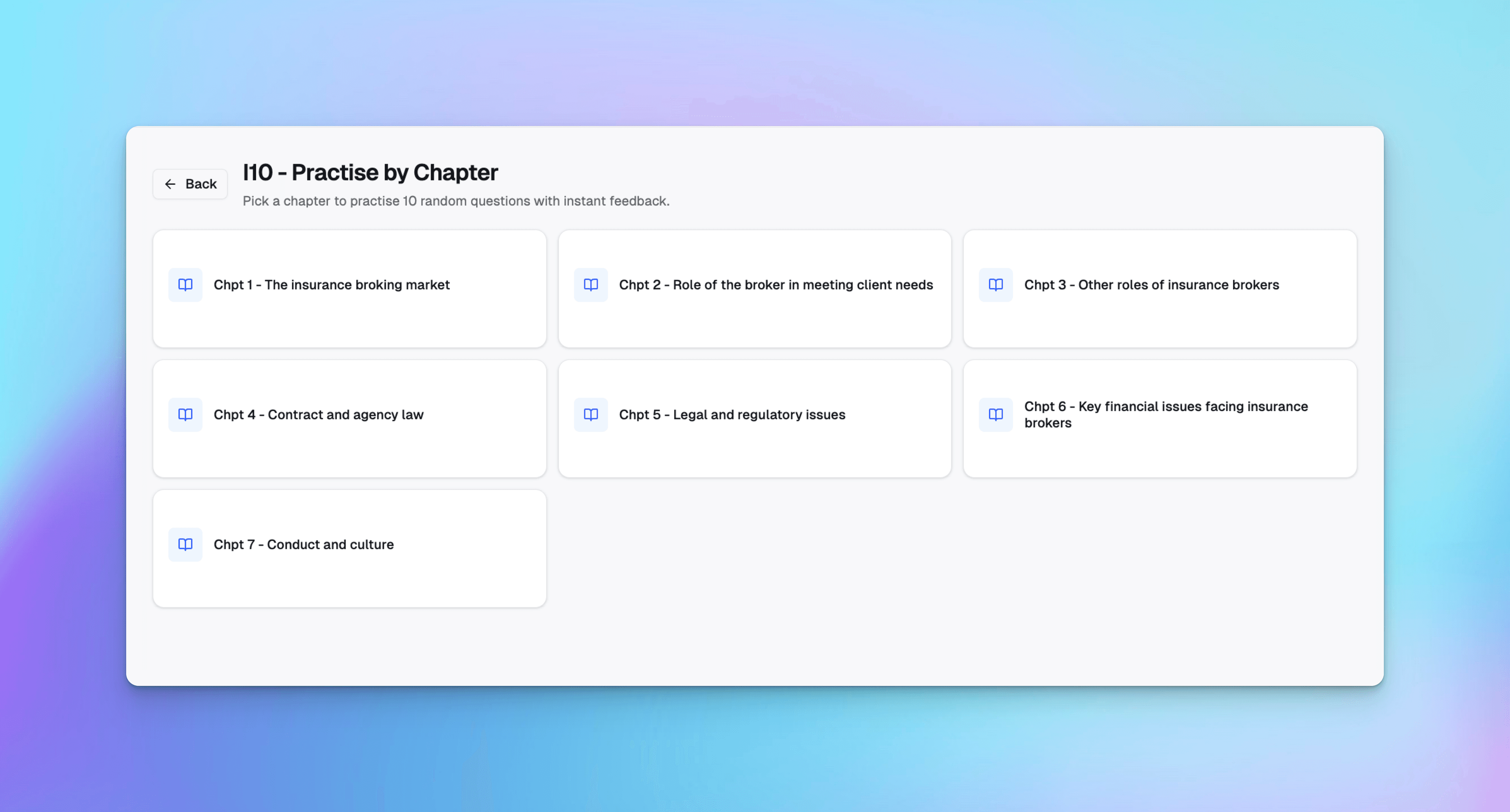
On ExamDen.uk, practise one learning outcome at a time, then sit a full mock in the real two-section format
LO4: Legal and Regulatory Issues — 15 Questions (20%)
- FCA authorisation. Permissions, Part IV permissions, the regulatory perimeter. Appointed representatives. Exempt professional firms.
- ICOBS. Insurance Conduct of Business Sourcebook: demands and needs, disclosure, suitability, product information, claims handling, complaints.
- IDD. Insurance Distribution Directive: scope, product oversight and governance, cross-selling rules.
- SM&CR. Senior Managers regime (SMFs), Certification regime, conduct rules. Individual accountability for senior managers. The duty of responsibility.
- Client money (CASS). FCA client money rules. Segregation, statutory trust (money held on trust for clients), non-statutory trust (risk transfer basis). Client money calculations. What happens if the broker fails.
- Data protection. GDPR: lawful basis, data subject rights, data protection officer, breach notification. The broker's responsibilities as data controller.
- Complaints. FCA rules: acknowledge, investigate, respond within 8 weeks. Financial Ombudsman Service: eligible complainants, process, binding awards. Root cause analysis.
- Financial crime. Proceeds of Crime Act 2002, Money Laundering Regulations 2017. Suspicious activity reports. The broker's obligations as a regulated firm.
- Conflicts of interest. Identifying, managing and disclosing conflicts. The duty to act in the client's best interests. Managing connected parties.
Quick test: What is the difference between a statutory trust and a non-statutory trust for client money, and what are the implications if the broker becomes insolvent?
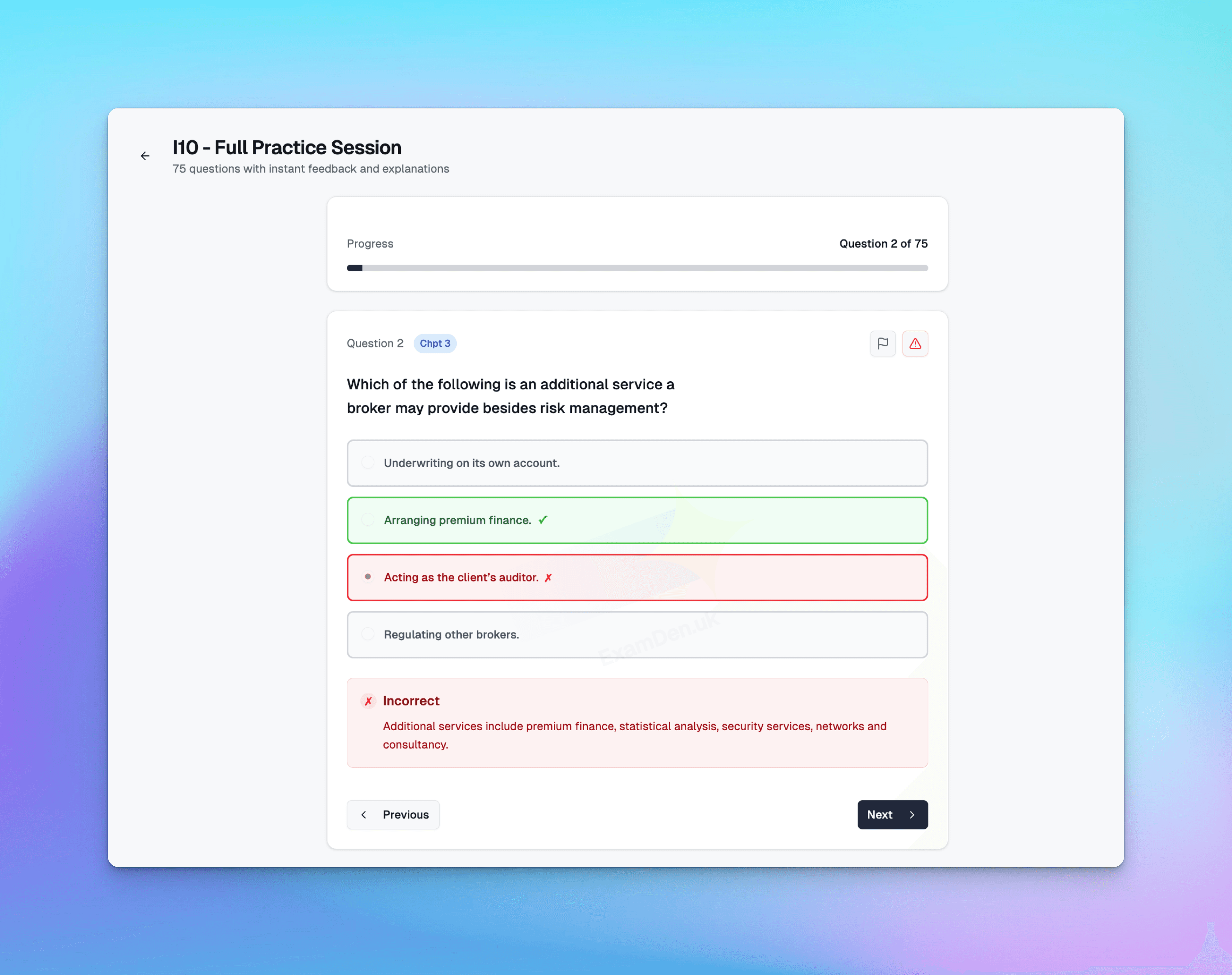
On ExamDen.uk, every question comes with a detailed explanation linked to the relevant learning outcome
🎯 Practise Like the Real Exam
ExamDen.uk tracks your score by learning outcome so you see exactly where you're losing marks. No more guessing which topics to revise.
Start I10 Practice →LO1: The Insurance Broking Market — 12 Questions (16%)
- Market structure. Lloyd's of London, the London company market, regional and national broking, direct insurance. How the subscription market works: the leading underwriter sets terms, following underwriters take lines on the same slip.
- Lloyd's. Syndicates (take the risk), managing agents (run syndicates), members' agents (represent Names), Lloyd's brokers (place risks). The slip, the signing process, the bureau. Only Lloyd's brokers can place risks directly at Lloyd's.
- Distribution chain. Client → retail broker → wholesale broker → insurer/Lloyd's. Each link adds a layer of expertise and access. Retail brokers know their clients; wholesale brokers know specialist markets.
- MGAs (Managing General Agents). Authorised by insurers to underwrite and sometimes handle claims. The MGA acts as agent of the insurer, not the client.
- Delegated authority. Binding authorities, line slips, consortia. The broker or MGA can bind cover within agreed parameters. The responsibilities that come with delegated authority (reporting, compliance, audit).
- Market trends. Consolidation (large broker groups acquiring smaller firms), insurtech, aggregators, embedded insurance, digital placement platforms.
LO5: Key Financial Issues — 12 Questions (16%)
- Client money. Holding premiums and claims money in trust. Statutory trust: money protected from creditors if the broker fails. Non-statutory trust (risk transfer): money belongs to the insurer from the point of receipt by the broker. Client money calculations.
- Broker remuneration. Commission: percentage of premium paid by the insurer. Fees: charged directly to the client. Profit commission: bonus from the insurer based on loss ratio. Contingent commission: linked to volume or profitability targets. Disclosure requirements.
- IPT. Insurance Premium Tax: standard rate (12%) and higher rate (20% for travel and some other classes). The broker collects IPT and accounts for it.
- Financial management. Cash flow management, debtor control, credit terms. The broker's obligation to remit premiums promptly. Errors and omissions: professional indemnity insurance.
- Risk transfer. When does the insurer become on risk? Cover notes, inception dates, binding authority terms. The implications for the broker and the client.
LO3: Contract and Agency — 6 Questions (8%)
- Agency. The broker is generally the agent of the insured. Under a binding authority, the broker acts as agent of the insurer for specific purposes (binding cover, issuing documentation). Disclosed agent: the third party knows the principal's identity. Undisclosed agent: the third party doesn't know.
- TOBAs. Client TOBA: sets out broker-client relationship, services, remuneration, complaints procedure. Broker-to-broker TOBA: sets out responsibilities between retail and wholesale brokers.
- Duty of care. The broker owes a common law duty to exercise reasonable skill and care. Standard: what a reasonably competent broker would do. Breach → professional negligence claim → professional indemnity (PI) insurance.
- Fiduciary duties. Act in the client's best interests. No secret profits. Full disclosure of material facts and any conflicts. Good faith.
LO6: Conduct and Culture — 10 Questions (13%, Case Studies)
All 10 LO6 questions are in Section B — the 2 case studies.
- FCA conduct rules. Acting with integrity. Acting with due skill, care and diligence. Being open and co-operative with the FCA. Paying due regard to customers' interests. Observing proper standards of market conduct.
- Consumer Duty. Delivering good outcomes: products and services, price and value, consumer understanding, consumer support. How brokers demonstrate compliance.
- Service excellence. Following procedures. Checking work. Accurate documentation. Timely communication. Learning from mistakes.
- Treating customers fairly (TCF). The predecessor to Consumer Duty and still embedded in conduct expectations. The 6 TCF outcomes.
- Conduct risk. How poor conduct harms clients, the firm and the market. Examples: mis-selling, non-disclosure, churning, conflicts of interest.
- Whistleblowing. When and how to raise concerns. The Public Interest Disclosure Act 1998. FCA whistleblowing requirements for firms. Protection against retaliation.
- Culture. How leadership, training, supervision, incentives and accountability shape behaviour. The role of a firm's culture in preventing conduct failures.
Case study approach: Read the scenario carefully. Identify what went wrong (the conduct failure). Think about what harm it causes (to the client, the firm, the market). Then pick the answer that aligns with the FCA conduct rules.
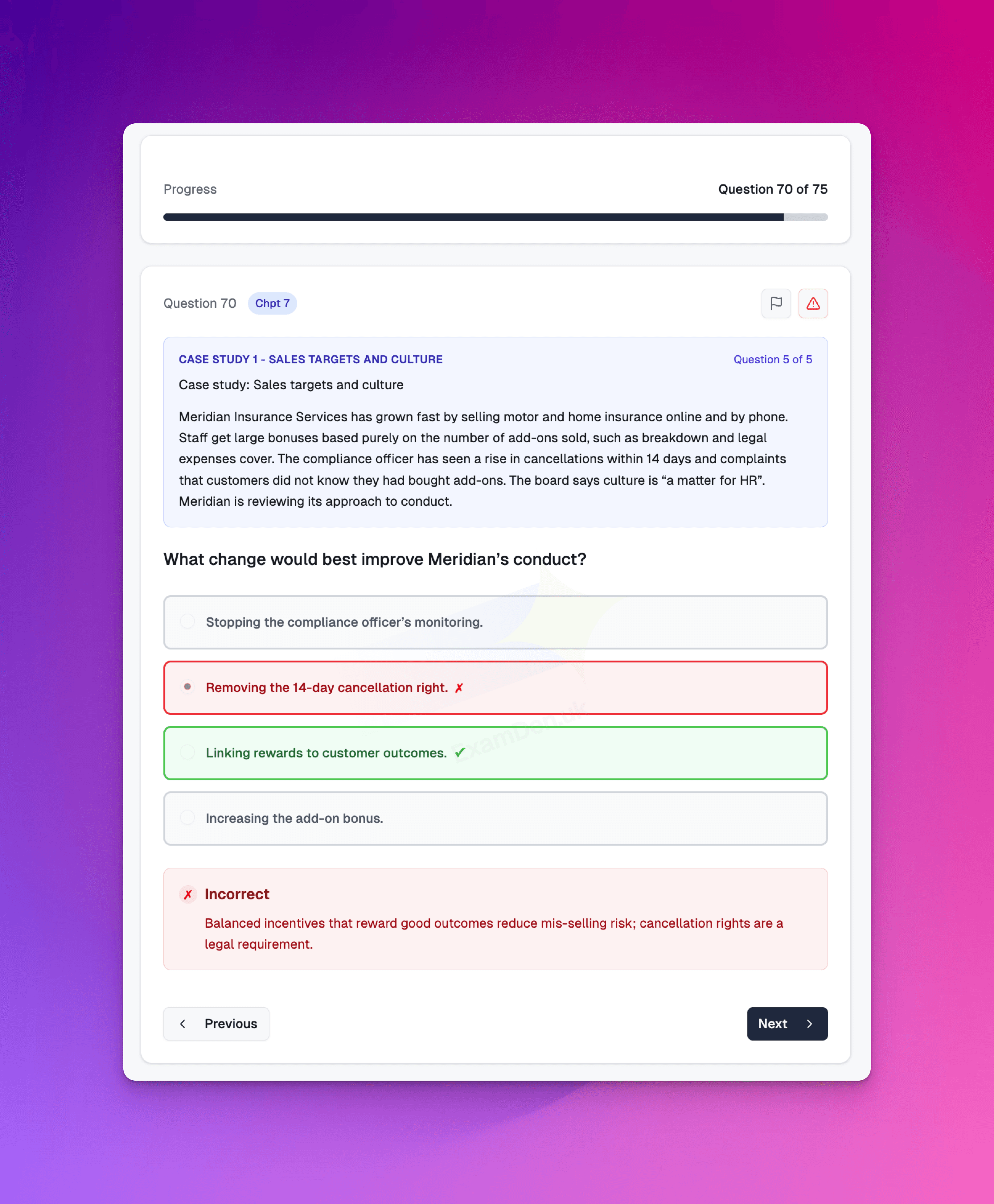
On ExamDen.uk, case study questions present a broking scenario with multiple linked questions, just like Section B of the real I10 exam
Final Revision Checklist
Before exam day, make sure you can:
- Explain the subscription market — leading underwriter, following lines, co-insurance
- Describe the broker's role from demands and needs through to claims
- Distinguish up-selling from cross-selling
- Explain when the broker is agent of the insured vs agent of the insurer
- Describe a TOBA — client TOBA and broker-to-broker TOBA
- Explain client money rules — statutory trust vs non-statutory trust
- Name the FCA conduct rules and give examples of each
- Explain the Consumer Duty and how it applies to broking
- Complete at least one full timed mock with case studies — 75 questions, 2 hours
- Practise at least 4 conduct case studies — building your scenario-reading technique
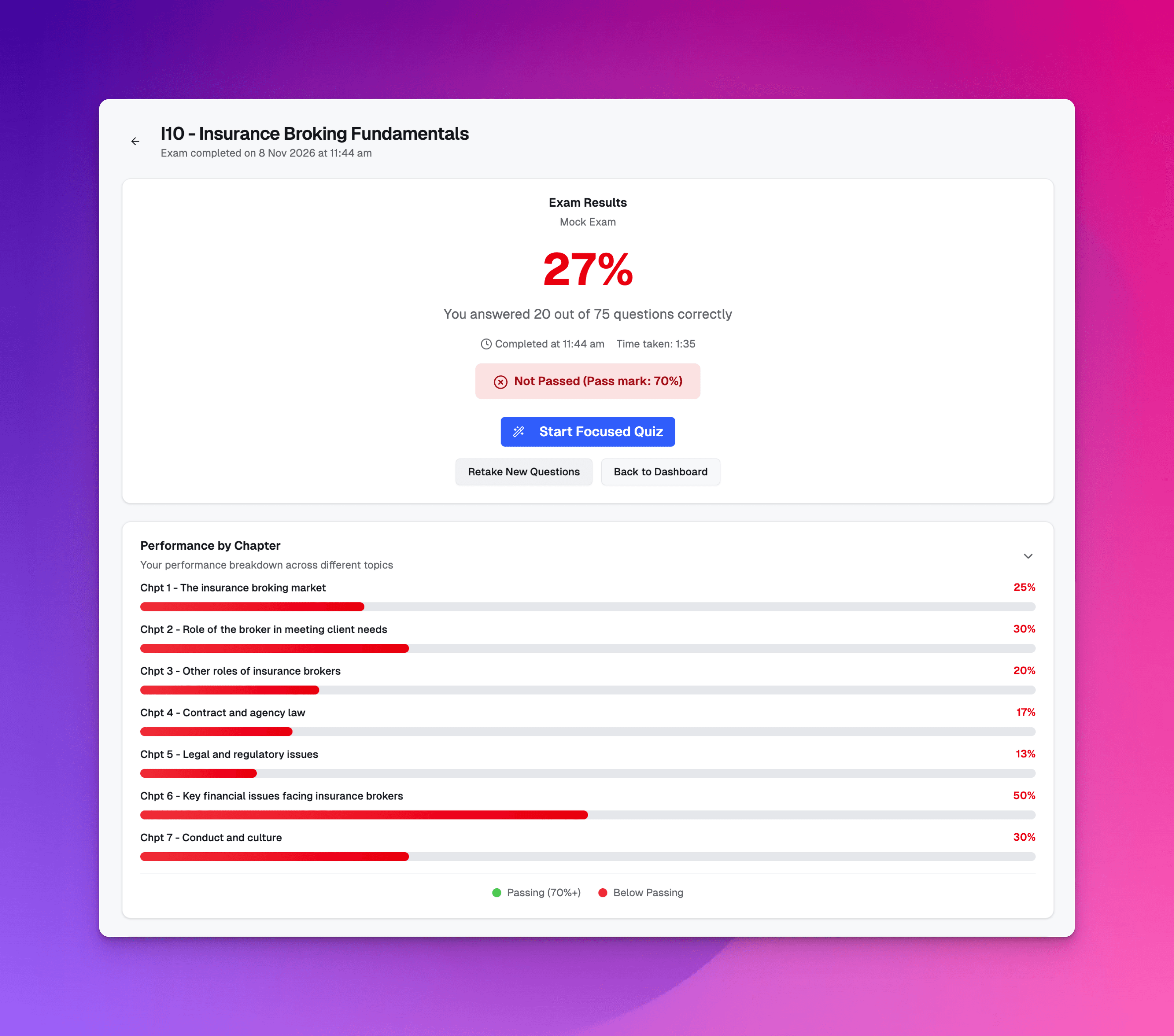
On ExamDen.uk, a timed mock shows your score against the 70% pass mark, and which learning outcomes are below it
For more on study strategy and common mistakes, see our I10 study guide. To start practising, visit ExamDen's I10 question bank.
I10 Revision FAQs
Ready to Put This Strategy Into Action? 💯
Revise smarter. Practise I10 by learning outcome — including conduct case studies — and let AI pinpoint the topics you need to revisit.

The ExamDen.uk Team
ExamDen.uk builds exam-style question banks and timed mocks for CeMAP, Cert CII and CII R01–R05, helping UK professionals prepare for their financial services exams.