How to Pass CII I10 (2026): Study Guide and Exam Tips
A practical guide to passing CII I10 — covering the exam format with case studies, all 6 learning outcomes, the 70% pass mark, insurance broking fundamentals and common mistakes.
I10 — Insurance Broking Fundamentals — is the broking practice unit of the Cert CII (Certificate in Insurance). It covers how insurance brokers operate — the market, their role and responsibilities, agency and contract, legal and regulatory requirements, financial management and professional conduct.
I10 includes case studies, but with a different format from IF5 and IF6. The exam has 65 standalone MCQs and 2 case studies with 5 questions each — and all 10 case study questions test LO6 (conduct and culture). So Section A tests your broking knowledge and Section B tests how you'd handle real-world conduct situations.
📋 I10 Quick Summary
- 75 questions in 2 hours: 65 standalone MCQs + 2 case studies × 5 questions
- Pass mark: 70% (at least 53 out of 75)
- 6 learning outcomes — LO1–LO5 tested in Section A, LO6 tested entirely through case studies
- Heaviest LO: LO2 (role and responsibilities) — 20 questions (27%)
- On-demand exam: book almost any day, sit at a test centre or online with a remote invigilator
I10 Exam Format
I10 has two sections:
Section A — 65 standard MCQs. These test your knowledge of the broking market, broker roles, agency, legal and regulatory issues and financial management. Each question stands alone.
Section B — 2 case studies, each followed by 5 MCQs. Each case study presents a broking scenario — a situation involving a broker, a client, an insurer or a conduct issue — and the questions test your ability to apply conduct and culture principles to that scenario. All 10 case study questions come from LO6.
All 75 questions are standard multiple-choice (pick one from four). There are no multiple-response questions. The pass mark is 70% — you need at least 53 out of 75 correct, meaning you can get 22 wrong. No marks are deducted for incorrect answers, so always attempt every question.
The exam is 2 hours — 96 seconds per question on average.
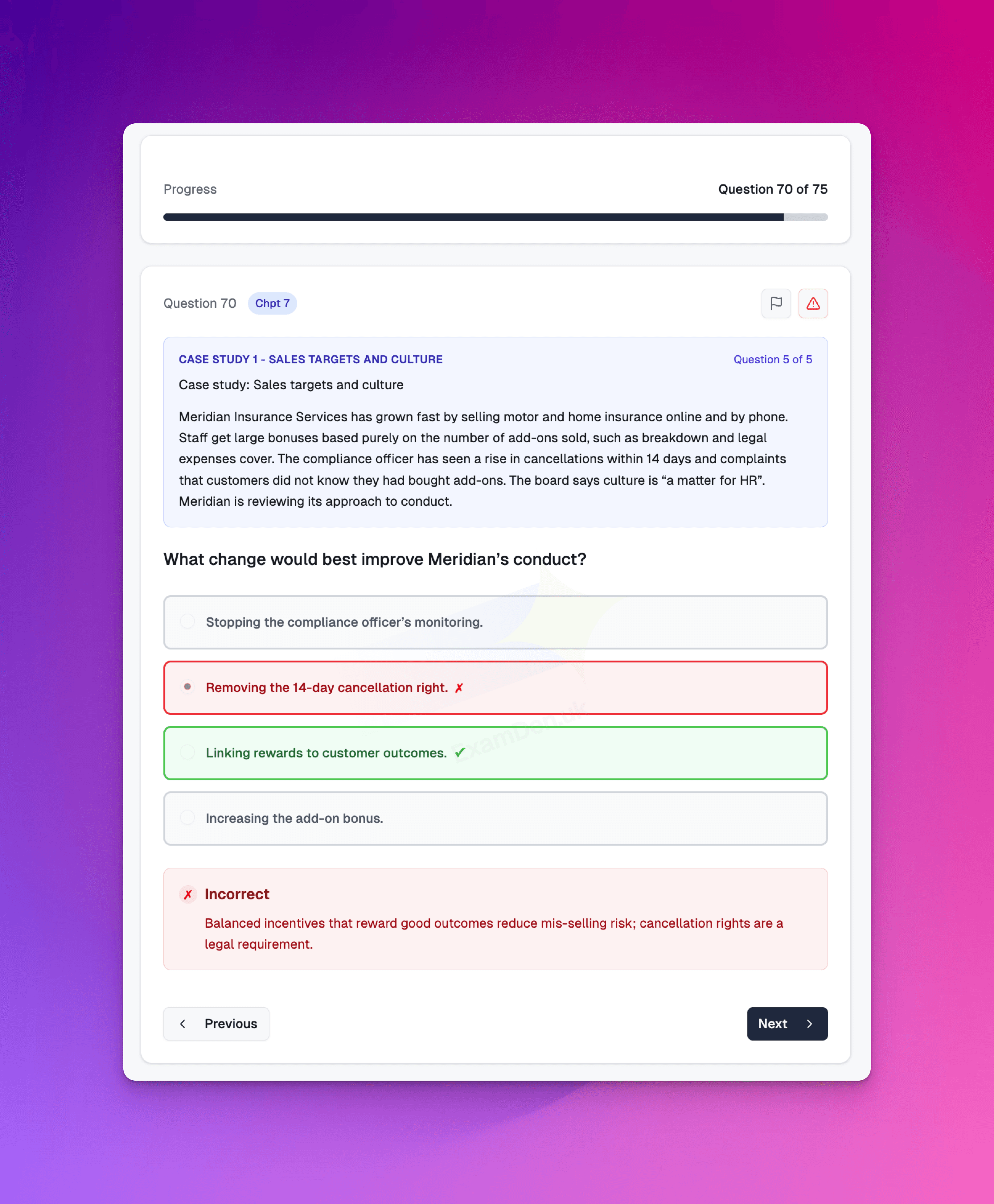
On ExamDen.uk, case study questions present a broking scenario with multiple linked questions, just like Section B of the real I10 exam
Question Distribution by Learning Outcome
| LO | Topic | Questions | % of exam |
|---|---|---|---|
| 2 | Role and responsibilities of the insurance broker | 20 | 27% |
| 4 | Key legal and regulatory issues | 15 | 20% |
| 1 | The insurance broking market | 12 | 16% |
| 5 | Key financial issues | 12 | 16% |
| 6 | Conduct and culture (case studies) | 10 | 13% |
| 3 | Contract and agency | 6 | 8% |
LO2 (role and responsibilities) is the largest at 27% — over a quarter of the exam. Combined with LO4 (legal and regulatory), the top two LOs account for 35 out of 75 questions (47%).
---
LO2: Role and Responsibilities — 20 Questions (27%)
The largest learning outcome. It covers what brokers actually do, from client engagement to claims.
What it tests:
- Demands and needs. Establishing the client's insurance requirements. The difference between advised and non-advised sales. Demands and needs statements.
- Placement. The placement process — presenting the risk to insurers, obtaining quotations, comparing terms, binding cover. Open market vs facilities/schemes.
- Documentation. Policy summaries, insurance product information documents (IPIDs), certificates of insurance, cover notes. What must be provided and when.
- Renewals. The renewal process, invitation to renew, reviewing cover, mid-term adjustments. FCA rules on renewal pricing transparency.
- Claims. The broker's role in claims — notification, progress chasing, claims advocacy. The difference between the broker's role and the insurer's role.
- Up-selling and cross-selling. Up-selling: increasing the cover on an existing product. Cross-selling: offering additional, different products. When each is appropriate and the conduct implications.
- Wholesale and retail broking. How the distribution chain works. Retail brokers dealing directly with clients, wholesale/London brokers accessing specialist markets. Lloyd's brokers.
Study approach: LO2 is broad but practical. Focus on the broker's workflow from initial client contact through to claims. Know the difference between advised and non-advised sales, and understand up-selling vs cross-selling.
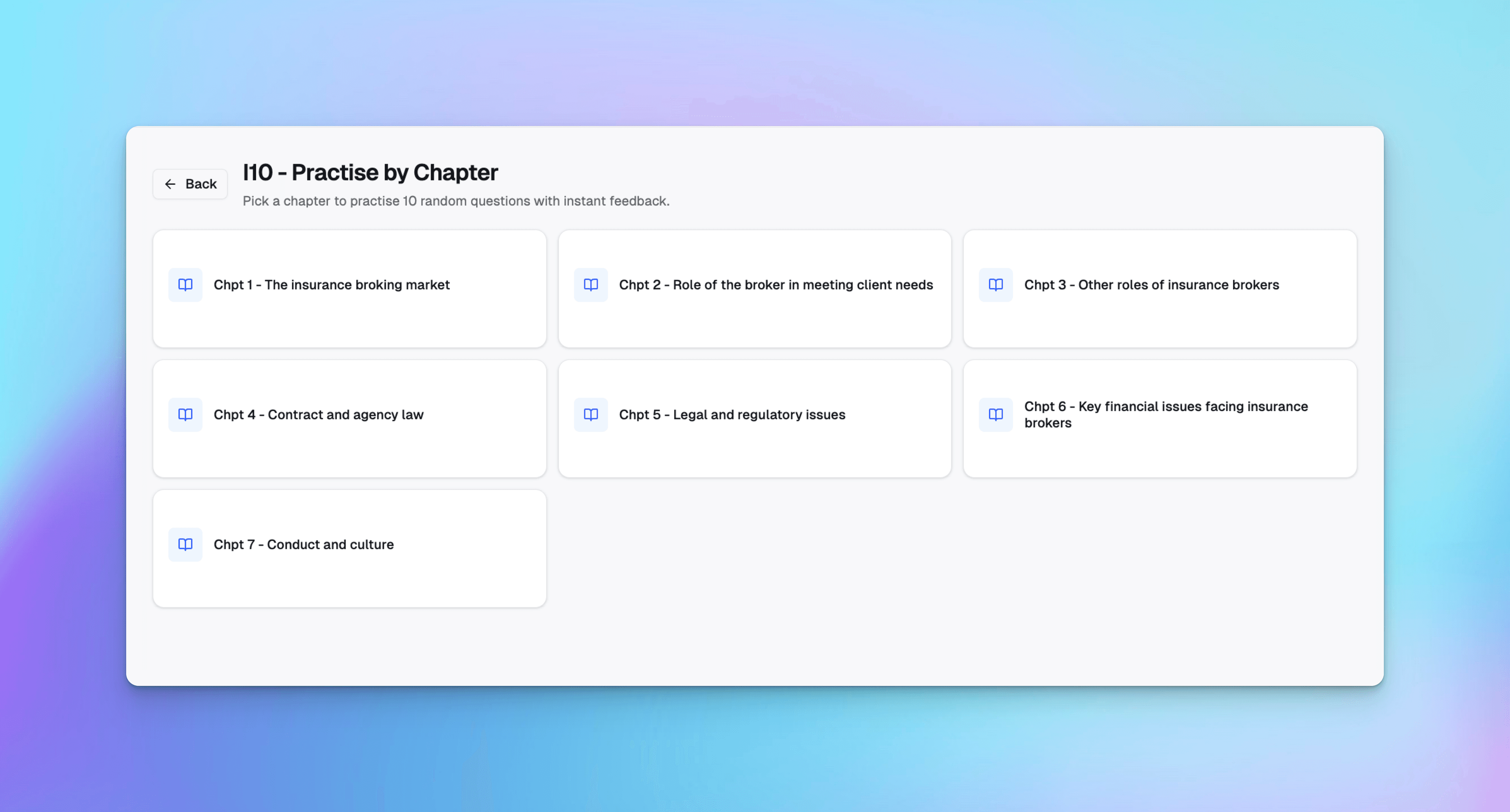
On ExamDen.uk, practise one learning outcome at a time, then sit a full mock in the real two-section format
LO4: Legal and Regulatory Issues — 15 Questions (20%)
What it tests:
- FCA regulation. Authorisation, permissions, the regulatory perimeter. ICOBS (Insurance Conduct of Business Sourcebook). The Insurance Distribution Directive (IDD).
- Senior Managers and Certification Regime (SM&CR). Senior Manager Functions, Certification Functions, conduct rules. Individual accountability.
- Client money. FCA client money rules (CASS). Segregation of client money, statutory trust, non-statutory trust. Client money calculations.
- Data protection. GDPR principles, lawful basis for processing, data subject rights. How brokers handle client data.
- Complaints handling. FCA rules: internal procedures, timelines (8 weeks), Financial Ombudsman Service. Root cause analysis.
- Financial crime. Money laundering, sanctions, fraud. The broker's obligations under the Proceeds of Crime Act and the Money Laundering Regulations.
- Conflicts of interest. Identifying, managing and disclosing conflicts. The broker's duty to act in the client's best interests.
Study approach: LO4 overlaps significantly with IF1's regulatory content but applies it specifically to broking. If you've done IF1, much of this will feel familiar.
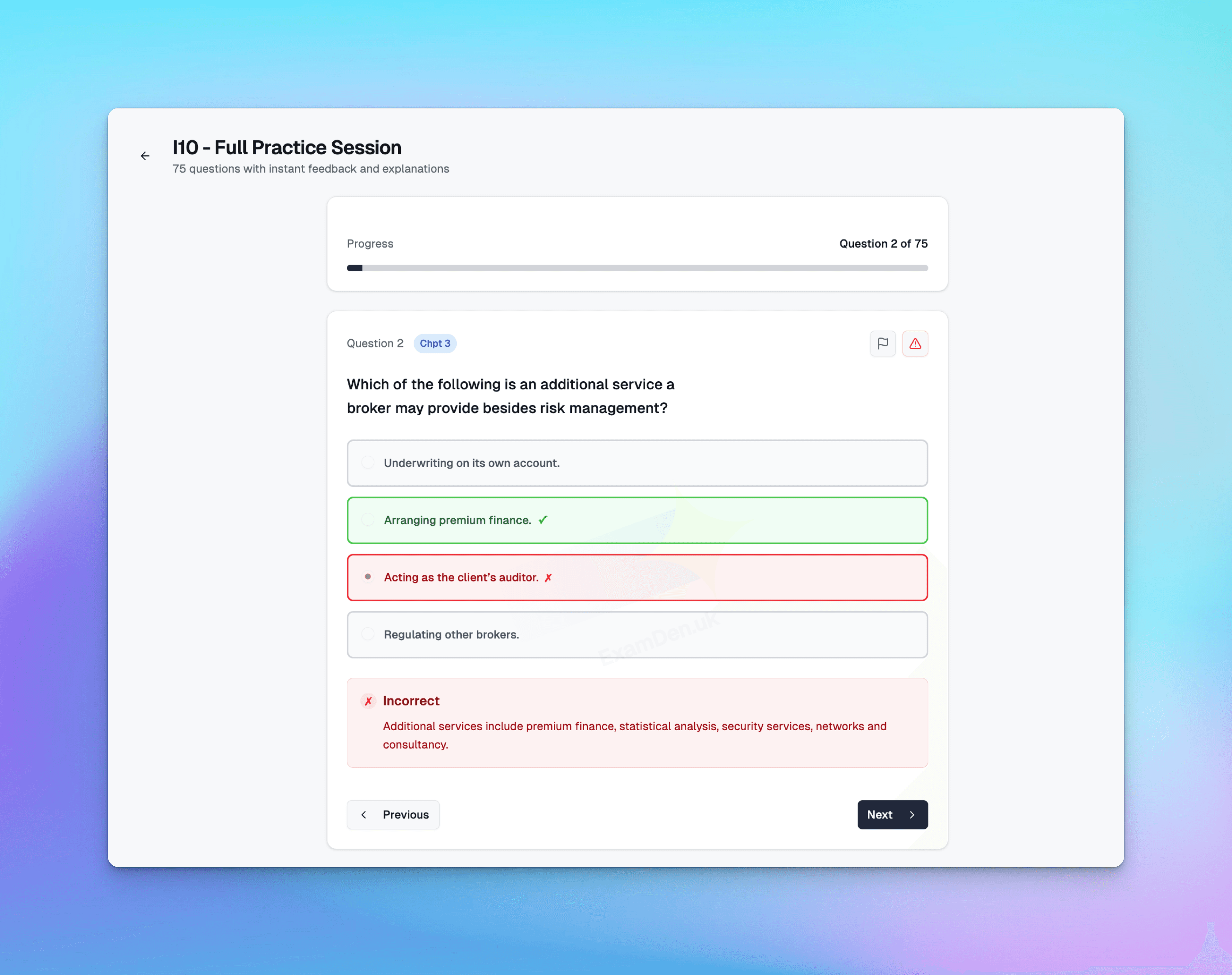
On ExamDen.uk, every question comes with a detailed explanation linked to the relevant learning outcome
🎯 Practise Like the Real Exam
ExamDen.uk tracks your score by learning outcome so you see exactly where you're losing marks. No more guessing which topics to revise.
Start I10 Practice →LO1: The Insurance Broking Market — 12 Questions (16%)
What it tests:
- Market structure. Lloyd's of London, the London market, regional broking, direct insurance. How the subscription market works — co-insurance, leading underwriter, following lines.
- Distribution channels. Retail brokers, wholesale brokers, Lloyd's brokers, MGAs (managing general agents), aggregators. The role of each in the distribution chain.
- Lloyd's. The Lloyd's market: syndicates, managing agents, members' agents, Lloyd's brokers. How risks are placed at Lloyd's. The subscription market and slip.
- Delegated authority. Binding authorities, line slips, consortia. What delegated authority means and the broker's responsibilities under it.
- Market trends. Consolidation, insurtech, digital distribution, embedded insurance.
LO5: Key Financial Issues — 12 Questions (16%)
What it tests:
- Client money. Holding client money in trust. Statutory trust vs non-statutory trust. Segregation requirements. Client money calculations.
- Broker remuneration. Commission (percentage of premium), fees (charged to client), profit commission, contingent commission. Disclosure requirements for remuneration.
- Insurance Premium Tax (IPT). The broker's role in collecting and accounting for IPT. Standard rate vs higher rate.
- Financial management. Cash flow, debtor management, credit control. The broker's obligation to pay premiums to insurers promptly.
- Risk transfer. When does the risk transfer from the client to the insurer? The significance of the inception date, cover notes and binding authority.
LO3: Contract and Agency — 6 Questions (8%)
- Agency. The broker as agent of the insured (general principle). Exceptions: when the broker acts as agent of the insurer (e.g. under a binding authority). Disclosed and undisclosed principals.
- Terms of business agreements (TOBAs). The contract between broker and client setting out responsibilities, remuneration and complaints procedures. TOBAs between retail and wholesale brokers.
- Duty of care. The broker's common law duty to exercise reasonable skill and care. Professional indemnity implications.
- Fiduciary duties. The duty to act in the client's best interests. Avoiding secret profits. Full disclosure of material facts.
LO3 is only 6 questions, but it tests fundamental legal principles that underpin everything else. Know the agency relationships cold.
LO6: Conduct and Culture — 10 Questions (13%, Case Studies)
All 10 LO6 questions are in Section B — the 2 case studies. Each case study presents a broking scenario with conduct implications.
What it tests:
- Service excellence. Following procedures, checking work, acting professionally. What good service looks like in practice.
- Treating customers fairly. The FCA's Consumer Duty and fair outcomes. How brokers demonstrate fair treatment.
- Due skill, care and diligence. The FCA conduct rule requiring competence and thoroughness. What happens when staff cut corners.
- Conduct risk. How poor conduct (skipping checks, failing to disclose, mis-selling) creates risk for the firm, its clients and its reputation.
- Whistleblowing. When and how to raise concerns about conduct. Protection for whistleblowers.
- Culture. How the firm's culture drives behaviour. The role of leadership, training, supervision and incentives.
Study approach: LO6 case studies test application, not just knowledge. Practise reading scenarios and identifying: what went wrong, what the consequences are, and what the broker should do. The case studies often involve staff not following procedures — think about why the procedure exists and what harm the shortcut causes.
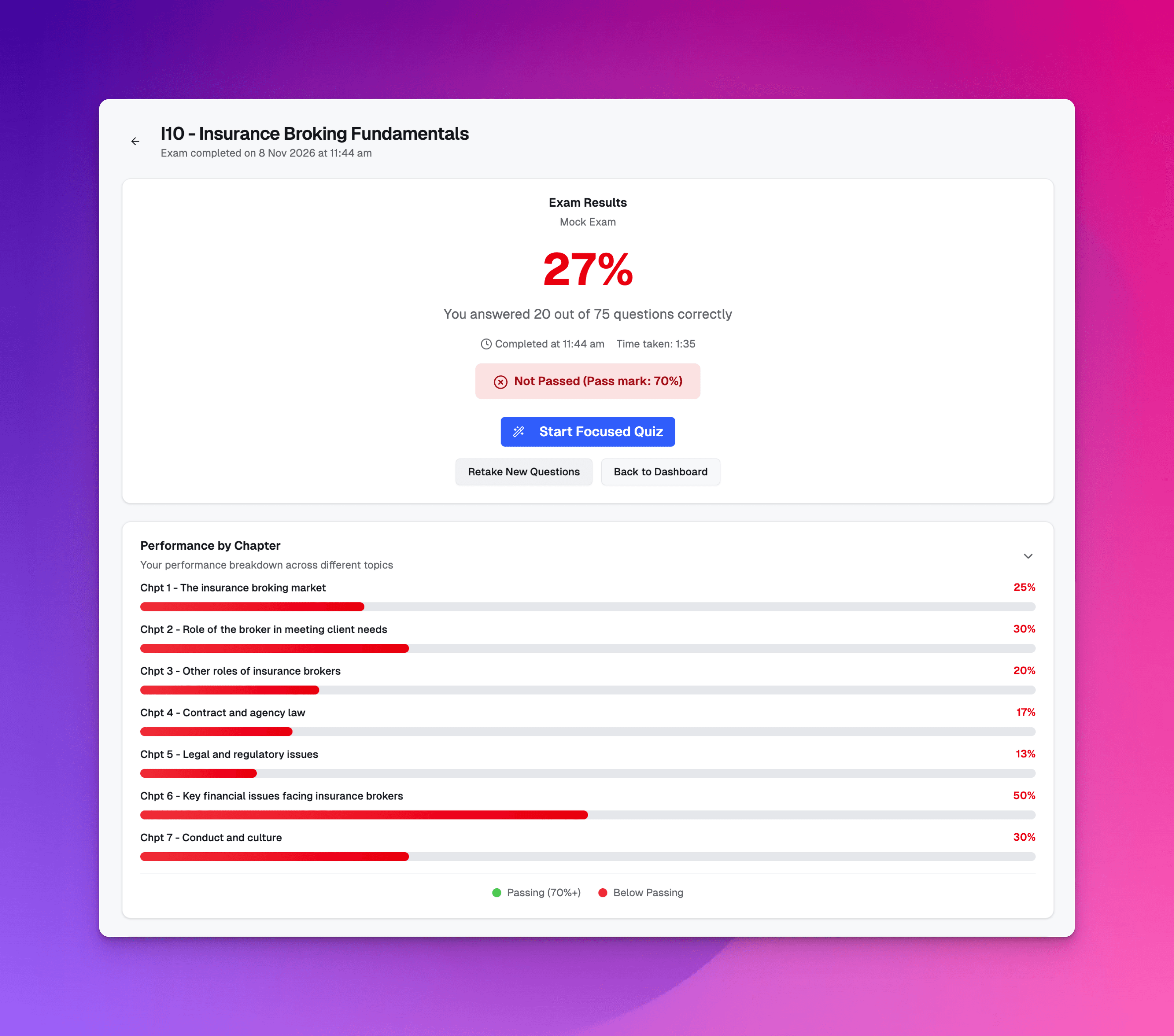
On ExamDen.uk, a timed mock shows your score against the 70% pass mark, and which learning outcomes are below it
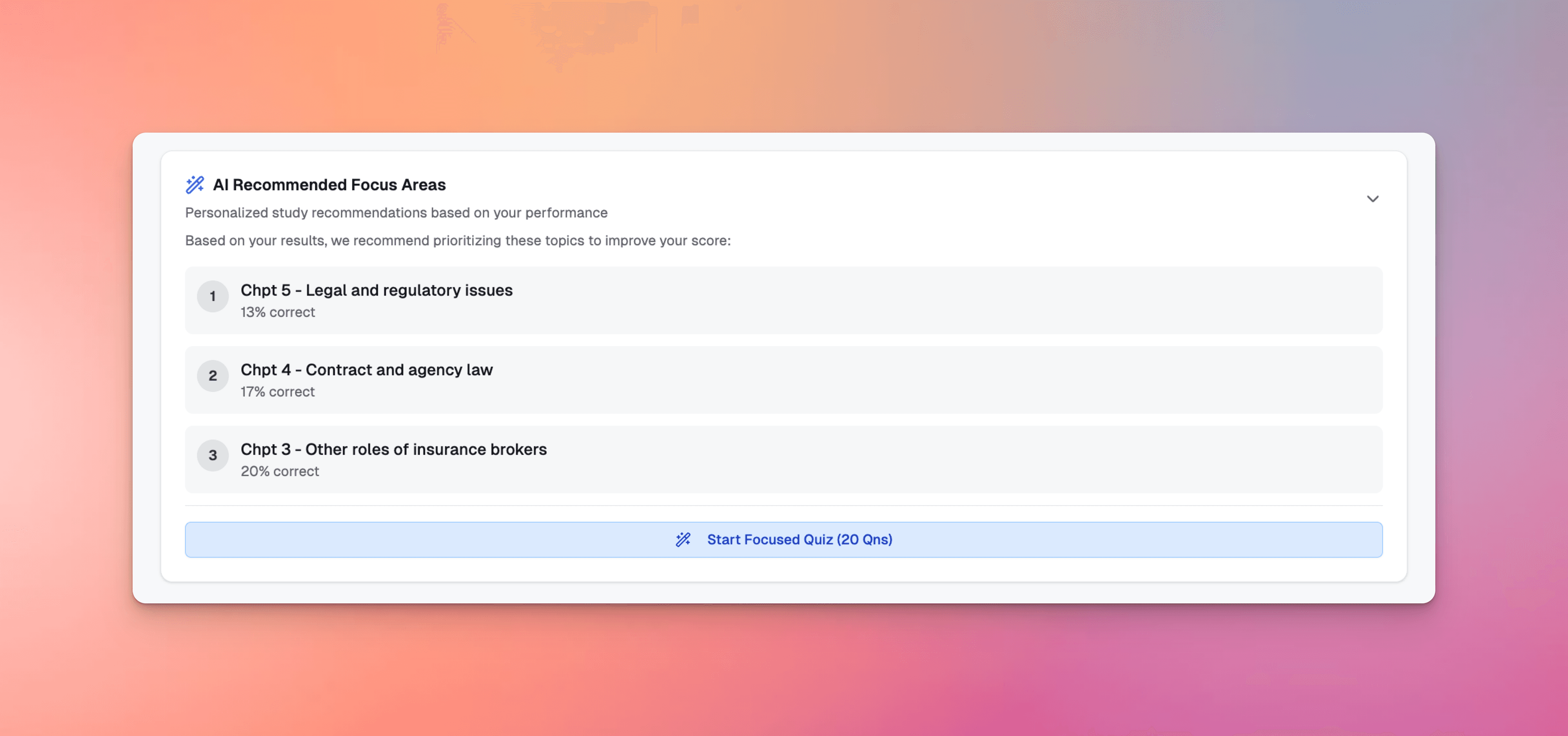
On ExamDen.uk, those weak learning outcomes become a short focus list for your next revision session
Common Mistakes That Cost Marks
1. Neglecting LO6 (conduct and culture).
LO6 is "only" 10 questions, but they're all case studies — and case studies require a different technique from standalone MCQs. If you haven't practised conduct scenarios, you'll struggle with Section B.
2. Confusing agency relationships.
The broker is usually the agent of the insured, not the insurer. But under a binding authority, the broker acts as agent of the insurer for certain purposes. Know when the agency relationship switches.
3. Not knowing client money rules.
Client money, statutory trust, segregation — these are tested in both LO4 and LO5. Know the principles and the practical requirements.
4. Mixing up up-selling and cross-selling.
Up-selling increases the level of cover on an existing product. Cross-selling offers a different product. The distinction matters for conduct — both must meet the client's demands and needs.
5. Underestimating the breadth of LO2.
LO2 is 20 questions (27%) covering everything from demands and needs to claims handling. It's easy to skim over it because the content seems practical, but the exam tests specific procedures and requirements.
How I10 Fits Into the Cert CII
I10 is the broking practice unit in the CII Certificate in Insurance (Cert CII). It's particularly relevant for anyone working in or moving into insurance broking, whether retail, wholesale or London market.
The legal and regulatory knowledge from IF1 provides useful background — LO4 in I10 overlaps with IF1's regulatory content but applies it specifically to broking. The product knowledge from IF2 helps with understanding placement and client needs. If you're interested in the broader risk management context, see our I11 study guide.
Start Practising
The fastest way to know whether you're ready for I10 is to take a timed mock — including the case studies. ExamDen's I10 question bank has hundreds of exam-style questions in both Section A and Section B format, with AI that pinpoints which learning outcomes you need to work on.
Want to try a few questions first? Here are 6 free I10 mock questions with answers — including a case study. If you're looking for past papers, read why the CII doesn't release them, and what to use instead.
For registration, fees and booking, see our guide to registering for CII exams.
CII I10 FAQs
Ready to Put This Strategy Into Action? 💯
Practise with exam-style I10 questions, timed mocks, case studies and AI that shows you which learning outcomes to revise.

The ExamDen.uk Team
ExamDen.uk builds exam-style question banks and timed mocks for CeMAP, Cert CII and CII R01–R05, helping UK professionals prepare for their financial services exams.