CII IF1 Revision Guide (2026): Learning Outcomes and Exam Tips
CII IF1 revision guide: every learning outcome explained with question counts, priority topics and exam tips for the Insurance, Legal and Regulatory exam.

This IF1 revision guide covers every learning outcome in the exam, in order of question weight. Use it during your final revision to check that you've covered each topic and know where to focus your remaining study time.
For a broader study plan and common mistakes, see our complete IF1 study guide. For practice questions, try these 5 free IF1 mock questions.
📋 IF1 Exam Recap
- 100 standard MCQs in 2 hours
- Pass mark: 70% (at least 70 out of 100)
- 14 learning outcomes
- No MR questions and no complex calculations
---
LO11: Regulatory and Legal Requirements — 15 Questions (15%)
The biggest learning outcome. Focus on:
- FCA objectives and principles. The FCA's three operational objectives (consumer protection, market integrity, competition). The 12 principles for businesses — especially Principle 6 (treating customers fairly) and Principle 11 (relations with regulators).
- SM&CR. Senior management functions, certification functions. The individual conduct rules: act with integrity, act with due skill and care, be open with regulators, pay due regard to customers, observe proper standards of market conduct.
- IDD requirements. Demands and needs, suitability requirements for advised sales, product governance rules, remuneration disclosure, conflicts of interest.
- AML. Customer due diligence (CDD), enhanced due diligence (EDD), suspicious activity reports (SARs), the Money Laundering Reporting Officer (MLRO), tipping off.
- Data protection. The seven GDPR principles, lawful bases for processing, data subject rights, breach notification.
- Financial sanctions. Firms must screen against HM Treasury's sanctions list. Dealing with a sanctioned person is a criminal offence.
Quick test: Can you list all five individual conduct rules? Can you explain the difference between CDD and EDD? If not, revise this LO.
LO4: Insurance Market Structure — 14 Questions (14%)
- Lloyd's of London. Syndicates, managing agents, members' agents, the Corporation of Lloyd's (market oversight, not risk-bearing). How a Lloyd's policy is placed and subscribed.
- Company market. Proprietary insurers, mutual insurers, captive insurers. How they differ from Lloyd's.
- Intermediaries. Brokers (act for the client), agents (act for the insurer), MGAs (binding authority from insurers), comparison websites. The legal distinction between broker and agent.
- Reinsurance. Proportional (quota share, surplus) vs non-proportional (excess of loss, stop loss). Treaty vs facultative. Why insurers buy reinsurance.
- Other market participants. Loss adjusters, loss assessors, actuaries, risk surveyors, run-off managers.
Quick test: Can you explain the difference between a broker and an agent in insurance law? Can you distinguish quota share from excess of loss reinsurance?
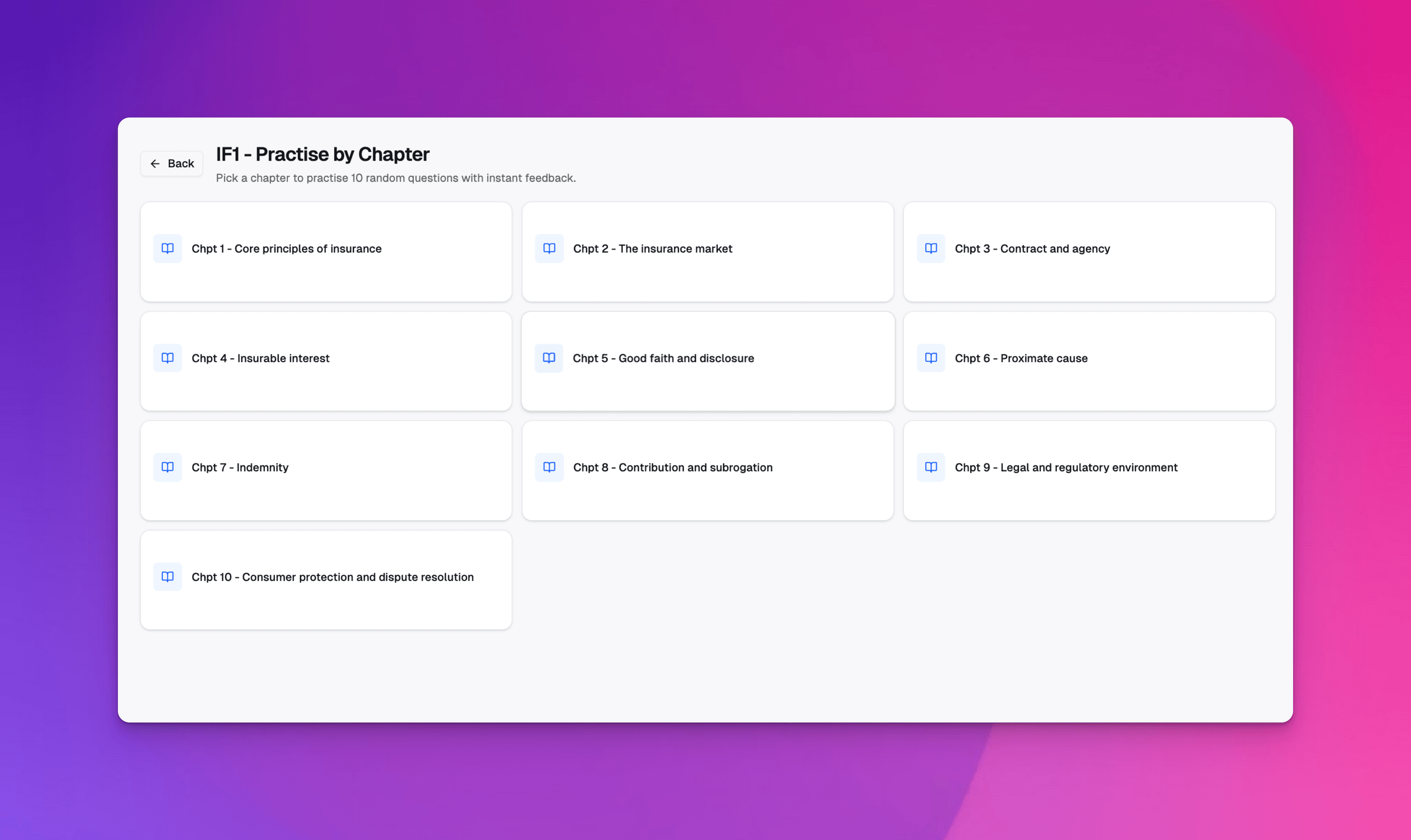
On ExamDen.uk, practise one learning outcome at a time, then sit a full mock in the real question count and time limit
LO7: Good Faith — 11 Questions (11%)
- Duty of fair presentation (Insurance Act 2015). The insured must disclose every material circumstance they know or ought to know. They must make the disclosure in a "reasonably clear and accessible manner."
- Material facts. Anything that would influence a prudent insurer's decision to accept the risk or set the terms.
- Remedies for non-disclosure. Deliberate/reckless = insurer can avoid the contract. Innocent = proportionate remedy (what the insurer would have done had it known).
- Warranties. A warranty is a term that must be exactly complied with. Under the 2015 Act, breach suspends cover; it no longer automatically discharges the insurer. Cover resumes if the breach is remedied.
- Basis of the contract clauses. Prohibited under the Insurance Act 2015.
- The Consumer Insurance (Disclosure and Representations) Act 2012. For consumer insurance, the duty is to take reasonable care not to make a misrepresentation (not a duty of disclosure).
Quick test: What's the difference between the duty of fair presentation (commercial) and the duty under the 2012 Act (consumer)?
LO1: Nature and Features of Risk — 9 Questions (9%)
- Risk classification. Pure risk (loss only) vs speculative risk (loss or gain). Fundamental risk (affects society) vs particular risk (affects individuals).
- Insurable risk. Large number of similar exposures, fortuitous, definite and measurable, not catastrophic, calculable probability, economically feasible premium.
- Hazards. Physical hazard (physical conditions that increase risk), moral hazard (dishonesty/intent to gain), morale hazard (carelessness/indifference).
- Peril. The cause of loss (fire, theft, flood). Distinguish peril from hazard.
LO5: Contract and Agency — 9 Questions (9%)
- Contract essentials. Offer, acceptance, consideration, capacity, legality, intention to create legal relations.
- Insurance contract specifics. Proposal, quotation, cover note, policy. When the contract is formed. Cooling-off periods.
- Agency. Actual authority, apparent (ostensible) authority, implied authority, ratified authority. The agent's duties: obedience, care, good faith, accounting. Vicarious liability.
- Binding authority. The authority given to an intermediary (e.g. a broker or MGA) to enter into insurance contracts on behalf of the insurer.
🎯 Practise Like the Real Exam
ExamDen.uk tracks your score by learning outcome so you see exactly where you're losing marks. No more guessing which topics to revise.
Start IF1 Practice →LO3: Main Features of Insurance — 8 Questions (8%)
- Function of insurance. Risk transfer, risk pooling, the law of large numbers.
- Types of insurance. Life vs general. Long-term vs short-term. Personal lines vs commercial lines. First-party (own loss) vs third-party (liability to others).
- Insurance products overview. Motor, property, liability, marine, aviation, cyber, life, health. Know the purpose and basic structure of each class.
- Policy structure. Proposal form, policy schedule, operative clause, conditions, exclusions, endorsements. What each part does.
LO9: Indemnity — 7 Questions (7%)
- The principle of indemnity. The insured should be restored to the same financial position they were in immediately before the loss — no better, no worse.
- Methods of indemnity. Cash payment, repair, replacement, reinstatement. When each is used.
- Measuring indemnity. Market value, reinstatement value, new-for-old. The effect of under-insurance and average clauses.
- Exceptions to indemnity. Valued policies (marine, fine art), new-for-old household policies, life assurance (benefit, not indemnity).
- Salvage. The insurer's right to the remains of insured property after paying a total loss.
LO12: Consumer Protection and Dispute Resolution — 6 Questions (6%)
- The Financial Ombudsman Service (FOS). Who can complain, time limits, the ombudsman's powers, binding decisions, compensation limits.
- The Financial Services Compensation Scheme (FSCS). When it applies (insurer insolvency), coverage limits, how claims are handled.
- Consumer duty. The FCA's Consumer Duty (from July 2023): delivering good outcomes, fair value, consumer understanding, consumer support.
- Treating Customers Fairly (TCF). The six consumer outcomes.
LO6: Insurable Interest — 5 Questions (5%)
- Definition. A legally recognised relationship between the insured and the subject matter of insurance, such that the insured would suffer a financial loss if the insured event occurred.
- When it must exist. For life assurance: at inception. For general insurance: at inception and at the time of loss (common law position).
- Examples. Owner in property, mortgagee in mortgaged property, employer in employee (employer's liability), trustee in trust assets.
- Statutory insurable interest. Married couples and civil partners have unlimited insurable interest in each other's lives.
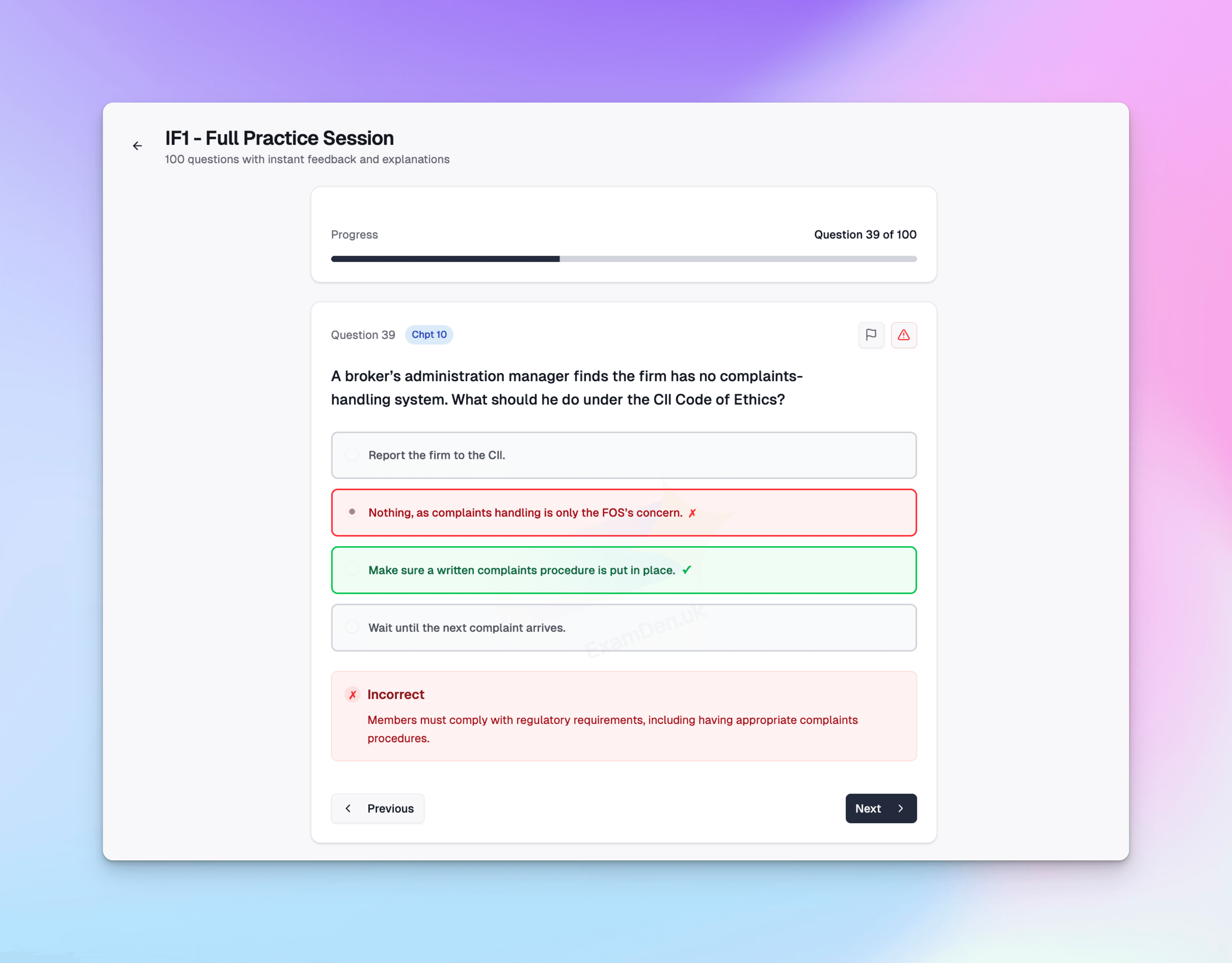
On ExamDen.uk, every question comes with a detailed explanation linked to the relevant learning outcome
LO10: Contribution and Subrogation — 4 Questions (4%)
- Contribution. When two or more policies cover the same loss, each insurer pays a share. Methods: rateable proportion, independent liability. Only applies to contracts of indemnity.
- Subrogation. The insurer's right to recover from a negligent third party after paying a claim. Arises at common law after payment. Policy conditions often allow pre-payment action.
- Subrogation and the insured. The insured cannot profit — if recovery exceeds the loss, the surplus goes to the insurer (after the insured's excess/uninsured portion).
LO13: Consumer Complaints — 4 Questions (4%)
- Internal complaints handling. FCA rules require firms to have a written procedure, acknowledge complaints promptly, and provide a final response within 8 weeks.
- Referring to FOS. If the firm's final response is unsatisfactory (or no response within 8 weeks), the complainant can refer to the Financial Ombudsman Service.
- Root cause analysis. Firms must identify patterns in complaints and address the underlying causes.
LO14: CII Code of Ethics — 4 Questions (4%)
- The five principles. Comply with the Code, act with the highest ethical standards, act in the best interests of each client, provide a high standard of service, treat people fairly.
- Application. The Code applies to all CII members, students and associates. Breaches can result in disciplinary action.
- Scenarios. The exam tests application of the principles to non-complex scenarios — e.g. a conflict of interest, a pressure to sell an unsuitable product.
LO2: Risk Management Application — 2 Questions (2%)
- Risk management process. Identify, analyse, evaluate, treat, monitor. The risk management cycle.
- Risk treatment options. Avoid, reduce, transfer (insurance), retain (self-insurance, deductibles, captives). Choosing the appropriate response.
LO8: Proximate Cause — 2 Questions (2%)
- The doctrine. The proximate cause is the dominant or effective cause of the loss — not necessarily the last event in the chain.
- Application. If the proximate cause is an insured peril, the claim is payable. If it's an excluded peril, it's not. If there are concurrent causes, the rules depend on whether the causes are independent or interdependent.
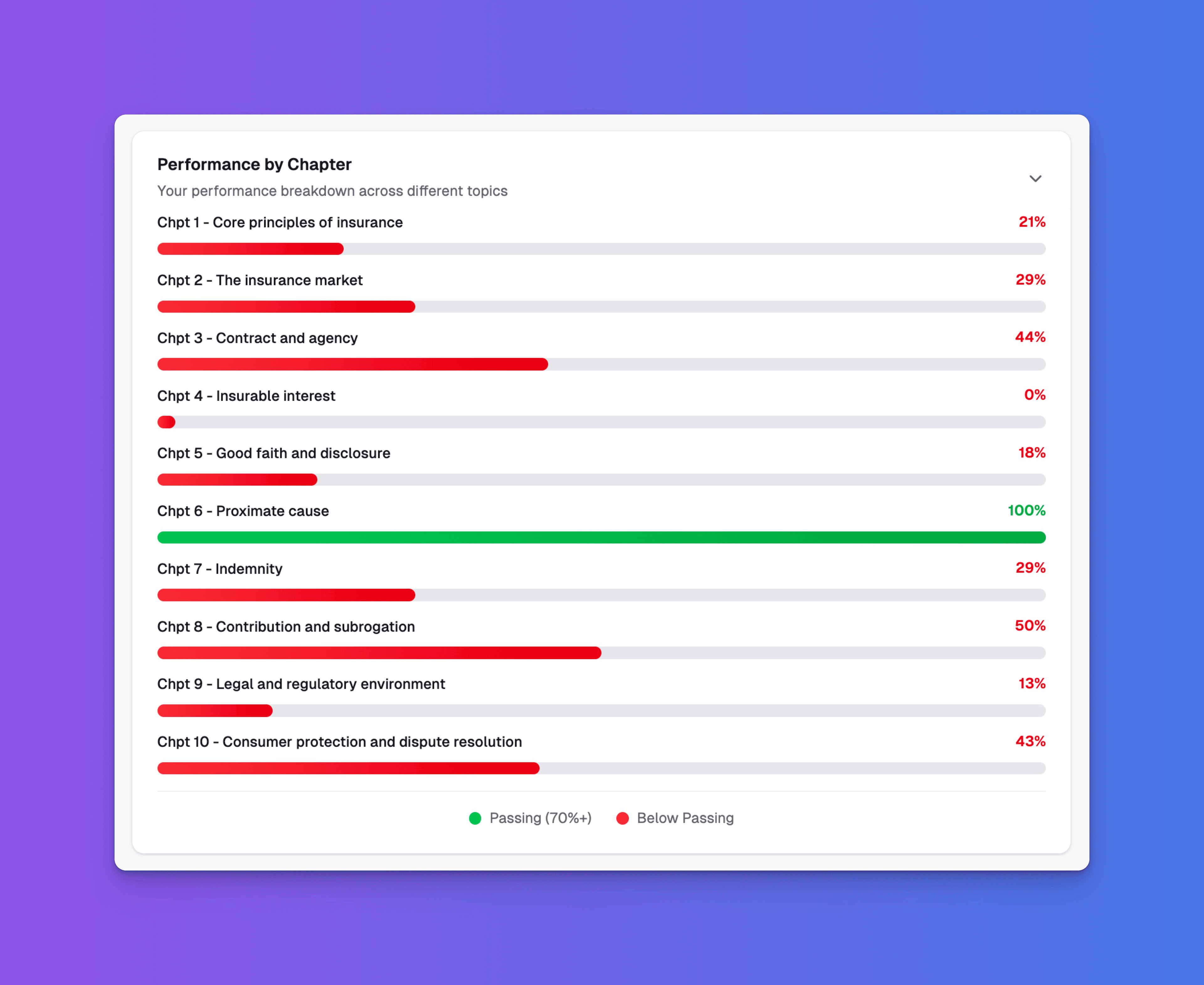
On ExamDen.uk, a timed mock shows your score against the 70% pass mark, and which learning outcomes are below it
Final Revision Checklist
Before exam day, make sure you can:
- List and distinguish all six insurance principles — insurable interest, good faith, proximate cause, indemnity, contribution, subrogation
- Explain the Insurance Act 2015 changes — duty of fair presentation, proportionate remedies, breach of warranty
- Name the five SM&CR individual conduct rules
- Describe the Lloyd's market structure — syndicates, managing agents, Corporation
- Distinguish types of reinsurance — proportional vs non-proportional, treaty vs facultative
- Explain the FOS and FSCS — who can complain, compensation limits, when FSCS applies
- Apply the CII Code of Ethics to a simple scenario
- Sit at least one full timed mock under exam conditions — 100 questions, 2 hours
For more on study strategy and common mistakes, see our IF1 study guide. To start practising, visit ExamDen's IF1 question bank.
IF1 Revision FAQs
Ready to Put This Strategy Into Action? 💯
Revise smarter. Practise IF1 by learning outcome and let AI pinpoint the topics you need to revisit.

The ExamDen.uk Team
ExamDen.uk builds exam-style question banks and timed mocks for CeMAP, Cert CII and CII R01–R05, helping UK professionals prepare for their financial services exams.