CII IF4 Revision Guide (2026): Learning Outcomes and Exam Tips
CII IF4 revision guide: every learning outcome explained with question counts, priority topics and exam tips for the Insurance Claims Handling Process exam.
This IF4 revision guide covers every learning outcome in the exam, in order of question weight. Use it during your final revision to check that you've covered each topic and know where to focus your remaining study time.
For a broader study plan and common mistakes, see our complete IF4 study guide. For practice questions, try these 5 free IF4 mock questions.
📋 IF4 Exam Recap
- 75 standard MCQs in 2 hours — 96 seconds per question
- Pass mark: 70% (at least 53 out of 75)
- 7 learning outcomes — very even distribution
- No MR questions. Some calculations
---
LO2: Insurance Products and Associated Services — 13 Questions (17%)
- Motor claims. Third-party only, TPFT, comprehensive. Total loss categories: S (structural — repairable but recorded), N (non-structural — repairable). Knock-for-knock agreements between insurers. Credit hire claims. MIB claims for uninsured and untraced drivers.
- Property claims. Buildings: reinstatement basis (cost of rebuilding). Contents: indemnity (market value) or new-for-old. Stock: cost price or selling price depending on policy terms. Business interruption: gross profit method, increased cost of working, indemnity period.
- Liability claims. Employers' liability: long-tail claims (asbestos, industrial disease), the Compensation Act 2006. Public liability: duty of care, breach, causation, remoteness. Products liability: Consumer Protection Act 1987 (strict liability). Professional indemnity: claims-made basis.
- Pecuniary claims. Fidelity guarantee: employee dishonesty. Credit insurance: debtor non-payment. Legal expenses: coverage of legal costs.
Quick test: What's the difference between a Category S and Category N motor write-off? Between claims-made and losses-occurring triggers for PI policies?
LO3: Claims Considerations and Administration — 13 Questions (17%)
- Reserving. Initial reserve based on first notification. Adjusted as information develops. Include: estimated repair/replacement cost, loss adjuster fees, legal costs, third-party damages. IBNR (Incurred But Not Reported) reserves for long-tail classes.
- Documentation. Claim forms, proof of loss, photographs, repair estimates, police reports (theft/crime), medical reports (injury), death certificates (fatal claims), fire brigade reports.
- Fraud detection. Red flags: inconsistent accounts, late notification, financial pressure, previous claims history, inflated estimates. Investigation techniques: desktop analysis, social media checks, surveillance, forensic analysis.
- Insurance Act 2015 fraud provisions. A fraudulent claim forfeits the entire claim. The insurer can terminate the contract from the date of the fraudulent act. Prior legitimate claims are not affected.
- Litigation and dispute resolution. Pre-action protocols, Part 36 offers, small claims track (up to £10,000), fast track, multi-track. Alternative dispute resolution: mediation, arbitration.
Quick test: If an insured submits a valid claim for £50,000 but fraudulently inflates it to £80,000, what can the insurer do under the Insurance Act 2015?
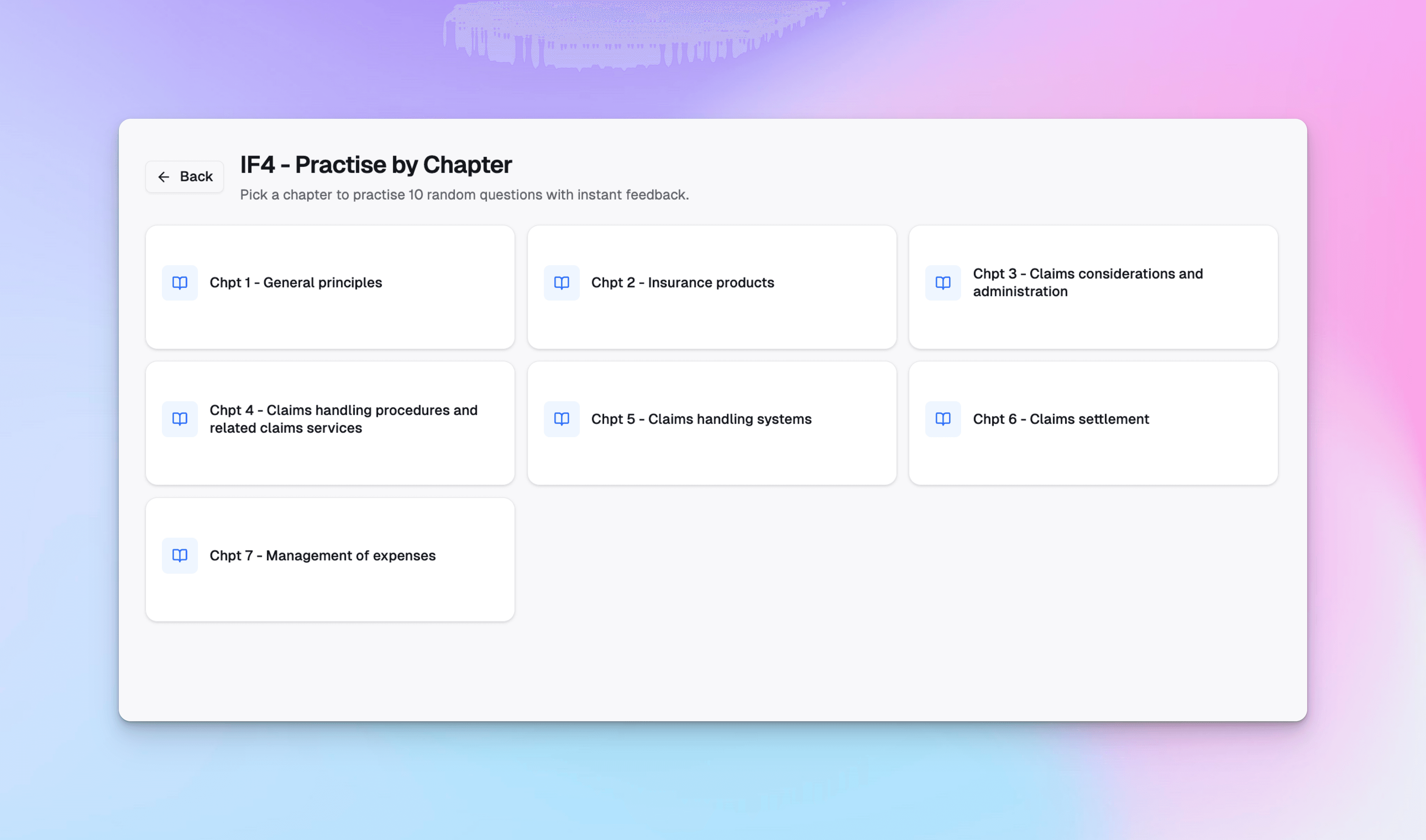
On ExamDen.uk, practise one learning outcome at a time, then sit a full mock in the real question count and time limit
LO4: Claims Handling Procedures and Related Services — 13 Questions (17%)
- Claims workflow. Notification (first notification of loss — FNOL) → registration → investigation → assessment → negotiation → settlement/repudiation. Key decisions and documentation at each stage.
- Loss adjusters vs loss assessors. Loss adjusters act for the insurer — investigate and assess the claim. Loss assessors act for the insured — help prepare and present the claim. Know the distinction cold.
- Specialist services. Motor engineers (vehicle damage assessment, total loss valuation), forensic accountants (business interruption, fraud), medical experts, surveyors, building consultants, rehabilitation providers.
- Subrogation. The insurer's right to recover from a negligent third party after paying a claim. Common law: arises after payment. Policy conditions usually allow earlier action. The insured must cooperate and not prejudice the insurer's recovery rights.
- Salvage. The insurer's right to the remains after paying a total loss. Salvage agents, disposal, environmental requirements.
- Third-party claims management. Assessing liability (was the insured at fault?), quantum (how much are the damages?), negotiation, settlement.
LO1: General Principles — 12 Questions (16%)
- Burden of proof. The insured proves loss by an insured peril. The insurer proves an exclusion applies. Know which way the burden sits for each scenario.
- Proximate cause. The dominant or effective cause of the loss. If the proximate cause is an insured peril, the claim is payable. If concurrent causes exist: if one is insured and one is excluded, the excluded cause prevails (unless the causes are independent).
- Indemnity. The insured is restored to the same financial position as before the loss — no better, no worse. Methods: cash payment, repair, replacement, reinstatement.
- Contribution. When two or more policies cover the same loss. Methods: rateable proportion, independent liability. Applies only to contracts of indemnity.
- Fatal Accidents Act 1976. Dependants can claim for lost financial dependency, bereavement damages and funeral costs.
- Limitation periods. Contract claims: 6 years. Tort claims: 6 years (3 years for personal injury from date of knowledge). Latent damage: 3 years from date of knowledge, longstop 15 years.
🎯 Practise Like the Real Exam
ExamDen.uk tracks your score by learning outcome so you see exactly where you're losing marks. No more guessing which topics to revise.
Start IF4 Practice →LO6: Claims Settlement — 10 Questions (13%)
- Settlement options. Cash payment, repair, replacement, reinstatement. When each is appropriate.
- Contributory negligence. Under the Law Reform (Contributory Negligence) Act 1945, damages are reduced by the claimant's share of fault. Calculation: damages × percentage NOT at fault.
- Average (under-insurance). If the sum insured is less than the value at risk, the claim is reduced proportionally. Claim paid = claim × (sum insured ÷ value at risk).
- Ex gratia payments. Payments made without admission of liability — typically for goodwill or when the strict policy terms don't cover the loss but the insurer wants to maintain the customer relationship.
- Negotiation. Negotiation strategies, Part 36 offers (costs consequences), mediation, arbitration.
Quick test: A claimant's damages are £60,000 and they're 40% at fault. What is the award? (Answer: £60,000 × 60% = £36,000.)
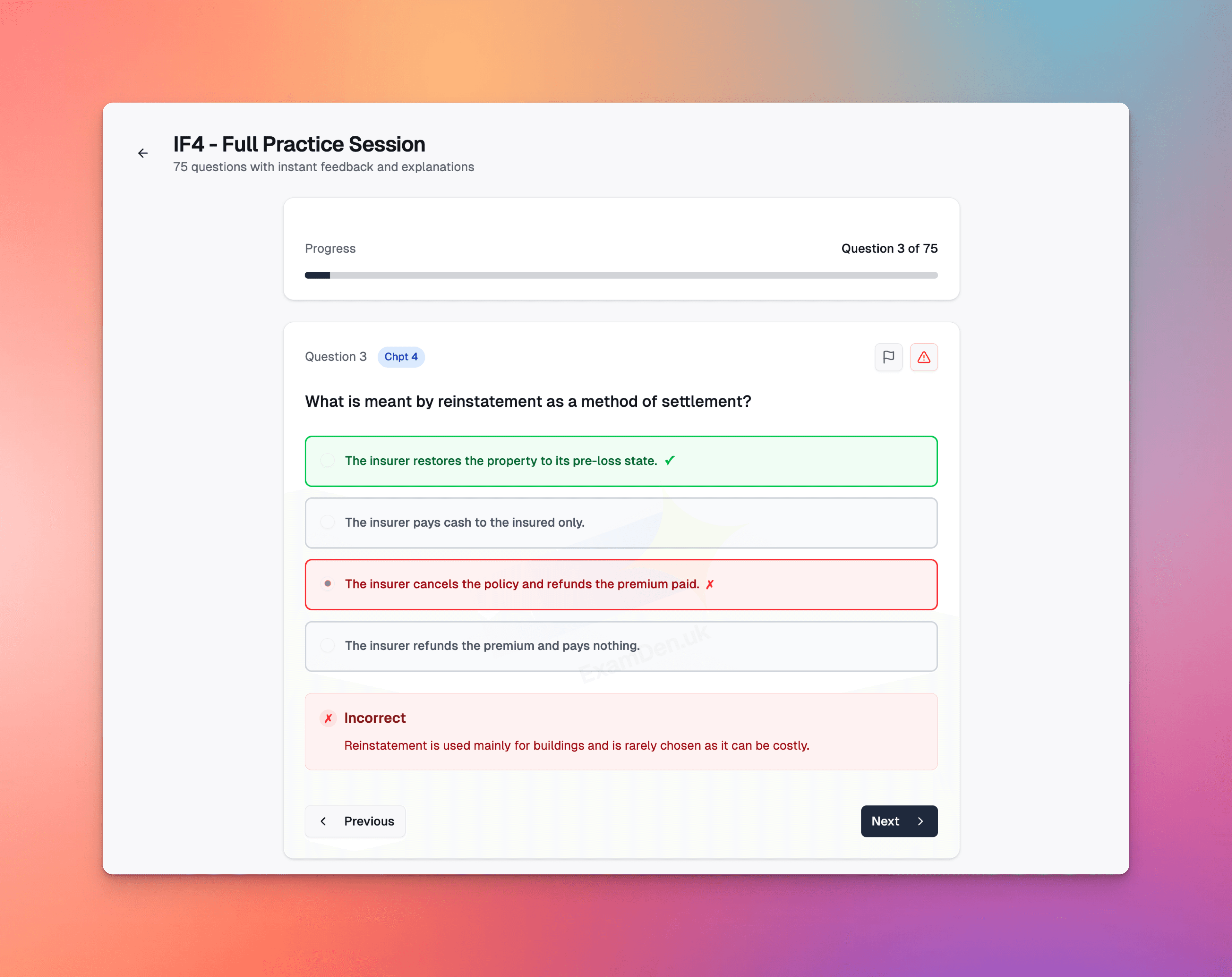
On ExamDen.uk, every question comes with a detailed explanation linked to the relevant learning outcome
LO7: How Expenses Are Managed — 8 Questions (11%)
- Claims expenses. Loss adjuster fees, expert fees, legal costs, rehabilitation costs, motor engineer fees. The difference between allocated (specific to a claim) and unallocated (overhead) expenses.
- Expense management. Budgets, benchmarking, service level agreements (SLAs) with suppliers. How insurers monitor and control claims costs.
- Outsourcing. Third-party administrators (TPAs), outsourced claims handling, managed repair networks. The advantages and risks of outsourcing.
- Leakage. Claims leakage — the gap between what the insurer pays and the true cost of the claim. Causes: poor reserving, over-settlement, inefficiency, fraud. How insurers measure and reduce leakage.
LO5: Claims Handling Operations — 6 Questions (8%)
- Claims management systems. How technology supports the claims process: FNOL systems, workflow management, document management, data analytics.
- Performance measurement. Key metrics: average claims cost, claims frequency, settlement speed, customer satisfaction, complaint rates, loss ratios.
- FCA Consumer Duty. Good outcomes for customers: products and services, price and value, consumer understanding, consumer support. How claims handling fits into the Consumer Duty framework.
- Complaints handling. FCA rules: acknowledge promptly, investigate, final response within 8 weeks, referral to FOS. Root cause analysis.
- Vulnerable customers. Identifying and supporting vulnerable customers during the claims process.
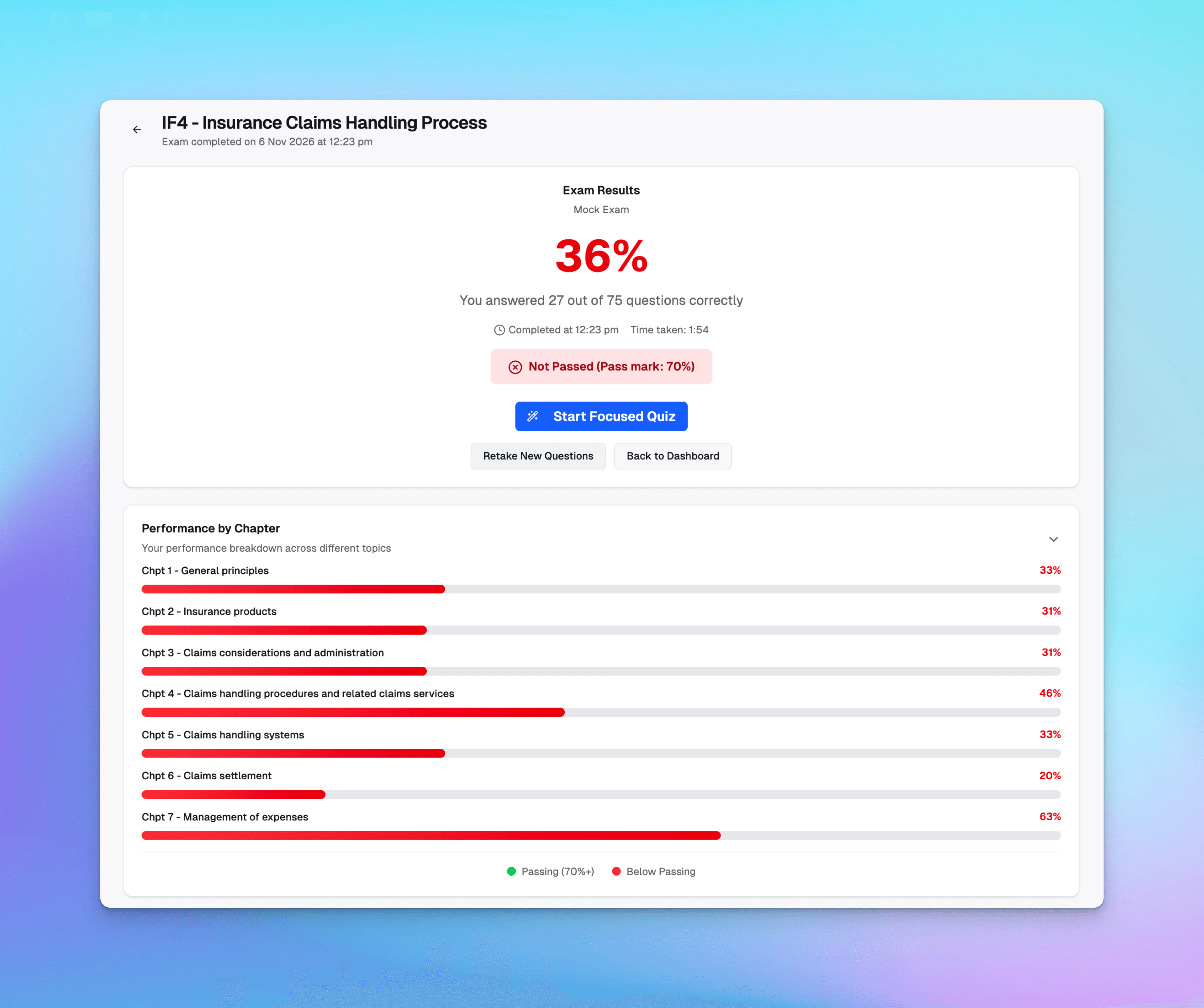
On ExamDen.uk, a timed mock shows your score against the 70% pass mark, and which learning outcomes are below it
Final Revision Checklist
Before exam day, make sure you can:
- Explain the burden of proof — insured proves insured peril, insurer proves exclusion
- Distinguish loss adjusters from loss assessors
- Calculate contributory negligence — damages × percentage NOT at fault
- Describe the reserving process — what to include, when to adjust
- Explain the Insurance Act 2015 fraud provisions
- Name the limitation periods for contract, tort and personal injury claims
- Describe how the FCA Consumer Duty applies to claims handling
- Sit at least one full timed mock under exam conditions — 75 questions, 2 hours
For more on study strategy and common mistakes, see our IF4 study guide. For the underwriting counterpart, see our IF3 study guide. To start practising, visit ExamDen's IF4 question bank.
IF4 Revision FAQs
Ready to Put This Strategy Into Action? 💯
Revise smarter. Practise IF4 by learning outcome and let AI pinpoint the topics you need to revisit.

The ExamDen.uk Team
ExamDen.uk builds exam-style question banks and timed mocks for CeMAP, Cert CII and CII R01–R05, helping UK professionals prepare for their financial services exams.