CII R03 Revision Guide (2026): Learning Outcomes and Exam Tips
A learning-outcome-by-learning-outcome revision guide for CII R03. Covers what each LO tests, the question weighting, where the 11 multiple-response questions sit and the key tax calculations.
This guide walks through each of R03's 4 learning outcomes — what they test, how many questions they carry, and what to focus your revision on. Use it alongside the CII study text to target the areas that will have the biggest impact on your score.
If you haven't read the overall study strategy yet, start with our R03 study guide. If you're wondering how hard the exam actually is, see Is R03 Hard?. This revision guide assumes you've already covered the material and are now preparing for the exam.
📋 R03 at a Glance
- 50 questions: 39 standard + 11 multiple-response
- 1 hour — 72 seconds per question on average
- Pass mark: 65% (at least 33 out of 50)
- Multiple-response questions: LO2 (7) and LO3 (4)
Question Distribution by Learning Outcome
| LO | Topic | Standard MCQ | Multiple Response | Total | % of exam |
|---|---|---|---|---|---|
| 1 | The UK tax system | 15 | 0 | 15 | 30% |
| 2 | Taxation of investments | 8 | 7 | 15 | 30% |
| 3 | Role and relevance of tax | 6 | 4 | 10 | 20% |
| 4 | Apply personal tax to investment advice | 10 | 0 | 10 | 20% |
LO1 and LO2 together make up 30 of 50 questions — 60% of the exam. These two deserve the most revision time. LO2 is particularly important because almost half its questions (7 out of 15) are multiple-response.
---
LO1: The UK Tax System — 15 Questions (All Standard)
The largest learning outcome, and all standard MCQs — no multiple-response. This is where solid factual knowledge pays off most directly.
Key areas to revise:
- Income tax rates and bands. Basic rate (20%), higher rate (40%), additional rate (45%). Know the current thresholds and how different types of income (earnings, savings, dividends) fit into the bands.
- Personal allowance. The standard allowance and the tapering rule for adjusted net income above £100,000 — reduced by £1 for every £2 over £100,000. Know how to calculate the reduced allowance and how pension contributions affect the calculation.
- Personal savings allowance. £1,000 for basic-rate taxpayers, £500 for higher-rate, nil for additional-rate. Income within the PSA is taxed at 0% but still uses up the rate band. This distinction is heavily tested.
- Dividend allowance. The current allowance amount. Like the PSA, dividend income within the allowance is taxed at 0% but counts towards the rate bands.
- National Insurance. Class 1 (employed earnings — know what counts as earnings and what's exempt), Class 2 (self-employed flat rate), Class 4 (self-employed profits above the threshold). The distinction between payments that attract NIC and those that don't is a classic exam question.
- Self-assessment. Filing deadlines (31 October paper, 31 January online), payments on account, balancing payment, penalties for late filing and late payment. Know the key dates.
- Tax residency and domicile. Statutory residence test, split-year treatment, deemed domicile rules. Know the difference between residence and domicile and how each affects UK tax liability.
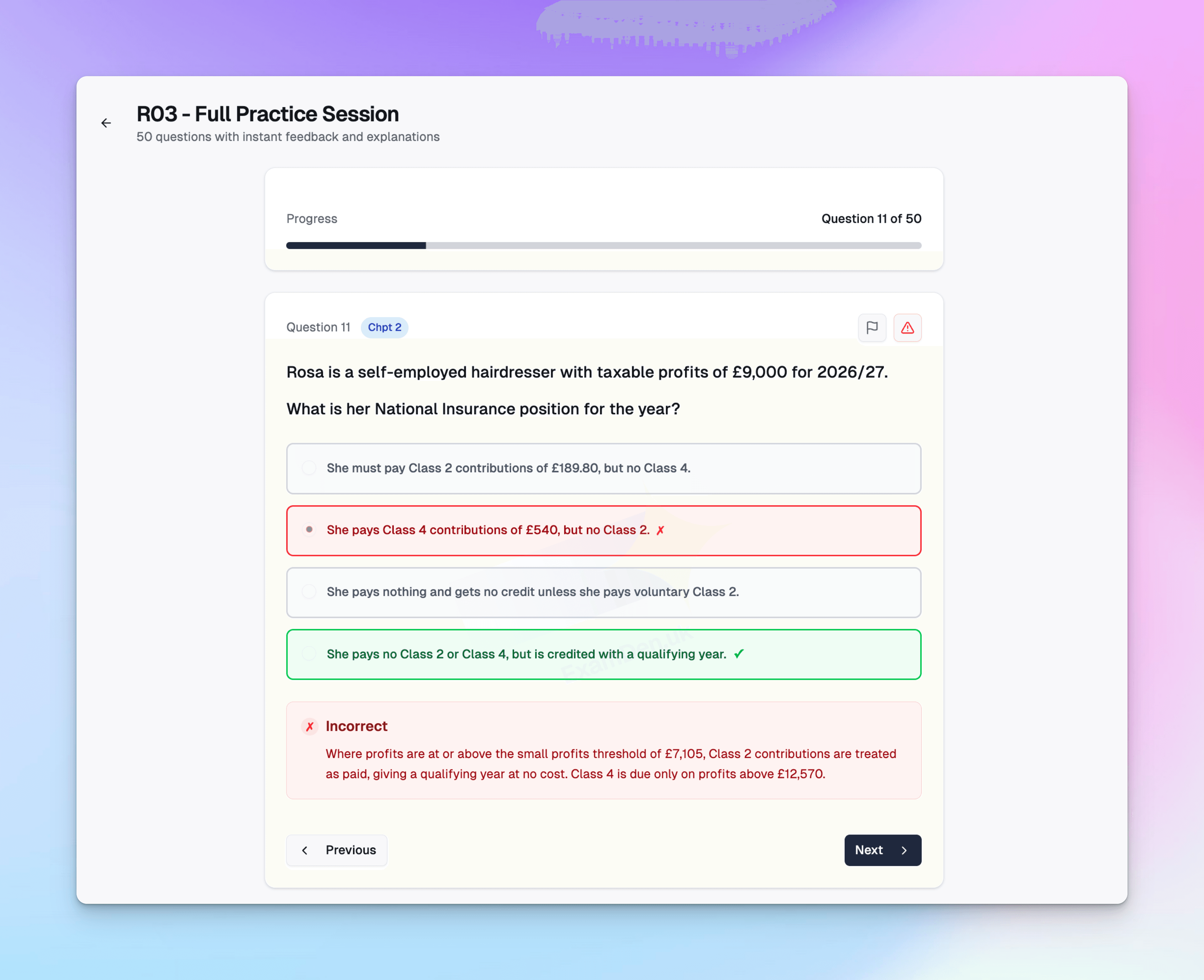
On ExamDen.uk, every question comes with a clear explanation linked to the relevant learning outcome
💡 Revision tip: make a one-page summary of all the key tax figures — personal allowance, PSA by band, dividend allowance, NIC thresholds, tax bands. Review it daily in the week before your exam. You can't calculate what you can't remember.
LO2: Taxation of Investments — 15 Questions (8 Standard + 7 Multiple Response)
LO2 ties with LO1 for the most questions, but it's harder because 7 of the 15 questions are multiple-response. This is where your R02 knowledge meets the tax system.
Key areas to revise:
- Tax on savings interest. Bank and building society interest, corporate bond interest, gilt interest. How each is taxed and the role of the personal savings allowance.
- Tax on dividends. The dividend allowance, dividend tax rates (8.75% basic, 33.75% higher, 39.35% additional), and how dividends sit on top of other income in the rate bands.
- ISA tax treatment. Cash ISAs, stocks and shares ISAs, Lifetime ISAs, Junior ISAs, Innovative Finance ISAs. Current contribution limits, tax advantages (no income tax, no CGT), transfer rules between providers and between ISA types.
- Investment bond taxation. Chargeable events (death, surrender, maturity, excess withdrawal, assignment for money/money's worth). The 5% cumulative annual withdrawal allowance. Top-slicing relief — know when it applies, how it works and why it matters for higher-rate taxpayers. This is one of the most frequently tested and commonly misunderstood areas in R03.
- Capital gains tax. Annual exempt amount, CGT rates for basic and higher-rate taxpayers, the order of deductions (proceeds − cost − allowable costs − annual exempt amount − losses). Business Asset Disposal Relief (formerly Entrepreneurs' Relief), holdover relief, rollover relief.
- Trust taxation. Bare trusts (taxed as if the beneficiary owns the assets), interest in possession trusts (income taxed at basic rate in the trust, beneficiary may have further liability), discretionary trusts (income taxed at the trust rate, 45%/39.35% for dividends). Know the differences — the exam tests them.
- Tax-efficient investments. Enterprise Investment Scheme (EIS) — income tax relief, CGT exemption, loss relief, holding period. Seed EIS — higher income tax relief. Venture Capital Trusts (VCTs) — income tax relief on subscription, tax-free dividends. Know the conditions and limits for each.
Multiple-response focus: the 7 MR questions in LO2 often present statements about a product's tax treatment and ask which are correct. For example, "which statements about investment bond taxation are correct?" Knowing the detail — not just the general principle — is what separates passing from failing these questions.
💡 Revision tip: investment bond taxation (chargeable events, the 5% allowance, top-slicing relief) is one of the most common exam topics. If you can only revise one area in depth, make it this one.
🎯 Practise Like the Real Exam
ExamDen.uk tracks your score by learning outcome so you see exactly where you're losing marks. No more guessing which topics to revise.
Start R03 Practice →LO3: Role and Relevance of Tax — 10 Questions (6 Standard + 4 Multiple Response)
LO3 is more conceptual than LO1 or LO2, but 4 of its 10 questions are multiple-response.
Key areas to revise:
- Tax avoidance vs tax evasion. Avoidance is legal (structuring affairs to minimise tax within the law); evasion is criminal (deliberately concealing income or gains). The exam tests whether you know the distinction and the consequences.
- GAAR (General Anti-Abuse Rule). Applies across the main taxes (except VAT). Targets abusive arrangements that cannot reasonably be regarded as reasonable. Know what triggers it and what powers HMRC has.
- DOTAS (Disclosure of Tax Avoidance Schemes). Promoters must notify HMRC; users must disclose the scheme reference number on their tax return. Failure to disclose is a separate offence.
- The Ramsay principle. Courts can tax a preordained series of transactions by reference to the end result, ignoring artificial intermediate steps. Know a simple example of how it applies.
- Tax planning in financial advice. How tax considerations affect investment choices, pension contributions, estate planning and business decisions. The role of the financial adviser in tax planning (advising within competence, referring to specialists).
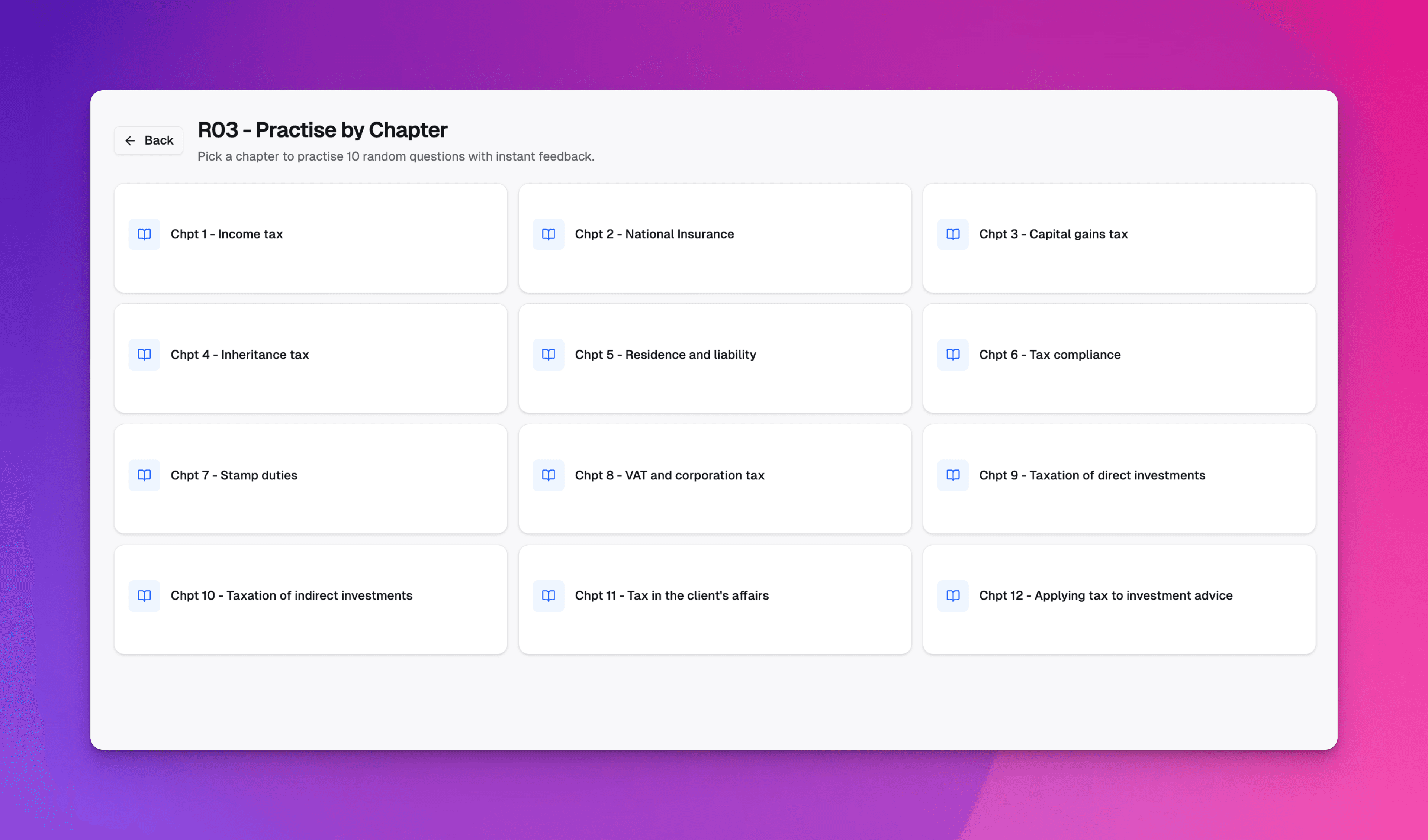
On ExamDen.uk, practise by learning outcome to find your weak spots before you take a full mock
LO4: Apply Personal Tax to Investment Advice — 10 Questions (All Standard)
LO4 is the practical application learning outcome. All 10 questions are standard MCQs, but they require you to apply tax rules to specific client scenarios.
Key areas to revise:
- SDLT calculations. Know the residential SDLT bands and be able to calculate total SDLT for a given purchase price. The calculation is multi-step (slice of price in each band), and the exam expects you to do it quickly. Practise until automatic.
- CGT computations. Given a disposal, calculate the taxable gain: proceeds minus acquisition cost minus allowable expenditure minus annual exempt amount. Apply the correct rate based on the taxpayer's income. Know how to use losses (current year first, then brought forward).
- Pension tax relief. Net vs gross contributions, basic-rate relief added automatically, higher-rate relief claimed through self-assessment. The annual allowance, carry forward of unused allowance, the money purchase annual allowance.
- Income tax computations. Calculate total tax from multiple income sources, applying the personal allowance, PSA and dividend allowance in the correct order. Know how non-savings, savings and dividend income stack in the rate bands.
- Practical advice scenarios. Given a client's income, gains and circumstances, which is the most tax-efficient option? ISA vs pension vs investment bond? These questions test your ability to pull together LO1–LO3 knowledge and apply it.
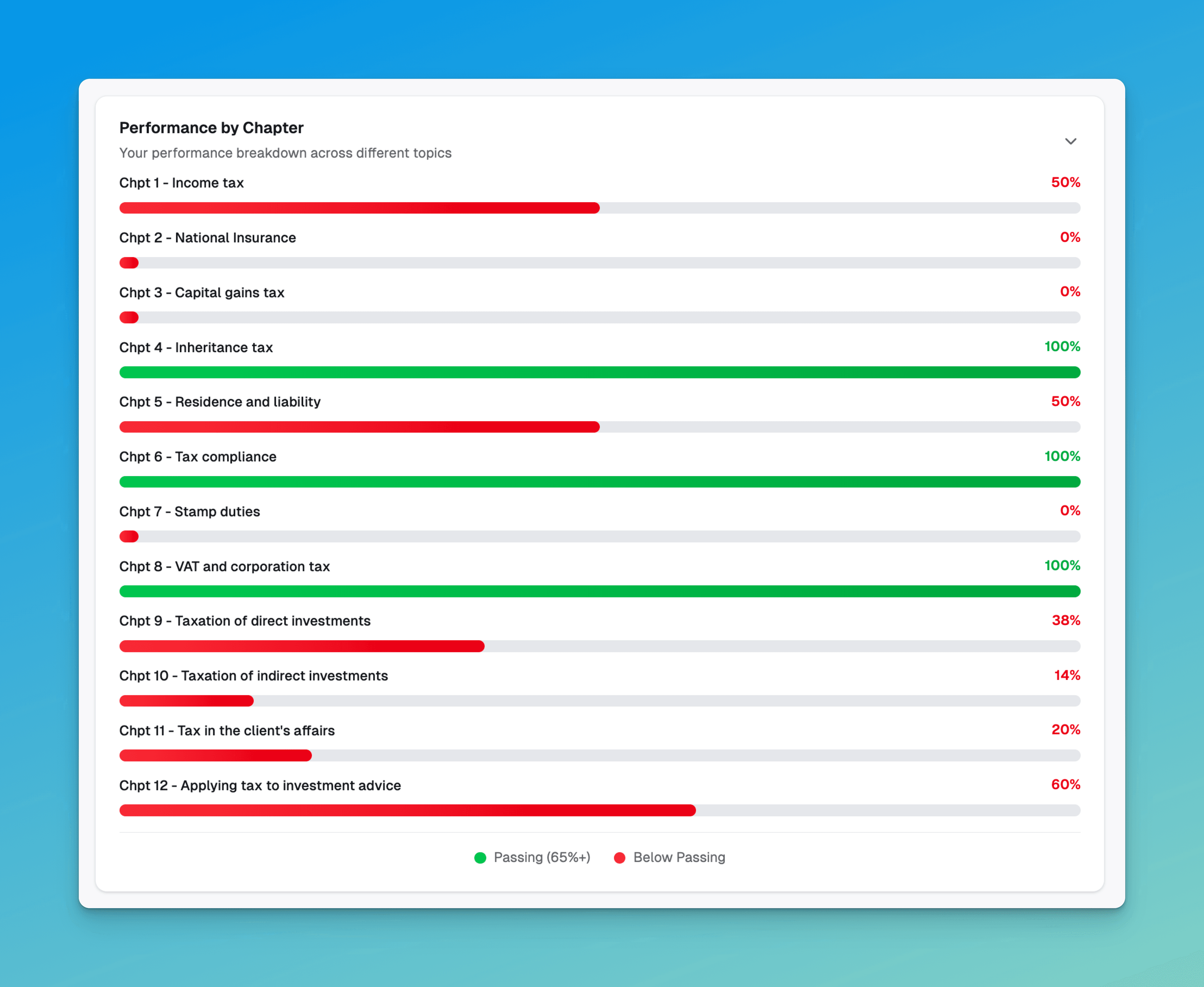
On ExamDen.uk, a mock result shows which learning outcomes are below the 65% line, so you revise those instead of the whole study text
💡 Revision tip: for SDLT, write out the bands from memory, then practise calculating SDLT for 5 different property prices. If you can do all 5 without checking the bands, you're ready for this question type.
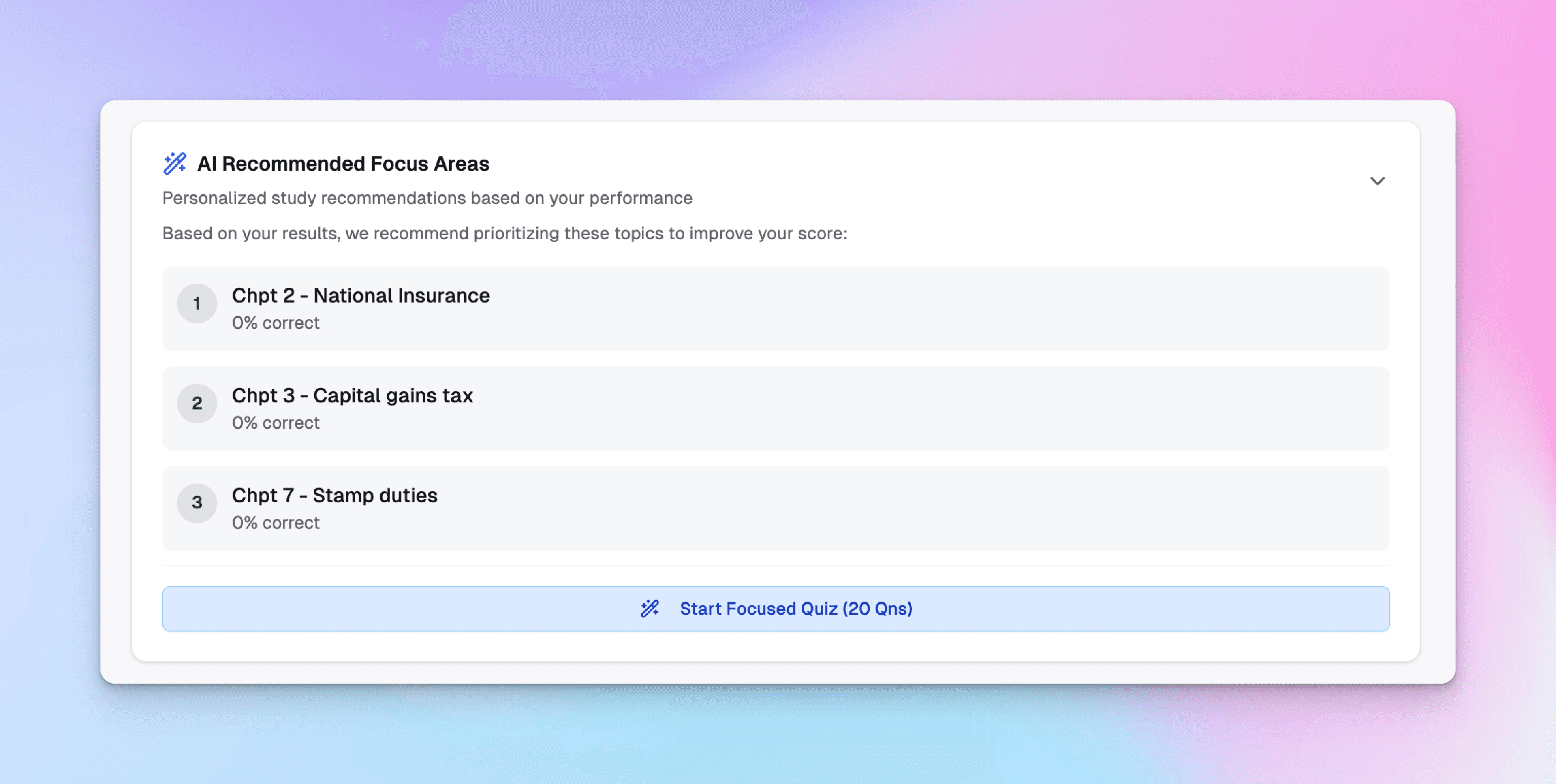
On ExamDen.uk, the focus list after a mock shows which learning outcomes to revise first
Exam Day Tips
- Do the calculations first. If you know the method, SDLT and personal allowance tapering questions are reliable marks. Do them while you're fresh, not when you're rushed at the end.
- Read every word carefully. The CII uses bold for emphasis (maximum, minimum, normally) and capitals for negatives (NOT, CANNOT). Missing these changes the answer.
- Don't dwell. If a question is taking too long, flag it and move on. Come back after you've answered everything else.
- Check your multiple-response answers. R03 has 11 MR questions. Before submitting, double-check that you've selected all the options you intended.
- Use remaining time to review. Go through every question again. With 50 questions and each one worth 2% of your total, changing one wrong answer to a correct one could be the difference between passing and failing.
Ready to Test Yourself?
Try these 5 free R03 mock questions to see the question style. When you're ready for full exam simulation, ExamDen's R03 question bank has hundreds of questions, timed mocks and AI that tracks your progress by learning outcome.
R03 Revision FAQs
Ready to Put This Strategy Into Action? 💯
Test your revision. Take a timed R03 mock with exam-style questions and see which learning outcomes need more work.

The ExamDen.uk Team
ExamDen.uk builds exam-style question banks and timed mocks for CeMAP, Cert CII and CII R01–R05, helping UK professionals prepare for their financial services exams.