CII R04 Revision Guide (2026): Learning Outcomes and Exam Tips
A learning-outcome-by-learning-outcome revision guide for CII R04. Covers what each LO tests, the question weighting, where the 11 multiple-response questions sit and the key pension rules.

This guide walks through each of R04's 8 learning outcomes — what they test, how many questions they carry, and what to focus your revision on. Use it alongside the CII study text to target the areas that will have the biggest impact on your score.
If you haven't read the overall study strategy yet, start with our R04 study guide. If you're wondering how hard the exam actually is, see Is R04 Hard?. This revision guide assumes you've already covered the material and are now preparing for the exam.
📋 R04 at a Glance
- 50 questions: 39 standard + 11 multiple-response
- 1 hour — 72 seconds per question on average
- Pass mark: 65% (at least 33 out of 50)
- Multiple-response questions: LO5 (2), LO6 (4) and LO8 (5)
Question Distribution by Learning Outcome
| LO | Topic | Standard MCQ | Multiple Response | Total | % of exam |
|---|---|---|---|---|---|
| 2 | HMRC tax regime for pensions | 10 | 0 | 10 | 20% |
| 6 | Drawing pension benefits | 5 | 4 | 9 | 18% |
| 4 | Defined Benefit schemes | 7 | 0 | 7 | 14% |
| 5 | Defined Contribution schemes | 4 | 2 | 6 | 12% |
| 1 | Political, economic and social context | 5 | 0 | 5 | 10% |
| 8 | Retirement planning objectives | 0 | 5 | 5 | 10% |
| 3 | Pensions law and regulation | 4 | 0 | 4 | 8% |
| 7 | State schemes | 4 | 0 | 4 | 8% |
LO2 and LO6 together make up 19 of 50 questions — over a third of the exam. LO8 is entirely multiple-response. These three deserve the most revision time.
---
LO2: HMRC Tax Regime for Pensions — 10 Questions (All Standard)
The biggest learning outcome, and all standard MCQs. This is the most technical LO and requires precise knowledge of the tax rules.
Key areas to revise:
- Tax relief methods. Net pay arrangement (relief at marginal rate immediately, deducted from gross pay before PAYE) vs relief at source (basic-rate relief added by provider, higher-rate claimed via self-assessment). Know exactly how each works — this is one of the most frequently tested topics.
- Annual allowance. The standard annual allowance and the money purchase annual allowance (MPAA) — triggered when benefits are flexibly accessed. Know the carry forward rules: unused allowance from the previous three tax years can be carried forward.
- Annual allowance tapering. For high earners, the annual allowance is reduced. Know the threshold income and adjusted income levels, and how the tapering calculation works step by step.
- Lump sum allowance (LSA). £268,275 — caps the tax-free pension commencement lump sum. A PCLS is the lower of 25% of the fund crystallised and the available LSA.
- Lump sum and death benefit allowance (LSDBA). Caps the combined total of tax-free lump sums and lump sum death benefits. Know the transitional protections for those with existing lifetime allowance protection.
- Death benefits. Before age 75: lump sums and drawdown can be paid tax-free (within the LSDBA). After age 75: taxed at the recipient's marginal rate. Know the difference.
- Overseas transfers. Only transfers to a QROPS are recognised. A transfer to any other overseas scheme is an unauthorised payment. Know the overseas transfer allowance.
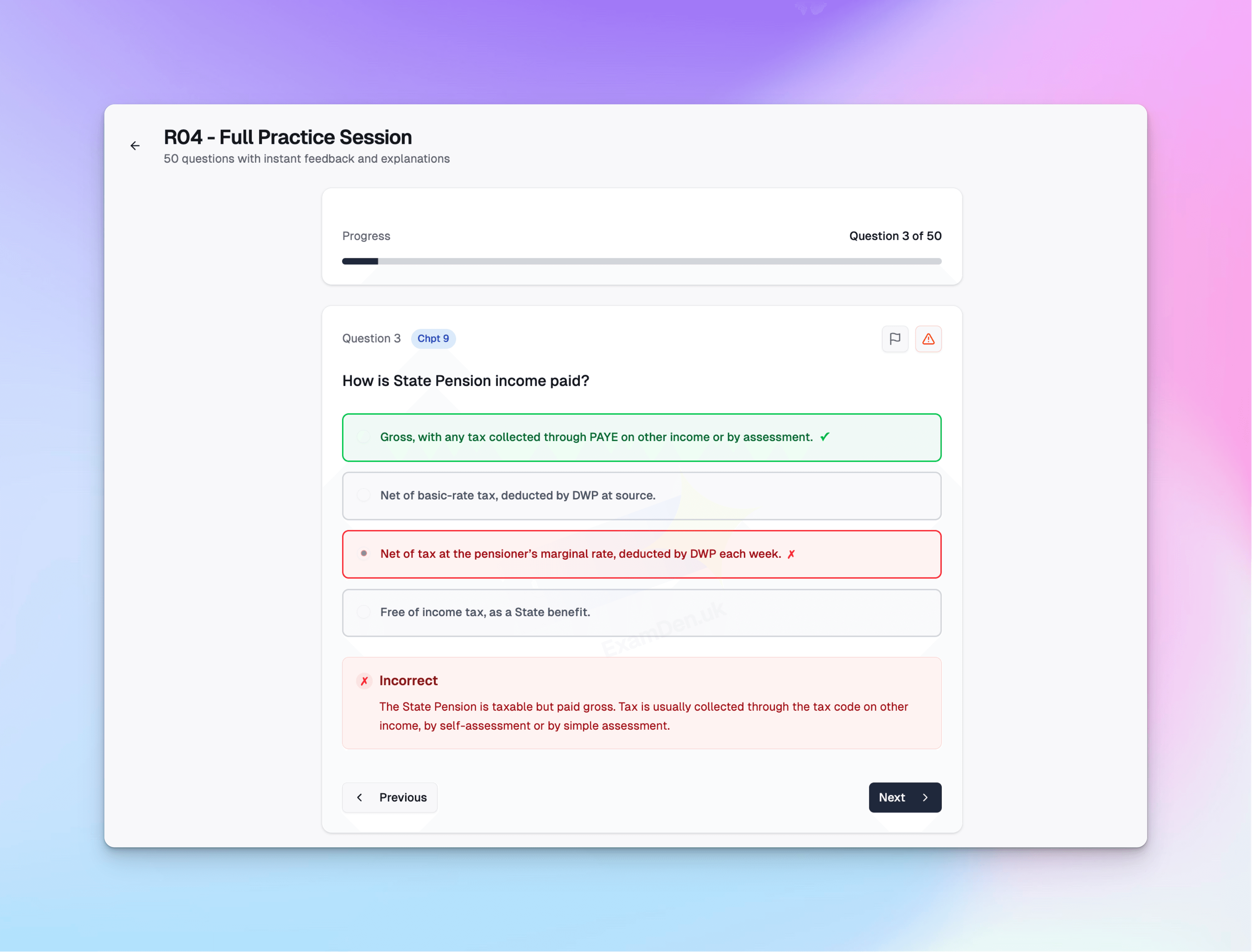
On ExamDen.uk, every question comes with a clear explanation linked to the relevant learning outcome
💡 Revision tip: make a comparison table of net pay vs relief at source. List who adds the relief, when it's added, and what the member needs to do for higher-rate relief. This single comparison will help you answer multiple exam questions.
LO6: Drawing Pension Benefits — 9 Questions (5 Standard + 4 Multiple Response)
The second-biggest learning outcome and the most MR-heavy after LO8. The pension freedoms since 2015 mean there are multiple ways to take benefits — and the exam tests all of them.
Key areas to revise:
- State Pension. New State Pension amount, qualifying years, deferral rules and the impact on payments. State Pension age for different cohorts.
- DB scheme benefits. Normal retirement age, early retirement factors, late retirement factors, commutation of pension for a tax-free lump sum. Know how a DB pension is calculated: accrual rate × years of service × pensionable salary.
- DC drawing options. Flexi-access drawdown (take income flexibly from a crystallised fund), UFPLS (take lump sums from an uncrystallised fund — 25% tax-free, 75% taxed), annuity purchase (lifetime, fixed-term, investment-linked), scheme pension.
- The MPAA. The money purchase annual allowance is triggered when DC benefits are flexibly accessed (not by taking a tax-free lump sum alone). Know the trigger events and the reduced allowance amount.
- Phased retirement. Crystallising pension funds in stages to manage tax and income. When it's suitable and how it uses the LSA over time.
- Small pots and trivial commutation. Rules for taking small pension pots as lump sums outside the normal limits.
💡 Revision tip: make a table comparing flexi-access drawdown, UFPLS, annuity purchase and scheme pension. For each, note: tax-free element, taxable element, MPAA trigger (yes/no), and when it's most suitable.
🎯 Practise Like the Real Exam
ExamDen.uk tracks your score by learning outcome so you see exactly where you're losing marks. No more guessing which topics to revise.
Start R04 Practice →LO4: Defined Benefit Schemes — 7 Questions (All Standard)
Key areas to revise:
- Types of DB scheme. Final salary vs CARE (career average revalued earnings). How each calculates the pension.
- Accrual and pensionable salary. Understand the pension calculation: accrual rate (e.g. 1/60th) × years of service × pensionable salary.
- Funding. Actuarial valuations, deficit recovery plans, the role of the Pension Protection Fund (PPF) and the Financial Assistance Scheme.
- Trustees. Roles, responsibilities, member-nominated trustees, investment strategy, conflicts of interest.
- Leaving service. Deferred pension benefits, revaluation, cash equivalent transfer values (CETV). The FCA requirement for advice on DB transfers over a certain value.
- Death benefits. Dependants' pensions, lump sum death benefits, expression of wish forms.
- Public sector schemes. Unfunded, CARE-based, index-linked. Key differences from private sector DB.
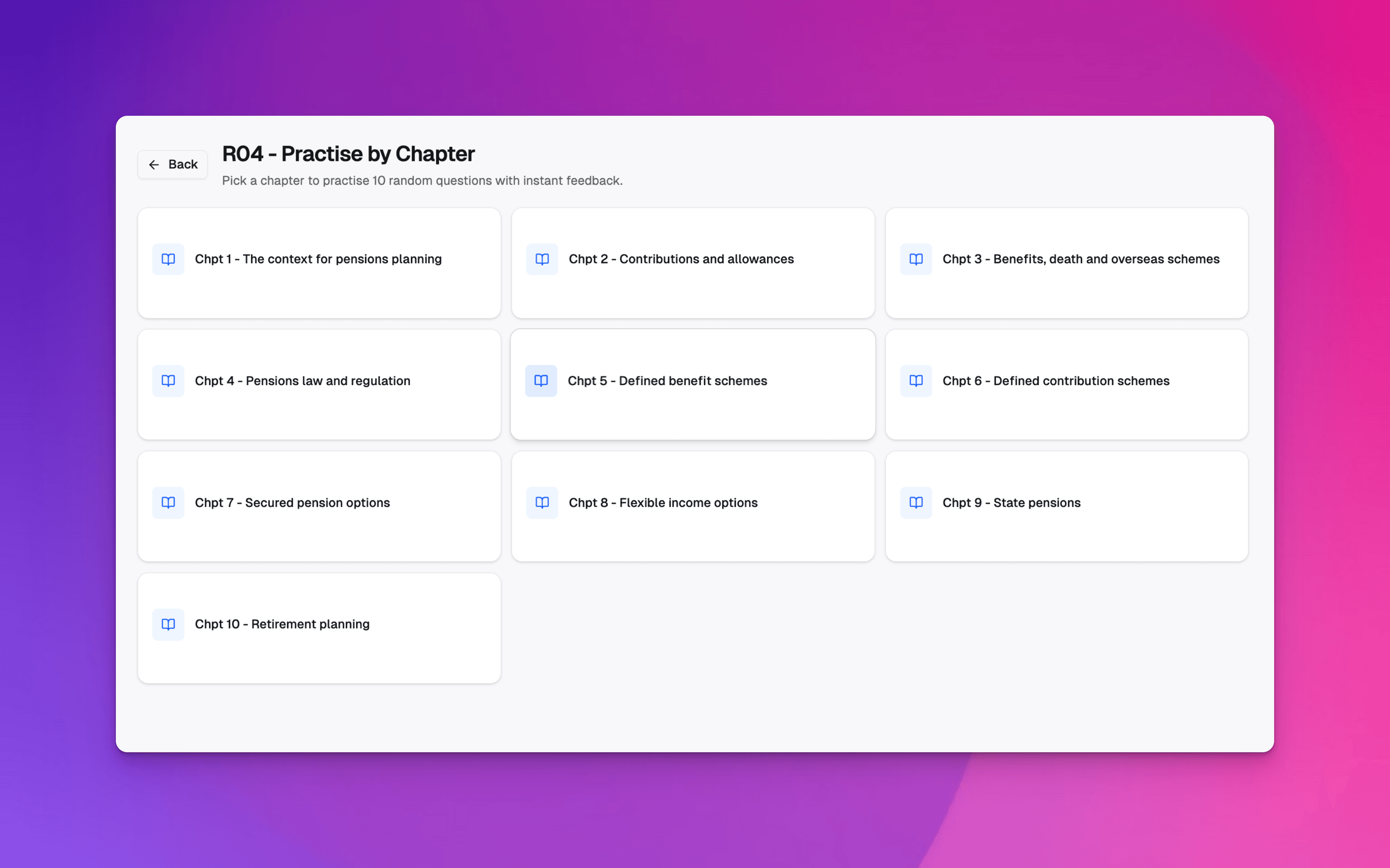
On ExamDen.uk, practise by learning outcome to find your weak spots before you take a full mock
LO5: Defined Contribution Schemes — 6 Questions (4 Standard + 2 Multiple Response)
Key areas to revise:
- Types of DC scheme. Personal pensions, stakeholder pensions, SIPPs, group personal pensions, workplace pensions under auto-enrolment.
- Auto-enrolment. Employer duties, qualifying earnings, minimum contribution rates, opt-out and re-enrolment, postponement.
- Investment choice and charges. How members choose investments, the default fund, charge caps for qualifying schemes.
- Leaving and transfers. The right to transfer, pension sharing on divorce, transfer value comparisons.
- Death benefits. Before age 75 (can be paid tax-free within the LSDBA) vs after age 75 (taxed at the recipient's marginal rate). Nomination and expression of wish.
LO8: Retirement Planning Objectives — 5 Questions (All Multiple Response)
Every question in LO8 is multiple-response — the highest-risk learning outcome.
Key areas to revise:
- Client objectives. Identifying a client's retirement aims: target income, lump sum needs, estate planning, tax efficiency, flexibility. Know how to prioritise these in a client scenario.
- Investment for retirement. Asset allocation at different life stages, sequencing risk (the risk of poor returns early in retirement), the role of cash, bonds and equities in a retirement portfolio.
- Alternative income sources. Property income, other savings (ISAs, investment bonds), state benefits, part-time work. How these affect the pension income needed.
- Regular reviews. When and why retirement plans should be reviewed: changes in circumstances, market conditions, legislative changes, approaching retirement.
- Self-investment. The rules around pension schemes investing in assets connected to the member (e.g. commercial property via a SIPP). Restrictions and tax consequences.
💡 Revision tip: for LO8, practise evaluating scenarios. The MR questions describe a client situation and ask which recommendations or factors are relevant. You need to consider all angles — income, tax, estate planning, risk — not just one.
LO1: Political, Economic and Social Context — 5 Questions (All Standard)
Key areas to revise:
- Government pension policy. Auto-enrolment, pension freedoms (2015), the new State Pension (2016), LTA abolition (2024). Know the timeline and the intent behind each reform.
- Corporate responsibilities. Employer duties under auto-enrolment, the shift from DB to DC, the impact on employees.
- Demographics. Ageing population, increasing longevity, the dependency ratio, the impact on pension funding and state provision.
- Attitudes to saving. Why people under-save (affordability is the most-cited reason), the savings gap, behavioural barriers.
LO3: Pensions Law and Regulation — 4 Questions (All Standard)
Key areas to revise:
- Key legislation. The Pensions Act 2004, the Pension Schemes Act 2021 and their main provisions.
- The Pensions Regulator (TPR). Powers, objectives, auto-enrolment enforcement.
- The Pensions Ombudsman. Complaints and disputes about pension administration.
- Trustees. Duties, fiduciary responsibilities, member-nominated trustees, investment governance.
LO7: State Schemes — 4 Questions (All Standard)
Key areas to revise:
- New State Pension. Full amount, qualifying years needed (35), minimum qualifying years (10), how it's calculated for those with pre-2016 entitlement.
- State Pension age. Current ages and planned increases. How to check an individual's State Pension age.
- Deferral. The impact of deferring State Pension — the increase in weekly amount for each year of deferral.
- Pension Credit. Guarantee Credit and Savings Credit. Who qualifies and how it interacts with other pension income.
- Death benefits. What a surviving spouse or civil partner can inherit from the deceased's State Pension.
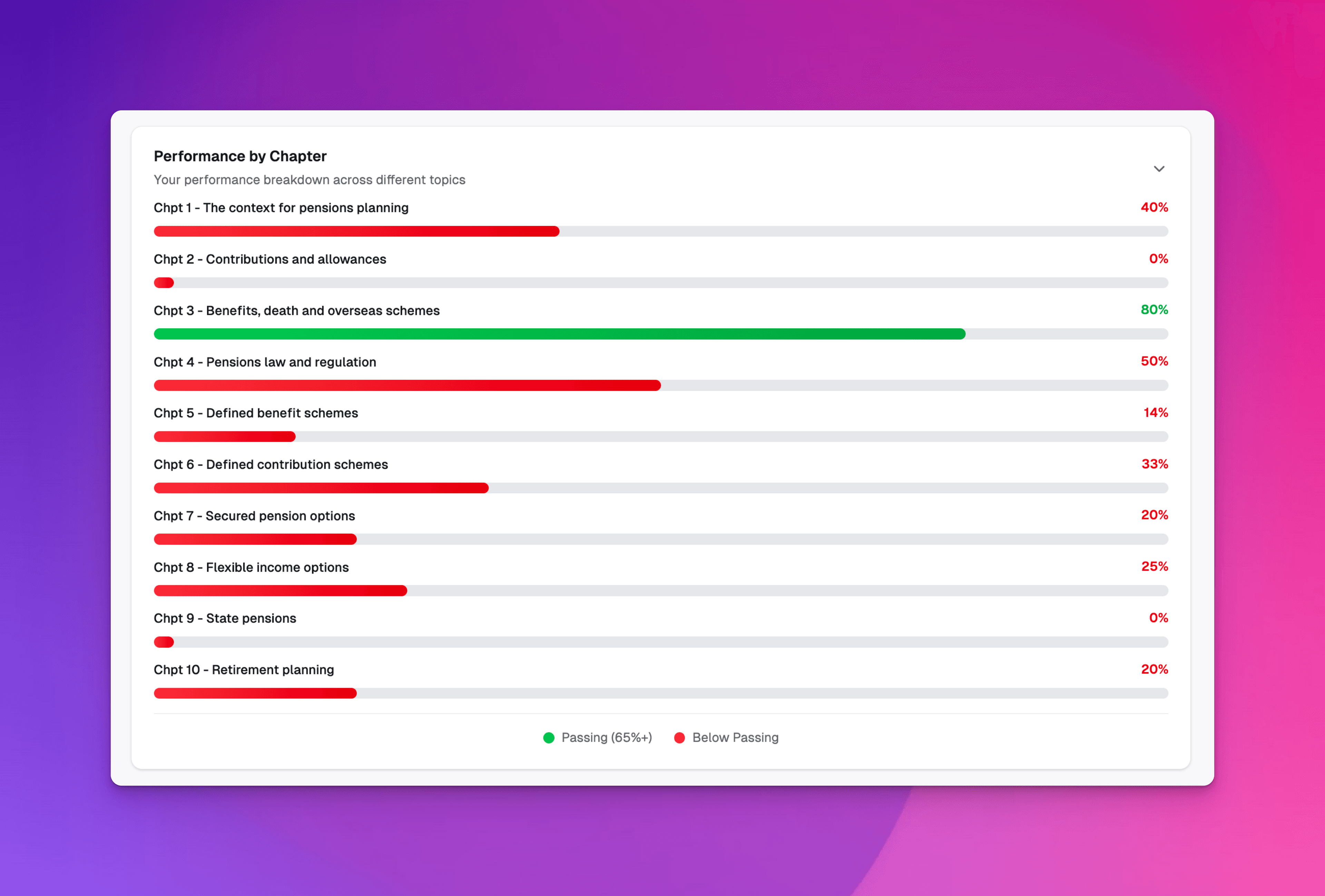
On ExamDen.uk, a mock result shows which learning outcomes are below the 65% line, so you revise those instead of the whole study text
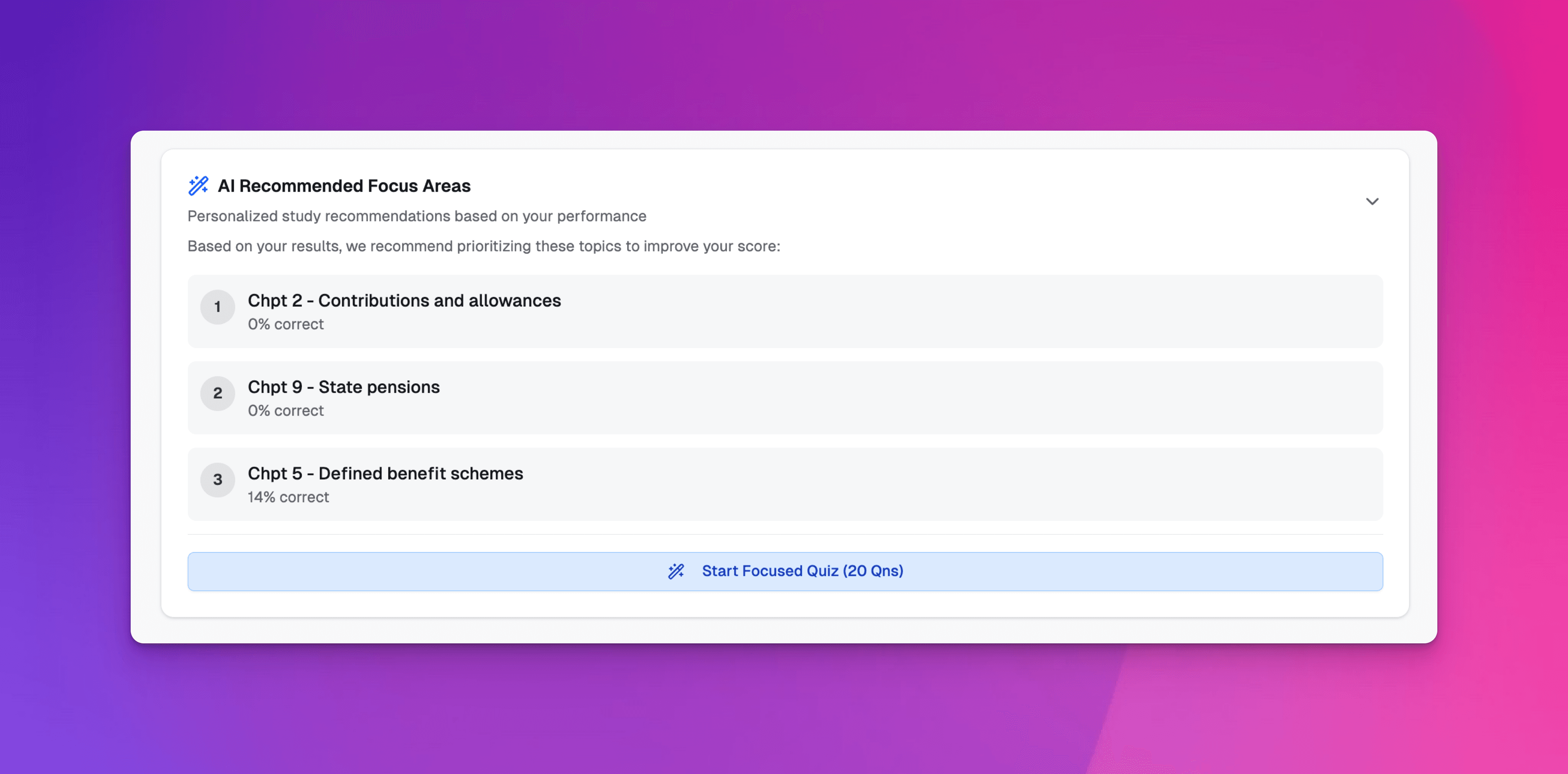
On ExamDen.uk, the focus list after a mock shows which learning outcomes to revise first
Exam Day Tips
- Start with the LOs you know best. Build confidence and bank marks before tackling the harder topics.
- Read every word carefully. The CII uses bold for emphasis (maximum, minimum, normally) and capitals for negatives (NOT, CANNOT). Missing these changes the answer.
- Don't dwell. If a question is taking too long, flag it and move on. Come back after you've answered everything else.
- Check your multiple-response answers. R04 has 11 MR questions, including 5 in LO8 that are evaluative. Before submitting, double-check that you've selected all the options you intended.
- Use remaining time to review. With 50 questions and each one worth 2% of your total, changing one wrong answer to a correct one could be the difference between passing and failing.
Ready to Test Yourself?
Try these 5 free R04 mock questions to see the question style. When you're ready for full exam simulation, ExamDen's R04 question bank has hundreds of questions, timed mocks and AI that tracks your progress by learning outcome.
R04 Revision FAQs
Ready to Put This Strategy Into Action? 💯
Test your revision. Take a timed R04 mock with exam-style questions and see which learning outcomes need more work.

The ExamDen.uk Team
ExamDen.uk builds exam-style question banks and timed mocks for CeMAP, Cert CII and CII R01–R05, helping UK professionals prepare for their financial services exams.