CII R05 Revision Guide (2026): Learning Outcomes and Exam Tips
A learning-outcome-by-learning-outcome revision guide for CII R05. Covers what each LO tests, the question weighting, product comparisons and what to focus on for the 70% pass mark.
This guide walks through each of R05's 10 learning outcomes — what they test, how many questions they carry, and what to focus your revision on. Use it alongside the CII study text to target the areas that will have the biggest impact on your score.
If you haven't read the overall study strategy yet, start with our R05 study guide. If you're wondering how hard the exam actually is, see Is R05 Hard?. This revision guide assumes you've already covered the material and are now preparing for the exam.
📋 R05 at a Glance
- 50 standard MCQs: no multiple-response questions
- 1 hour — 72 seconds per question on average
- Pass mark: 70% (at least 35 out of 50)
- 10 learning outcomes — the most of any diploma unit
Question Distribution by Learning Outcome
| LO | Topic | Questions | % of exam |
|---|---|---|---|
| 4 | Life assurance and pension-based policies | 8 | 16% |
| 5 | Taxation of protection policies | 6 | 12% |
| 6 | Income protection insurance | 6 | 12% |
| 7 | Critical illness insurance | 6 | 12% |
| 9 | Other insurance-based protection | 6 | 12% |
| 10 | Evaluate needs and select solutions | 6 | 12% |
| 1 | Consumer and retail market factors | 3 | 6% |
| 2 | Protection planning needs | 3 | 6% |
| 3 | State benefits for protection | 3 | 6% |
| 8 | Long-term care insurance | 3 | 6% |
LO4 is the biggest at 8 questions. Five LOs carry 6 questions each (LO5–7, LO9–10) — they make up 60% of the exam. The four small LOs (LO1–3, LO8) carry 12 questions total — don't skip them.
---
LO4: Life Assurance and Pension-Based Policies — 8 Questions
The biggest learning outcome. Know the products, the underwriting process and the claims process.
Key areas to revise:
- Term assurance. Level term (fixed sum, fixed premium, fixed term), decreasing term (for repayment mortgages), increasing term, renewable term, convertible term. Know when each is suitable.
- Whole of life. Standard, universal, unit-linked, with-profits. Reviewable premiums vs guaranteed premiums. Maximum cover plans vs balanced (savings) plans. When whole of life is suitable (IHT planning, lifelong cover).
- Endowment policies. Unit-linked and with-profits. Their original role in mortgage repayment and why they declined. Surrender values.
- Pension-based death benefits. Lump sum death benefits and dependants' pensions. How they interact with standalone life assurance and the lump sum and death benefit allowance.
- Underwriting. The purpose, the process, medical and non-medical limits, pre-existing conditions, loading and exclusions. How underwriting affects premiums.
- Claims. Proof of death, contestability, fraud, the role of the trust.
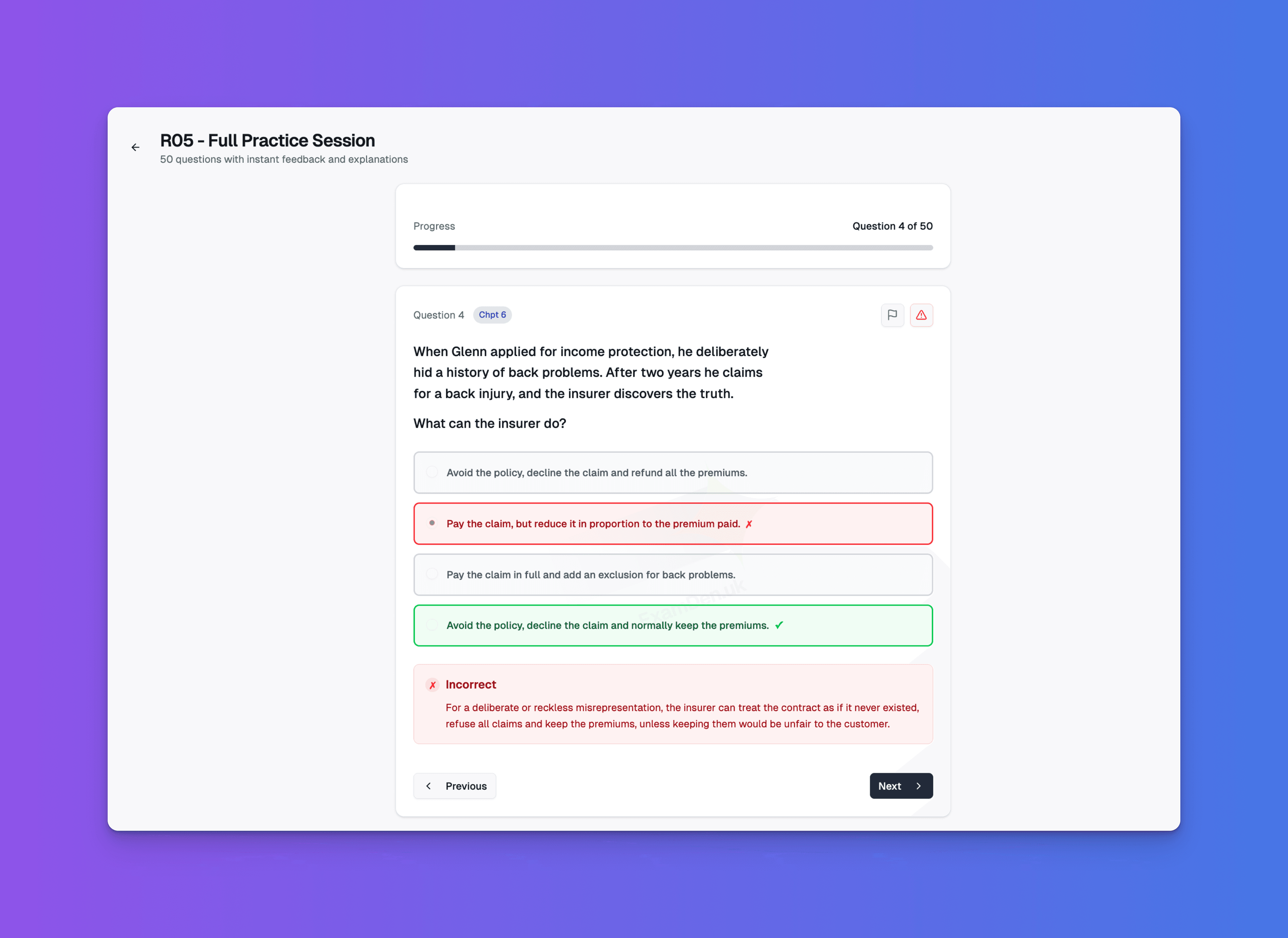
On ExamDen.uk, every question comes with a clear explanation linked to the relevant learning outcome
💡 Revision tip: make a comparison table with columns for term, whole of life and endowment. For each, note: cover type (life only / savings), premium pattern, surrender value, typical use, tax status (qualifying/non-qualifying). This single table will help answer multiple exam questions.
LO5: Taxation of Protection Policies — 6 Questions
Key areas to revise:
- Qualifying vs non-qualifying. The conditions for a qualifying policy: minimum 10-year term (or 75% of term for endowments), regular premiums, sum assured at least 75% of total premiums. Qualifying policy gains are tax-free for individuals.
- Onshore bond taxation. Chargeable events, the 5% cumulative annual withdrawal allowance, the 20% basic-rate credit. A higher-rate taxpayer pays only 40% − 20% = 20%. Top-slicing relief for gains that push the policyholder into a higher band.
- Offshore bond taxation. No basic-rate credit (no UK tax in the fund). Full gain taxed at the marginal rate. Top-slicing relief still applies.
- Tax on protection payouts. Life assurance proceeds: generally tax-free under a qualifying policy or when paid in trust. Income protection: individual-paid premiums not deductible, benefits tax-free; employer-paid premiums deductible, benefits taxable via PAYE.
- Trusts and tax. How placing a policy in trust can take the proceeds outside the estate for IHT. Bare trusts, discretionary trusts, their different tax implications.
💡 Revision tip: the onshore bond tax calculation appears in nearly every R05 exam. Practise it until you can do it in 30 seconds: gain × (higher rate − basic rate). For offshore bonds, it's gain × marginal rate (no credit).
🎯 Practise Like the Real Exam
ExamDen.uk tracks your score by learning outcome so you see exactly where you're losing marks. No more guessing which topics to revise.
Start R05 Practice →LO6: Income Protection Insurance — 6 Questions
Key areas to revise:
- Long-term income protection. Pays until retirement, return to work or death. Benefit typically 50–65% of pre-incapacity earnings. Deferred periods (4 weeks to 12 months). Own occupation, any occupation, suited occupation definitions.
- Short-term income protection. Pays for a fixed period (typically 1–2 years). Often used by employers.
- ASU (Accident, Sickness and Unemployment). Covers all three risks. Often sold alongside mortgages. Shorter benefit periods than long-term IP.
- Tax treatment. Individual policy: premiums not deductible, benefits tax-free. Employer policy: premiums deductible as a business expense, benefits taxable as earnings via PAYE.
- Underwriting. Occupation classes, medical history, hazardous activities. How these affect premiums and terms.
LO7: Critical Illness Insurance — 6 Questions
Key areas to revise:
- How CI works. Pays a tax-free lump sum on diagnosis of a specified condition that meets the severity threshold. Not the same as income protection (which pays regular income).
- Covered conditions. ABI model definitions, the core conditions, additional conditions, severity requirements. Children's CI cover.
- Standalone vs accelerated. Standalone: separate sum assured. Accelerated: shares the sum assured with life cover — a CI claim reduces or ends the life cover.
- Comparison with income protection. CI covers specific conditions; IP covers incapacity from any cause. CI pays a lump sum; IP pays income. Both can be held together.
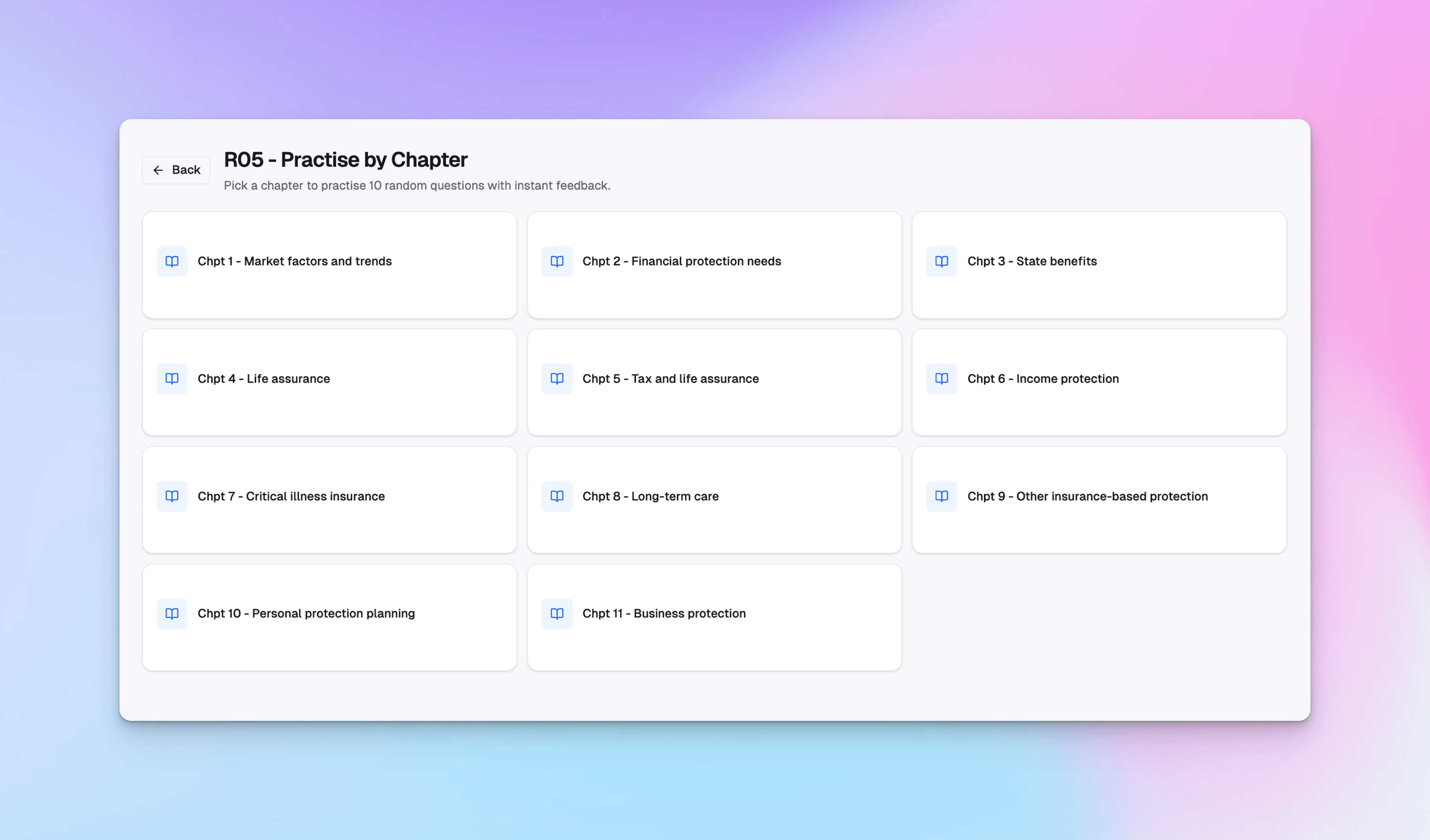
On ExamDen.uk, practise by learning outcome to find your weak spots before you take a full mock
LO9: Other Insurance-Based Protection — 6 Questions
Key areas to revise:
- Private medical insurance (PMI). What it covers, exclusions, moratorium vs full medical underwriting. The role of the NHS.
- Business protection. Keyperson insurance (covers the business against loss of a key individual), share protection (cross-option agreements — surviving shareholders buy the deceased's shares), partnership protection (each partner insures their own life in trust for the others). Know how to calculate the sum assured for each.
- Group protection. Group life assurance, group income protection, group CI. How employer schemes work, eligibility, free cover limits.
- Relevant life policies. Tax-efficient life cover for employees — paid by the employer, not a P11D benefit.
LO10: Evaluate Needs and Select Solutions — 6 Questions
Key areas to revise:
- Needs analysis. Identifying protection priorities: income replacement, mortgage repayment, family provision, IHT liability, business continuity.
- Quantifying need. How to calculate the sum assured needed for each risk — taking account of existing provision (state benefits, employer benefits, personal savings).
- Suitability. Matching products to needs. Term for a mortgage. Whole of life for IHT. Income protection for an employed person with dependants. CI for a high-earning single person with no dependants but a mortgage.
- Business suitability. When keyperson is appropriate, when share protection is needed, when partnership protection applies.
- Regular reviews. Life events (marriage, children, divorce, retirement), changes in income, legislative changes.
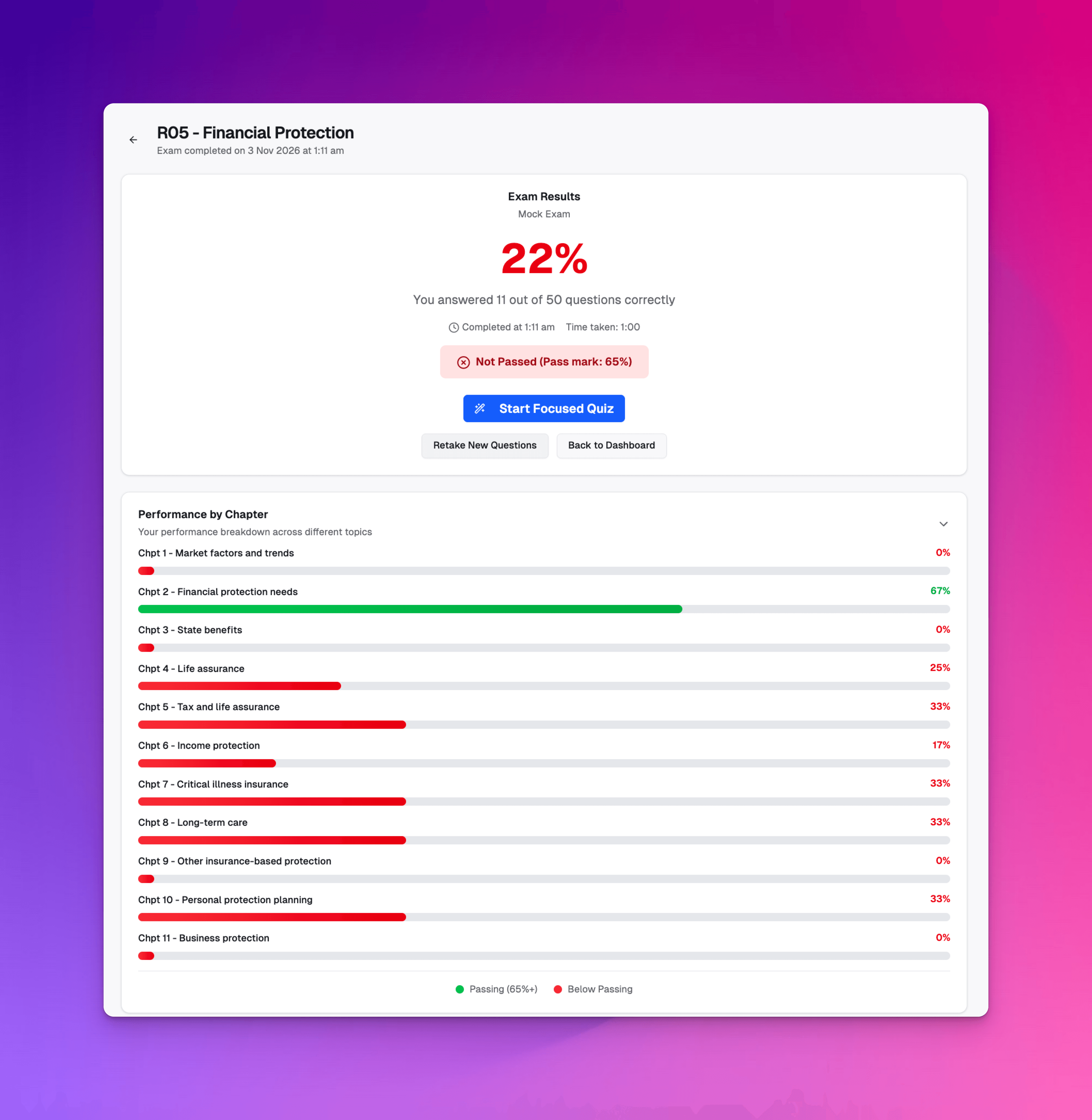
On ExamDen.uk, a mock result shows which learning outcomes are below the 70% line, so you revise those instead of the whole study text
The Smaller LOs: LO1, LO2, LO3 and LO8 — 12 Questions Total
These four LOs carry 3 questions each. They're factual and straightforward — but at a 70% pass mark, 12 questions is 24% of the exam. Don't skip them.
LO1: Consumer and retail market factors (3 questions). The role of insurance in mitigating risk, consumer attitudes to protection, market trends.
LO2: Protection planning needs and sources (3 questions). Why individuals and businesses need protection, the relationship between insurance and assets/liabilities, sources of financial protection.
LO3: State benefits for financial protection (3 questions). Bereavement benefits, Employment and Support Allowance (ESA), state incapacity benefits, local authority care funding. Know the main state benefits and their limitations.
LO8: Long-term care insurance (3 questions). Types of LTC policies (pre-funded, immediate needs annuities), the regulation of LTC products, the care planning process, state vs private funding.
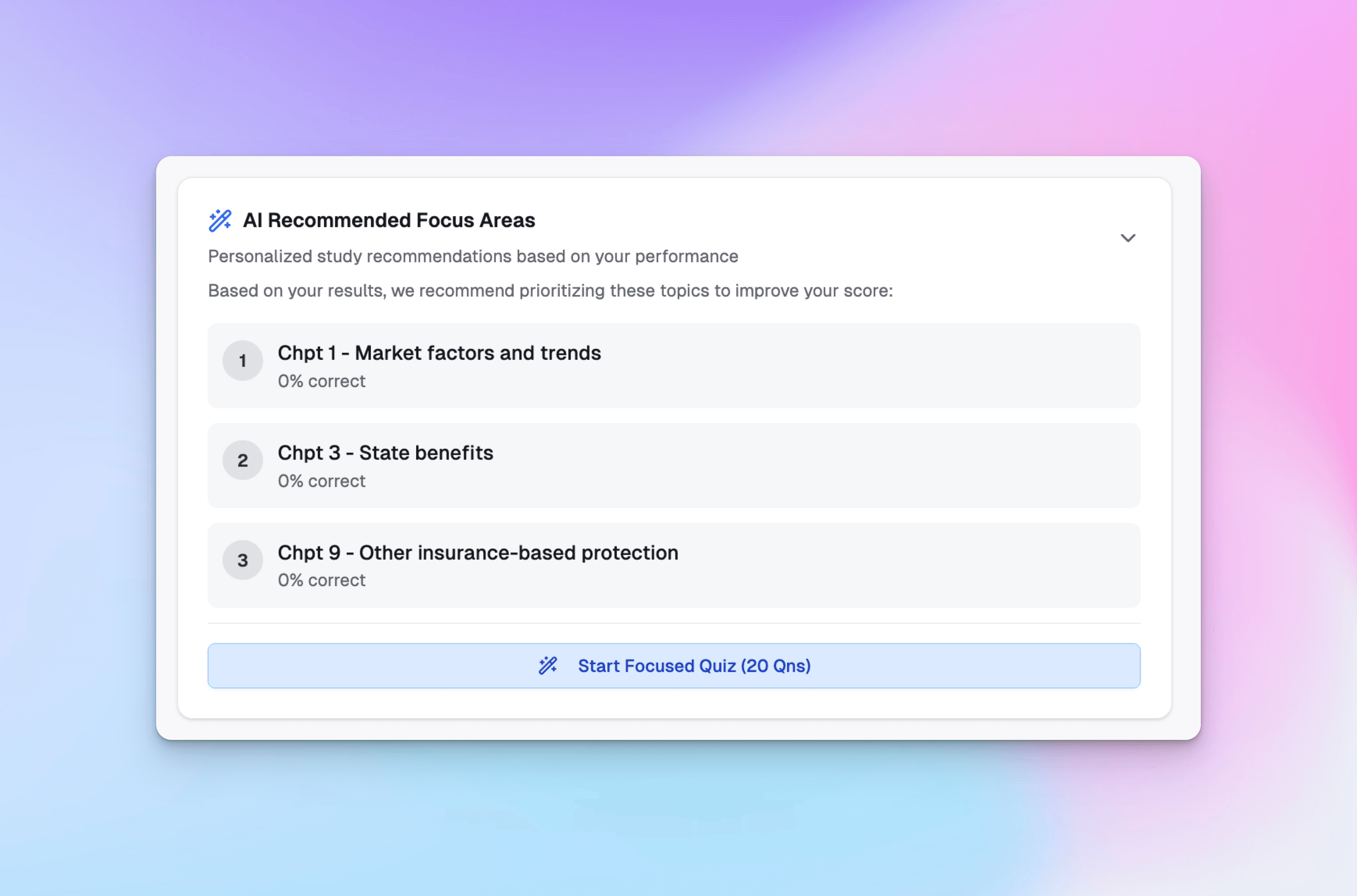
On ExamDen.uk, the focus list after a mock shows which learning outcomes to revise first
Exam Day Tips
- Be precise. At 70%, you have less room for error. Read each question carefully and eliminate options systematically.
- Don't overthink. R05 questions are straightforward MCQs — no MR marking, no trick format. The difficulty is in the detail, not the structure.
- Watch for product confusion. If a question asks about income protection, make sure you're not thinking about critical illness. The products have different triggers and benefits.
- Do the bond calculation carefully. Onshore = 20% credit. Offshore = no credit. Check which type the question is asking about before calculating.
- Use remaining time to review. With 50 questions and each one worth 2%, changing one wrong answer to a correct one can move you from 68% to 70%.
Ready to Test Yourself?
Try these 5 free R05 mock questions to see the question style. When you're ready for full exam simulation, ExamDen's R05 question bank has hundreds of questions, timed mocks and AI that tracks your progress by learning outcome.
R05 Revision FAQs
Ready to Put This Strategy Into Action? 💯
Test your revision. Take a timed R05 mock with exam-style questions and see which learning outcomes need more work.

The ExamDen.uk Team
ExamDen.uk builds exam-style question banks and timed mocks for CeMAP, Cert CII and CII R01–R05, helping UK professionals prepare for their financial services exams.