CeMAP 2 Study Guide: How to Pass MRT1 and MRT2
A detailed guide to CeMAP 2 (MORT) — what MRT1 and MRT2 cover, how to handle the tight timing on MRT1, the calculations you need to know, and where candidates lose marks.
CeMAP 2 is the module that feels most like what you'd expect from a mortgage qualification. It covers mortgage products, borrower types, MCOB rules, property valuations, affordability, arrears and repossession — the practical knowledge you'll use as a mortgage adviser.
After the abstract regulation content of CeMAP 1, many candidates find CeMAP 2 more engaging. But it has its own challenges: MRT1 has the tightest time pressure of any CeMAP unit, the calculations catch people out, and the sheer volume of product detail in MRT2 requires careful revision.
📋 CeMAP 2 at a Glance
- Module name: MORT (Mortgages)
- Two units: MRT1 (50 MCQs, 1 hour) and MRT2 (40 MCQs, 1 hour)
- Format: standalone MCQs only — no case studies
- Pass mark: 35/50 (70%) for MRT1 and 28/40 (70%) for MRT2
- Tightest timing: MRT1 gives you just 72 seconds per question
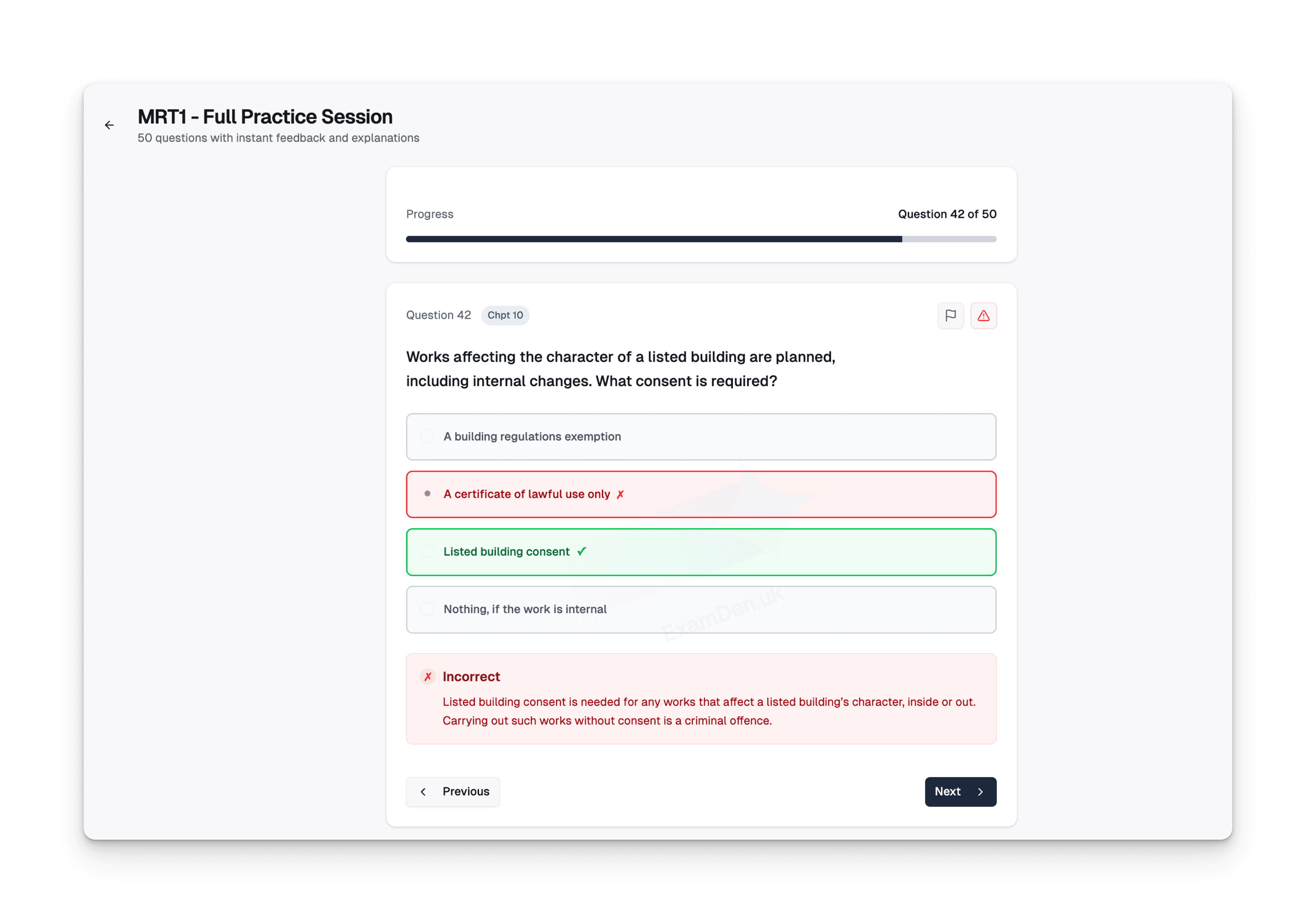
On ExamDen.uk, every MRT1 question comes with an explanation of why the answer is right
MRT1: Mortgage Law, Practice and Application
MRT1 is the bigger and denser of the two CeMAP 2 papers. It covers 11 learning outcomes spanning the full mortgage advice process, from the definition of a regulated mortgage contract through to property valuations.
| LO | Topic |
|---|---|
| 1 | Regulated mortgage definitions and types of mortgage |
| 2 | Buying property at auction |
| 3 | Types of borrower and what disqualifies people from borrowing |
| 4 | MCOB rules and legislation affecting mortgages |
| 5 | Economic and regulatory context for mortgage advice |
| 6 | The mortgage adviser's role and principles of fair outcomes |
| 7 | Additional forms of security |
| 8 | Fees and charges in arranging a mortgage |
| 9 | Property defects that surveys can identify |
| 10 | Factors affecting property value |
| 11 | Different forms of valuation and survey |
The time pressure is real
MRT1 gives you 72 seconds per question — the least of any CeMAP unit. For comparison, FRE1 and FRE2 give you 90 seconds, and ASEW/ASSC gives you 120.
This means you can't afford to spend two or three minutes working through a calculation from scratch. You need to know the methods before you walk in, so that you can apply them quickly.
⏱️ If you're running out of time on MRT1 practice papers, the issue isn't the exam — it's that you're still thinking through the basics. Practise until the common question types feel automatic.
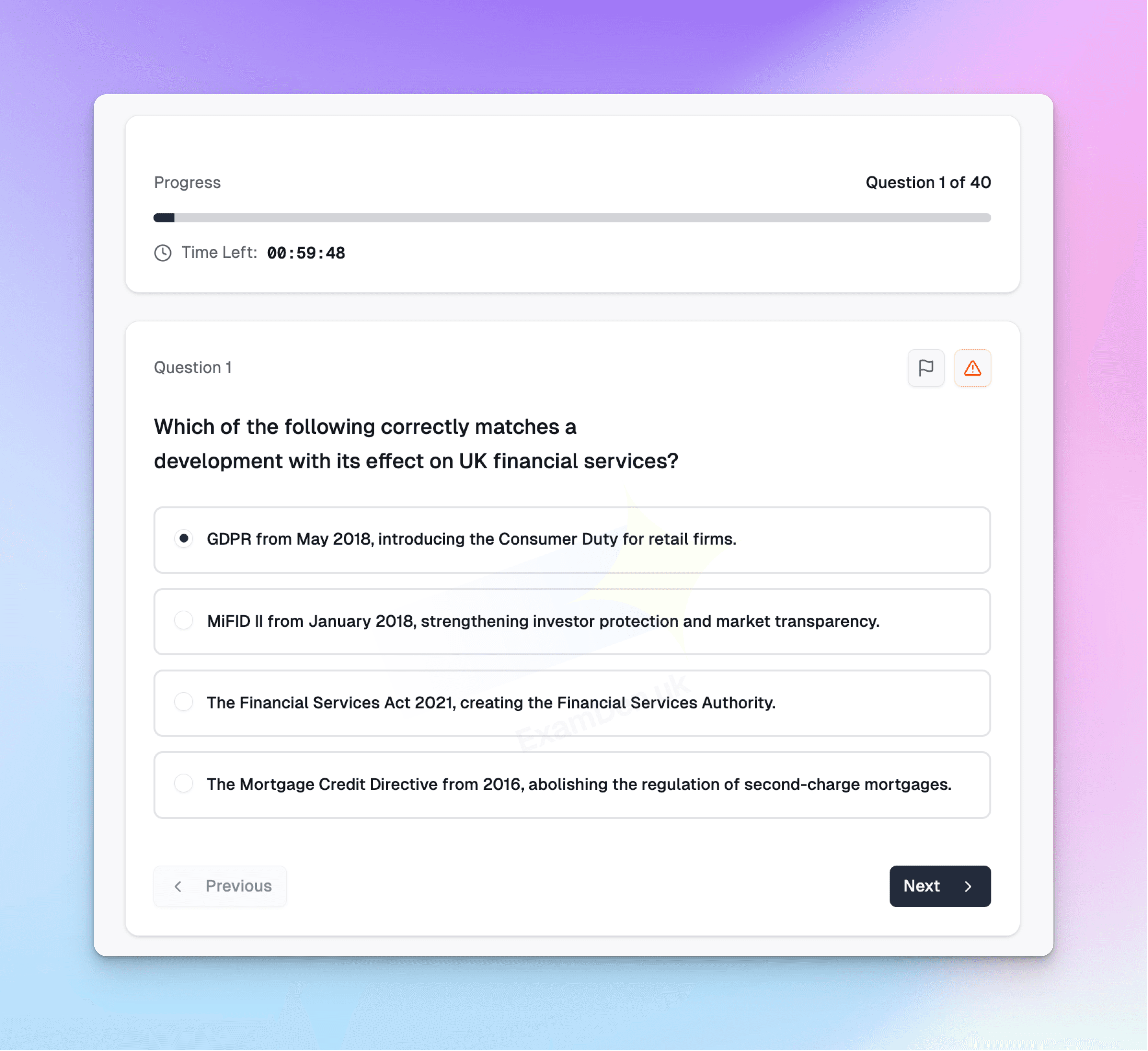
On ExamDen.uk, sit a full timed mock so the 72-second pace feels familiar before exam day
Calculations you need to know
The MRT1 calculations that catch candidates out:
- Loan-to-value (LTV) ratio — loan amount ÷ property value × 100. Know how to work backwards from LTV to find the deposit too.
- Affordability assessments — gross income multiples, net disposable income approach. Know which method does what.
- Early repayment charges (ERCs) — calculating the charge based on the outstanding balance, the ERC percentage and the timing.
- Stamp duty thresholds — the current thresholds and how to calculate the total. Remember that stamp duty uses a tiered system, not a flat rate.
- Interest calculations — the difference between how monthly payments are calculated on repayment vs interest-only mortgages.
Dedicate separate study sessions to calculations. Practise them repeatedly until the method is automatic — then you won't waste time in the exam.
MRT2: Mortgage Products and Post Completion
MRT2 covers 6 learning outcomes focused on what happens after the initial mortgage arrangement — further advances, remortgages, debt consolidation, arrears and the full range of mortgage products.
| LO | Topic |
|---|---|
| 1 | Raising additional money (further advances, bridging, second charges) |
| 2 | Transferring and amending mortgages (porting, product switches, remortgages) |
| 3 | Consolidating debt within a mortgage |
| 4 | Non-payment of mortgages and breaches of the mortgage deed |
| 5 | Lender rights and remedies for non-payment |
| 6 | Structure and features of different mortgage types |
Where candidates lose marks on MRT2
- Mixing up product types. Fixed, variable, tracker, discount, offset, capped — each has specific features, risks and use cases. Questions will test whether you understand the differences, not just the names.
- Arrears and repossession processes. The steps a lender must follow before repossession, the FCA's MCOB rules on forbearance, and the borrower's rights — this is a heavily tested area.
- Further advances vs remortgages. When would you recommend one over the other? What are the cost implications? What if the borrower is in negative equity?
Study Strategy for CeMAP 2
Week-by-week plan (12 hours/week)
| Week | Focus |
|---|---|
| 1–2 | MRT1 LO1–LO6: mortgage definitions, borrowers, MCOB, adviser role |
| 3 | MRT1 LO7–LO11: security, fees, valuations. Calculation drills |
| 4 | MRT1 timed mocks. Sit MRT1 when scoring 75%+ |
| 5–6 | MRT2 LO1–LO6: products, arrears, remortgages |
| 7 | MRT2 timed mocks. Sit MRT2 when scoring 75%+ |
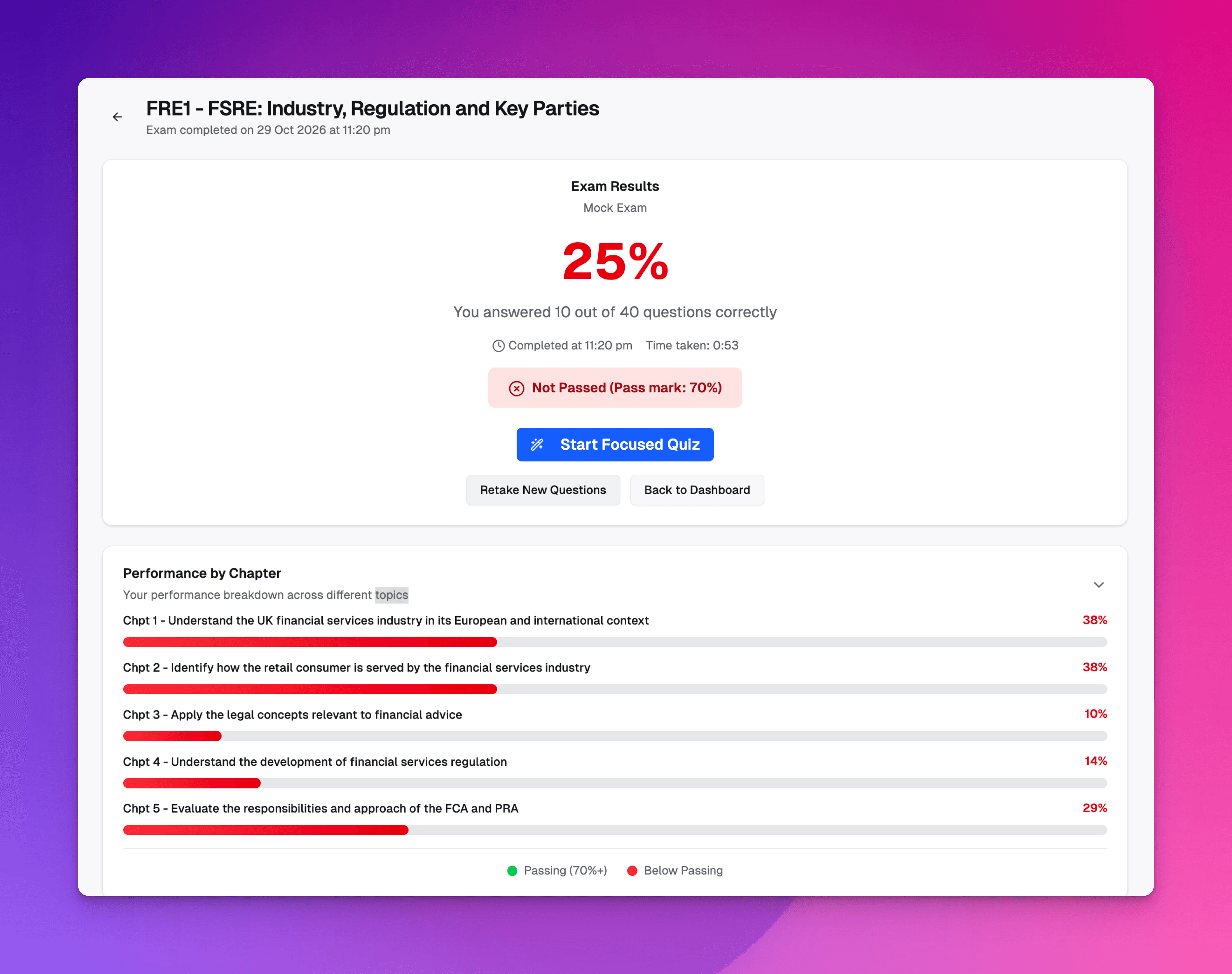
On ExamDen.uk, a timed mock shows your score against the 70% pass mark, and which chapters are below it
Key study habits for CeMAP 2
- Start with MRT1. It's the harder paper and feeds into CeMAP 3. Getting it done first gives you momentum.
- Practise calculations every day. Even 10 minutes a day on LTV, affordability and stamp duty calculations will pay off in the exam.
- For MRT2, make comparison tables. Fixed vs variable, repayment vs interest-only, remortgage vs product switch. Writing out the comparisons yourself is more effective than re-reading them in the study text.
- Take timed mocks before you book. MRT1 at 72 seconds per question is genuinely fast. You need to have done at least 2–3 timed practice papers before the real thing.
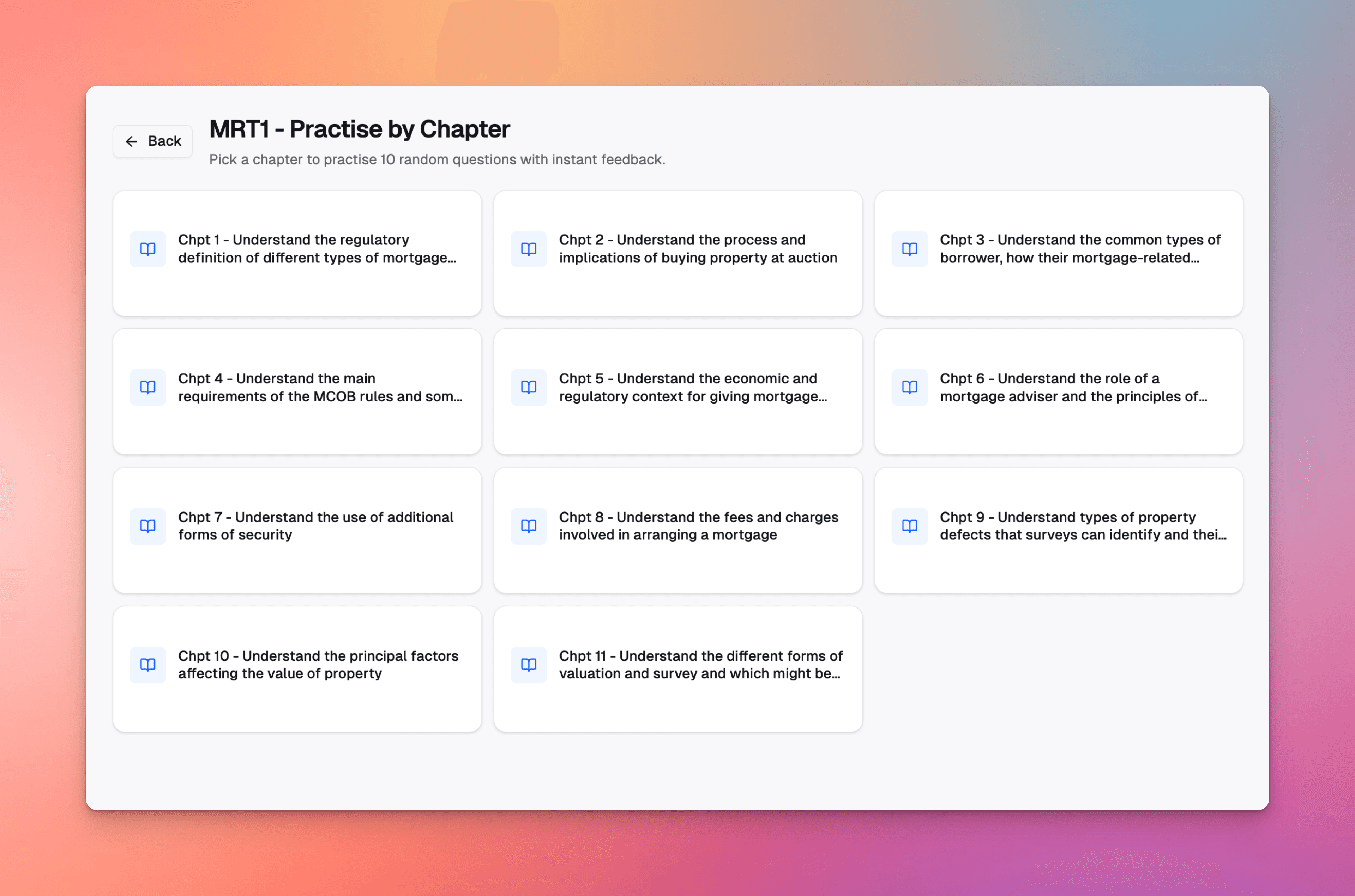
On ExamDen.uk, practise MRT1 one chapter at a time before you sit the full 50-question paper
For the full picture across all three modules, see our complete CeMAP study guide.
After CeMAP 2: Getting Ready for CeMAP 3
CeMAP 3 draws heavily on CeMAP 2 content. The case studies test you on mortgage products, MCOB rules and property processes — all of which you've just studied in MRT1 and MRT2. Most candidates go straight from CeMAP 2 into CeMAP 3 while the material is fresh.
See our CeMAP 3 case study guide for a detailed breakdown of how the synoptic exam works.
Ready to Practise?
The MRT1 and MRT2 question banks on ExamDen cover all 17 learning outcomes with exam-style questions and timed mocks at the real 72 sec/question (MRT1) and 90 sec/question (MRT2) pace.
CeMAP 2 FAQs
Ready to Put This Strategy Into Action? 💯
Practise MRT1 and MRT2 with 500+ exam-style questions, timed at the real 72 sec/question pace for MRT1.

The ExamDen.uk Team
ExamDen.uk builds exam-style question banks and timed mocks for CeMAP, Cert CII and CII R01–R05, helping UK professionals prepare for their financial services exams.