Free CII I11 Mock Exam Questions with Answers (2026)
Try 5 free I11 practice questions with answers and explanations — covering the UK Corporate Governance Code, hybrid risk structures, Consumer Duty, risk society and severity.
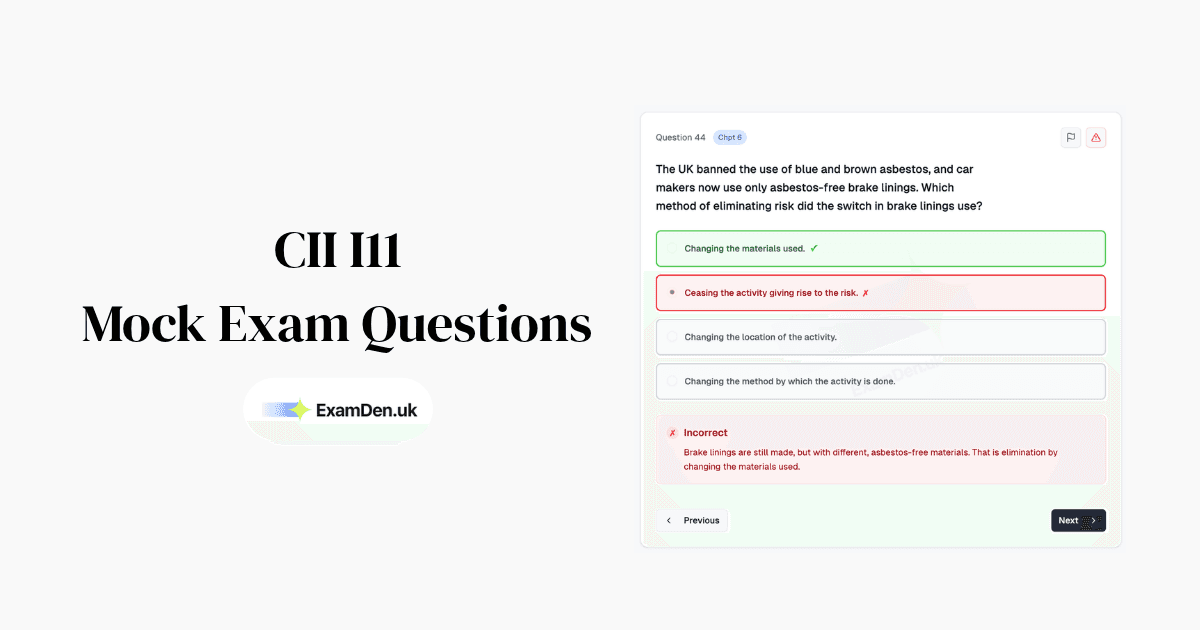
Looking for free CII I11 practice questions? Here are 5 exam-style questions with answers and detailed explanations.
I11 is a straightforward format: 75 standalone MCQs in 2 hours. No case studies, no multiple-response questions — just pick one from four. The challenge is the breadth of the syllabus, from risk theory (Ulrich Beck's "risk society") to practical governance (the UK Corporate Governance Code).
📝 I11 Exam Quick Facts
- 75 standalone MCQs in 2 hours — no case studies
- Pass mark: 70% (at least 53 out of 75)
- No multiple-response questions: every question is pick one from four
- Syllabus: concept of risk, identification & analysis, evaluation, treatment, risk in practice, business continuity
---
Question 1: LO5 — Risk Management in Practice
Under the UK Corporate Governance Code, what must the board do in respect of the company's principal and emerging risks?
A. Publish them only to the regulator
B. Transfer all of them to insurers through one combined policy
C. Appoint a separate officer for each risk
D. Robustly assess them and confirm this in the annual report
Click to reveal answer
✓ Correct Answer: D
Robustly assess them and confirm this in the annual report.
The UK Corporate Governance Code requires the board to carry out a robust assessment of the company's emerging and principal risks and confirm this in the annual report, describing how those risks are being managed or mitigated. This is a governance responsibility — the board cannot simply delegate it to the regulator or transfer it all to insurers.
Question 2: LO5 — Risk Management Structures
A group has a largely decentralised structure but a small central risk team reporting to the CRO sets standards for all business units.
What structure is this?
A. A fully decentralised approach
B. A governance, risk and compliance merger
C. A centralised approach
D. A hybrid approach
Click to reveal answer
✓ Correct Answer: D
A hybrid approach.
A hybrid approach combines elements of both centralised and decentralised risk management. Individual business units manage their own risks day-to-day (decentralised), while a small central risk team — typically reporting to the Chief Risk Officer (CRO) — sets group-wide standards through a risk policy and manual. This is the most common structure in large organisations.
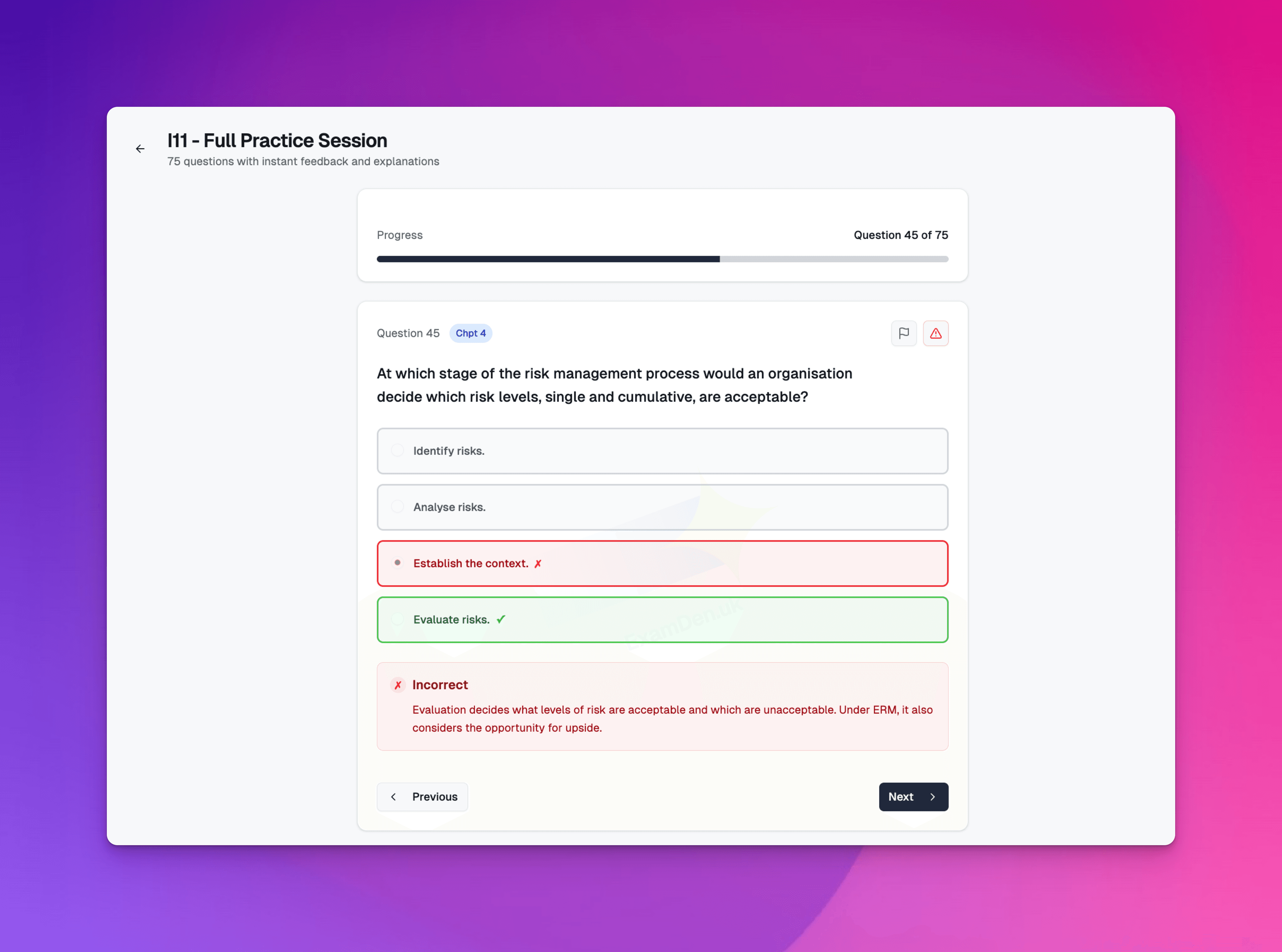
On ExamDen.uk, every question comes with a detailed explanation, like the sample questions above
Question 3: LO5 — Regulatory Requirements
Since its rules took full effect for closed products on 31 July 2024, which FCA requirement obliges firms to act to deliver good outcomes for retail customers?
A. The UK Corporate Governance Code
B. The Solvency UK regime
C. The Consumer Duty
D. The Senior Managers and Certification Regime
Click to reveal answer
✓ Correct Answer: C
The Consumer Duty.
The FCA's Consumer Duty applied to open products and services from 31 July 2023 and extended to closed products from 31 July 2024. It requires firms to act to deliver good outcomes for retail customers across four areas: products and services, price and value, consumer understanding, and consumer support.
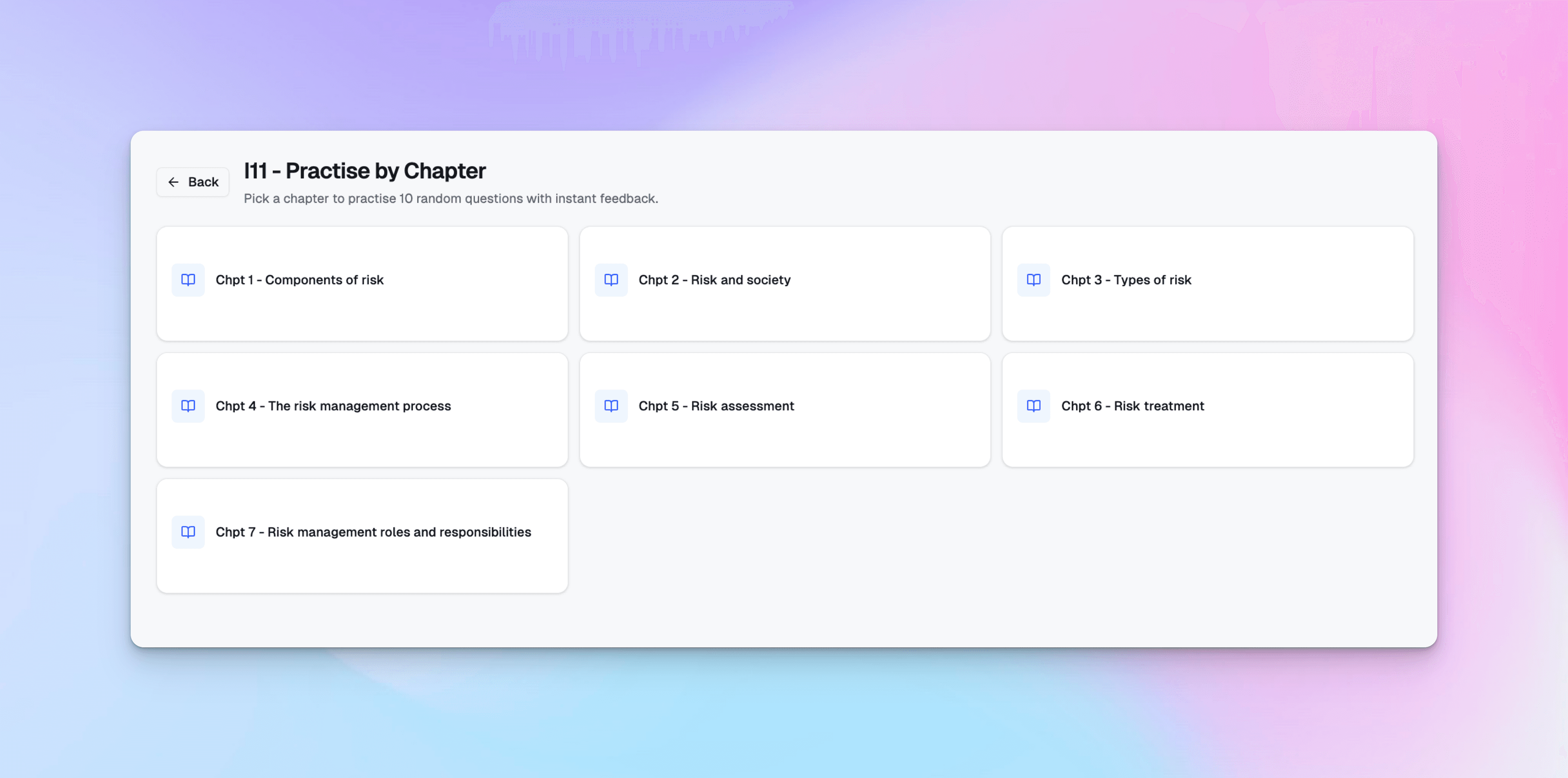
On ExamDen.uk, practise one learning outcome at a time to build confidence before a full timed mock
🎯 Practise Like the Real Exam
ExamDen.uk tracks your score by learning outcome so you see exactly where you're losing marks. No more guessing which topics to revise.
Start I11 Practice →Question 4: LO1 — The Concept of Risk
A sociologist argues that modern society has become far more anxious about risk and more risk-averse than in the past. Which term, coined by Ulrich Beck, describes this?
A. The risk society
B. The compensation culture
C. The risk-mature organisation
D. The prevention paradox
Click to reveal answer
✓ Correct Answer: A
The risk society.
Ulrich Beck coined the term "risk society" to describe an era dominated by anxiety about risk. Beck's argument is that modern society has become more risk-averse — not necessarily because life is riskier, but because awareness and anxiety about risk have grown. This is a key theoretical concept in LO1 and is tested frequently.
Question 5: LO1 — Frequency and Severity
House A sits beside a river that has flooded twice in 50 years. House B is on higher ground but is worth three times as much.
Why might an underwriter view House B as the higher risk despite its lower flood frequency?
A. Its flood risk is fundamental rather than particular
B. Its moral hazard is likely to be worse
C. Its potential severity of loss is greater
D. Its exposure is speculative rather than pure
Click to reveal answer
✓ Correct Answer: C
Its potential severity of loss is greater.
Risk is assessed on both frequency and severity. Although House B has a lower flood frequency, its much higher value means any loss would be far more costly. An underwriter assesses total risk exposure — and a single high-severity loss can outweigh many small, frequent losses. This distinction between frequency and severity is a core concept in LO1.
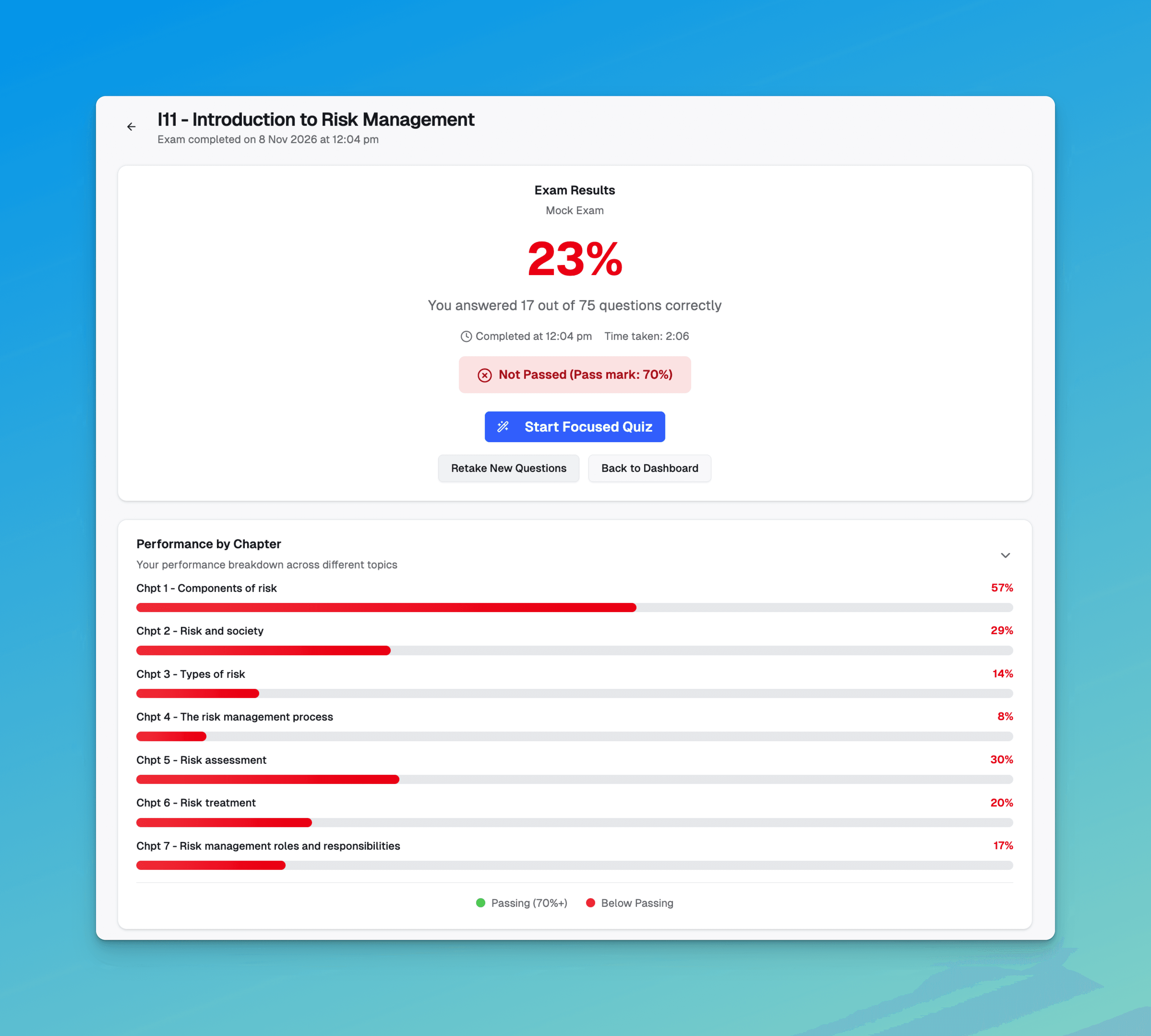
On ExamDen.uk, a timed mock shows your score against the 70% pass mark, and which learning outcomes are below it
How Did You Do?
These 5 questions cover three of I11's six learning outcomes — and the real exam has 75 questions across all six.
For a full study plan and learning outcome breakdown, see our complete I11 study guide. If you want to practise more, ExamDen's I11 question bank has hundreds of exam-style questions with timed mocks and AI that tracks your weak learning outcomes.
For a revision-ready overview of every learning outcome, see our I11 revision guide. Wondering about the difficulty level? Read Is I11 Hard? for a full breakdown.
I11 Practice Questions FAQs
Ready to Put This Strategy Into Action? 💯
Try hundreds more exam-style I11 questions with timed mocks and AI-driven learning outcome tracking.

The ExamDen.uk Team
ExamDen.uk builds exam-style question banks and timed mocks for CeMAP, Cert CII and CII R01–R05, helping UK professionals prepare for their financial services exams.