How to Pass CII I11 (2026): Study Guide and Exam Tips
A practical guide to passing CII I11 — covering the exam format, all 6 learning outcomes, the 70% pass mark, risk management fundamentals and common mistakes.
I11 — Introduction to Risk Management — is the risk management unit of the Cert CII (Certificate in Insurance). It covers the theory and practice of managing risk: what risk is, how to identify and evaluate it, how to treat it, and how organisations manage it in the real world.
Unlike IF5, IF6 and I10, I11 has no case studies. All 75 questions are standalone MCQs — pick one from four. The challenge is the breadth: LO1 alone (the concept of risk) is 21 questions, covering everything from Ulrich Beck's "risk society" to the difference between pure and speculative risk.
📋 I11 Quick Summary
- 75 standalone MCQs in 2 hours — no case studies
- Pass mark: 70% (at least 53 out of 75)
- 6 learning outcomes
- Heaviest LO: LO1 (concept of risk) — 21 questions (28%)
- On-demand exam: book almost any day, sit at a test centre or online with a remote invigilator
I11 Exam Format
I11 is 75 standard multiple-choice questions in 2 hours. Every question has four options; pick one. There are no multiple-response questions and no case studies.
The pass mark is 70% — you need at least 53 out of 75 correct, meaning you can get 22 wrong. No marks are deducted for incorrect answers, so always attempt every question.
That gives you 96 seconds per question on average — comfortable provided you've studied the material.
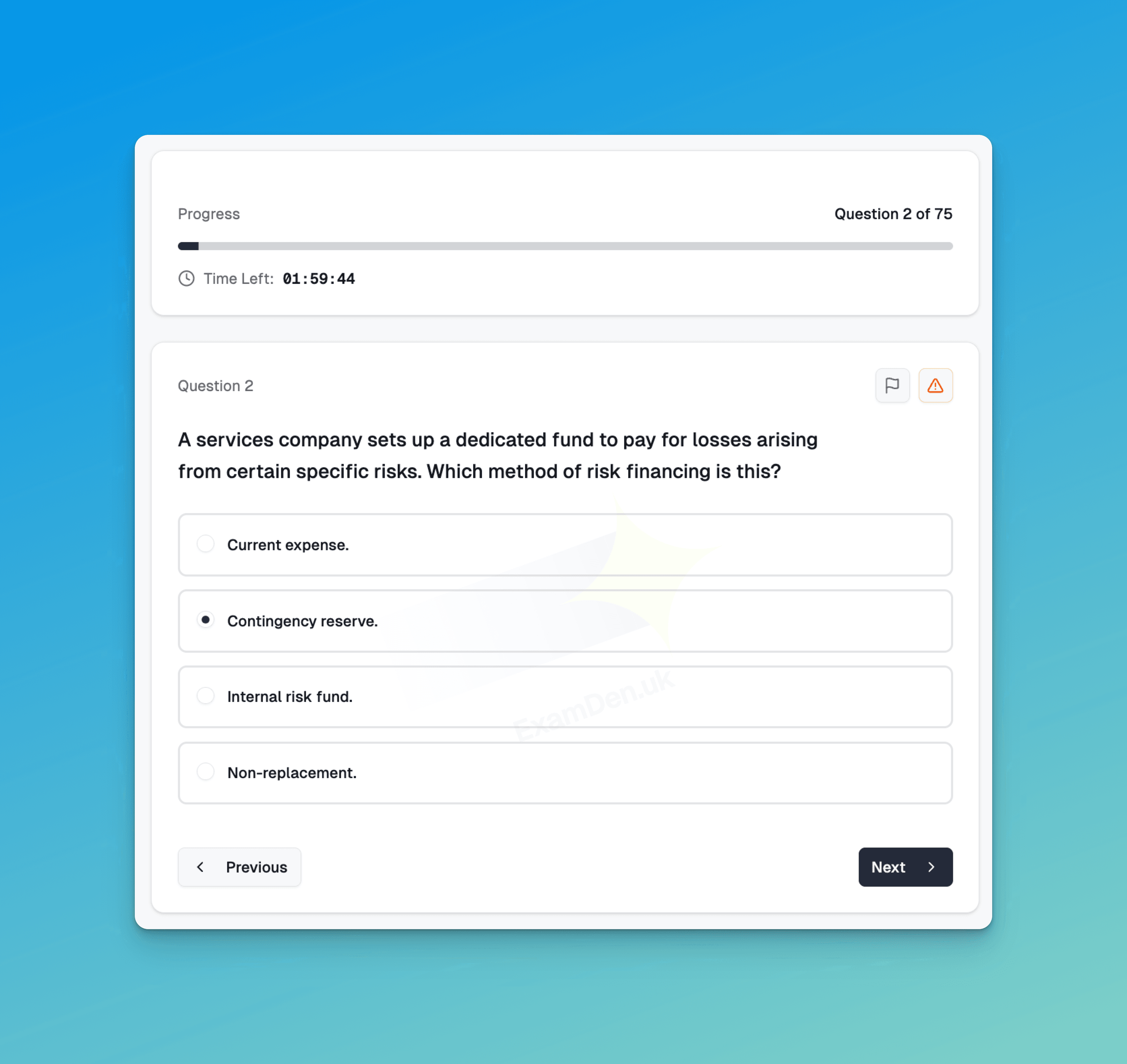
On ExamDen.uk, timed mocks use the same question count, time limit and pass mark as the real I11 exam
Question Distribution by Learning Outcome
| LO | Topic | Questions | % of exam |
|---|---|---|---|
| 1 | The concept of risk | 21 | 28% |
| 4 | How risk can be treated | 16 | 21% |
| 2 | How risk can be identified and analysed | 12 | 16% |
| 5 | How risk is managed in practice | 12 | 16% |
| 3 | How risk can be evaluated | 10 | 13% |
| 6 | Business continuity management | 4 | 5% |
LO1 and LO4 together account for 37 out of 75 questions (49%) — nearly half the exam. Get these two right and you're well on the way.
---
LO1: The Concept of Risk — 21 Questions (28%)
The largest learning outcome by a clear margin. It covers what risk actually is, how we perceive it and the role insurance plays in managing it.
What it tests:
- Risk definitions. Pure risk (only loss or no loss) vs speculative risk (loss, gain or no change). Fundamental risk (affecting society broadly) vs particular risk (affecting individuals).
- Frequency and severity. How risk is measured by how often losses occur (frequency) and how large they are (severity). Why an underwriter might view a low-frequency, high-severity risk as more dangerous than a high-frequency, low-severity one.
- Hazards. Physical hazard (tangible features increasing risk — e.g. a thatched roof). Moral hazard (dishonesty — e.g. deliberate over-valuation). Morale hazard (carelessness — e.g. leaving doors unlocked because "the insurance will pay").
- Risk perception. Why the same risk is perceived differently by different people. The role of media, experience and cognitive biases (availability heuristic, optimism bias).
- The risk society. Ulrich Beck's concept — modern society has become more anxious about risk and more risk-averse, even though life may not actually be riskier.
- The role of insurance. Insurance as a mechanism for transferring pure risk. Insurable interest, pooling, the law of large numbers. Why speculative risks are generally uninsurable.
Study approach: LO1 is broad and partly theoretical. Don't skip the sociological and perceptual material — questions on Beck's "risk society" and risk perception are common.
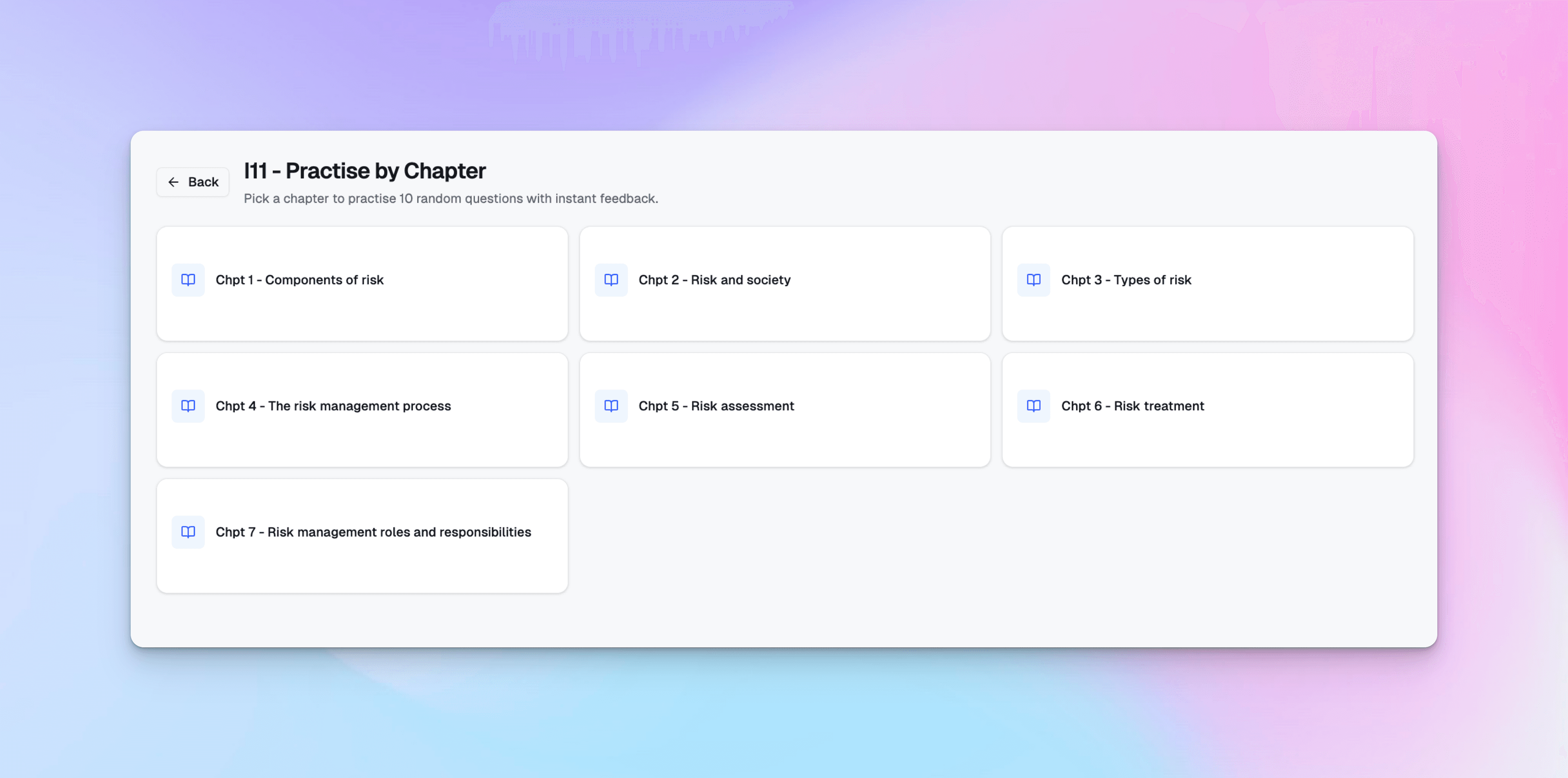
On ExamDen.uk, practise one learning outcome at a time to build confidence before a full timed mock
LO4: How Risk Can Be Treated — 16 Questions (21%)
What it tests:
- The four strategies. Avoid (eliminate the risk entirely), Reduce (lower frequency or severity), Transfer (shift the financial consequence — typically through insurance), Retain (accept the risk, fund losses internally). Some frameworks use Tolerate, Treat, Transfer, Terminate.
- Insurance as risk transfer. How insurance works to transfer pure risk. The distinction between risk transfer and risk financing.
- Self-insurance and captives. Retaining risk through self-insurance funds, captive insurance companies. When and why organisations choose these over commercial insurance.
- Risk retention. Deductibles, excesses, aggregate limits. Why organisations retain some risk (cost, control, availability of cover).
- Loss prevention and loss reduction. Loss prevention stops losses happening (sprinkler systems, training). Loss reduction limits severity once a loss occurs (fire walls, business continuity plans). Know the difference.
- Risk financing. How organisations fund retained risk. Provisions, reserves, contingency funds, catastrophe bonds.
Study approach: Focus on being able to distinguish the four treatment strategies and give examples of each. Know why an organisation might choose one strategy over another.
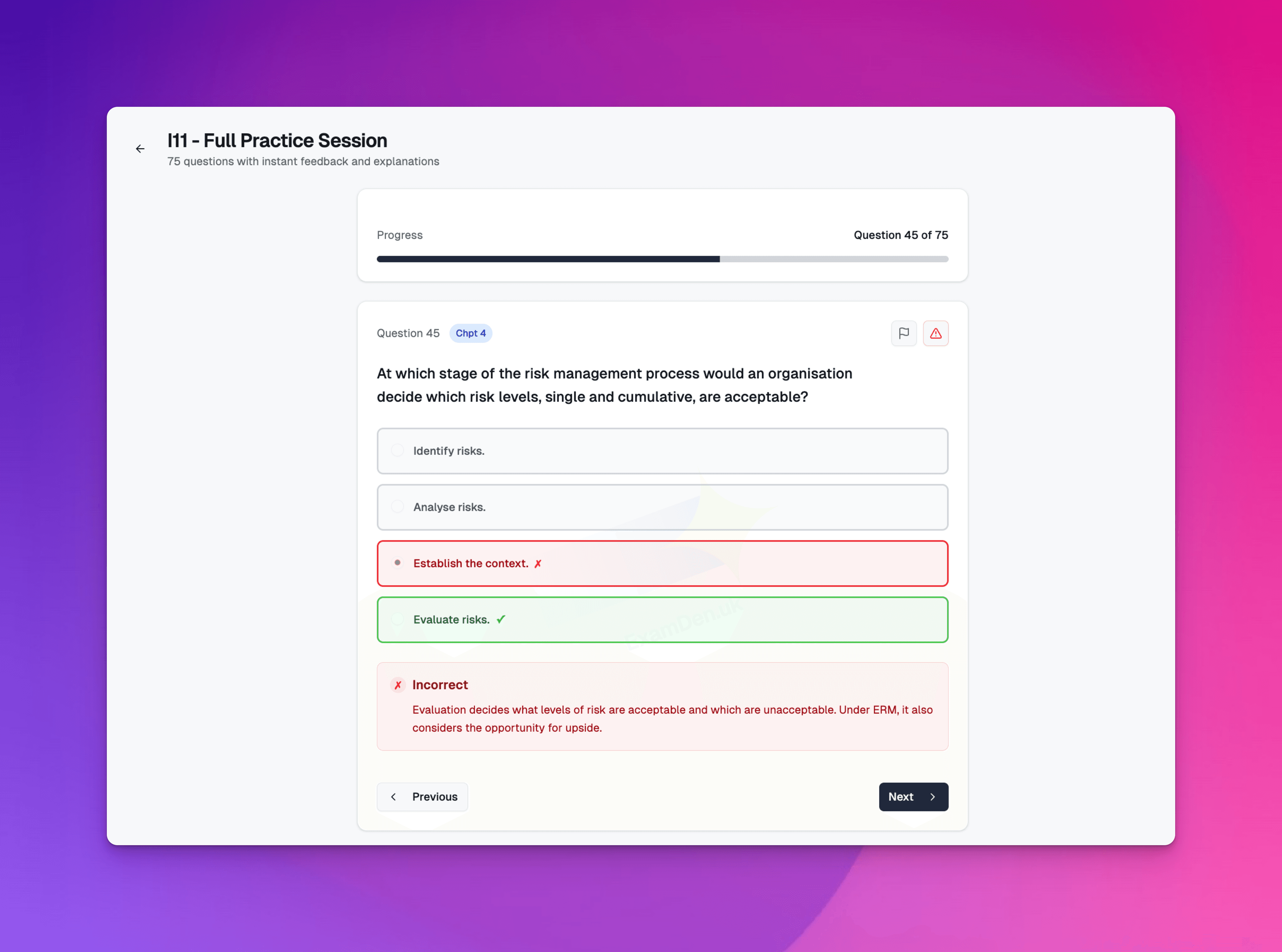
On ExamDen.uk, every question comes with a detailed explanation linked to the relevant learning outcome
🎯 Practise Like the Real Exam
ExamDen.uk tracks your score by learning outcome so you see exactly where you're losing marks. No more guessing which topics to revise.
Start I11 Practice →LO2: Risk Identification and Analysis — 12 Questions (16%)
What it tests:
- Identification techniques. SWOT analysis, PESTLE analysis, brainstorming, checklists, inspections, flowcharts. What each technique reveals and its limitations.
- Risk registers. Recording identified risks with descriptions, owners, likelihood, impact and treatment plans. How registers are maintained and reviewed.
- Risk mapping. Probability/impact matrices (risk maps). Plotting risks by how likely they are and how severe their consequences would be. Using the map to prioritise.
- Scenario analysis. "What if" thinking. Stress testing. Worst-case, best-case and most-likely scenarios. How scenario analysis complements quantitative methods.
- Loss data. Using historical loss data and trends to identify patterns. Internal data vs external benchmarking.
- Hazard identification. Linking back to LO1's hazard types — identifying physical, moral and morale hazards in practice.
LO5: Risk Management in Practice — 12 Questions (16%)
What it tests:
- Corporate governance. The UK Corporate Governance Code. The board's responsibility for risk management: robustly assessing principal and emerging risks and confirming this in the annual report. Audit committees, risk committees.
- Enterprise Risk Management (ERM). A holistic, organisation-wide approach to risk. COSO framework, ISO 31000. How ERM differs from silo-based risk management.
- Risk management structures. Centralised (one central team), decentralised (each business unit manages its own risk) and hybrid (business units manage risk locally, a small central team sets standards and reports to the CRO).
- The Chief Risk Officer (CRO). Role, reporting lines, independence. How the CRO fits into the governance structure.
- Regulatory requirements. The FCA's Consumer Duty (good outcomes for retail customers). Senior Managers and Certification Regime (SM&CR). Solvency requirements.
- Risk culture. How leadership, incentives, training and accountability shape risk behaviour across an organisation. The difference between a risk-aware and a risk-averse culture.
LO3: Risk Evaluation — 10 Questions (13%)
- Probability and impact. Quantifying the likelihood of a risk occurring and the financial or operational impact if it does. Qualitative (high/medium/low) vs quantitative (numerical probability, expected loss).
- Risk appetite and risk tolerance. Risk appetite: how much risk an organisation is willing to take in pursuit of its objectives. Risk tolerance: the acceptable variation around that appetite. How the board sets and communicates appetite.
- Cost-benefit analysis. Comparing the cost of risk treatment against the expected loss. When treatment costs exceed the expected benefit, retention may be the rational choice.
- Risk prioritisation. Using evaluation results to decide which risks need treatment first. Gross risk (before controls) vs net risk (after existing controls) vs target risk (desired residual level).
LO6: Business Continuity Management — 4 Questions (5%)
LO6 is only 4 questions, but it's easy marks if you know the basics.
- Business continuity planning (BCP). A plan to maintain critical operations during and after a disruption. The stages: business impact analysis, strategy development, plan documentation, testing, maintenance.
- Business impact analysis (BIA). Identifying critical processes, their dependencies, the impact of disruption over time and the maximum tolerable period of disruption (MTPD).
- Recovery objectives. Recovery Time Objective (RTO): how quickly a process must be restored. Recovery Point Objective (RPO): how much data loss is acceptable (measured in time).
- Crisis management. The immediate response to an incident. Communication plans, incident command structures, media handling.
- Testing and exercising. Tabletop exercises, simulation drills, full rehearsals. Why testing is essential — an untested plan may not work when needed.
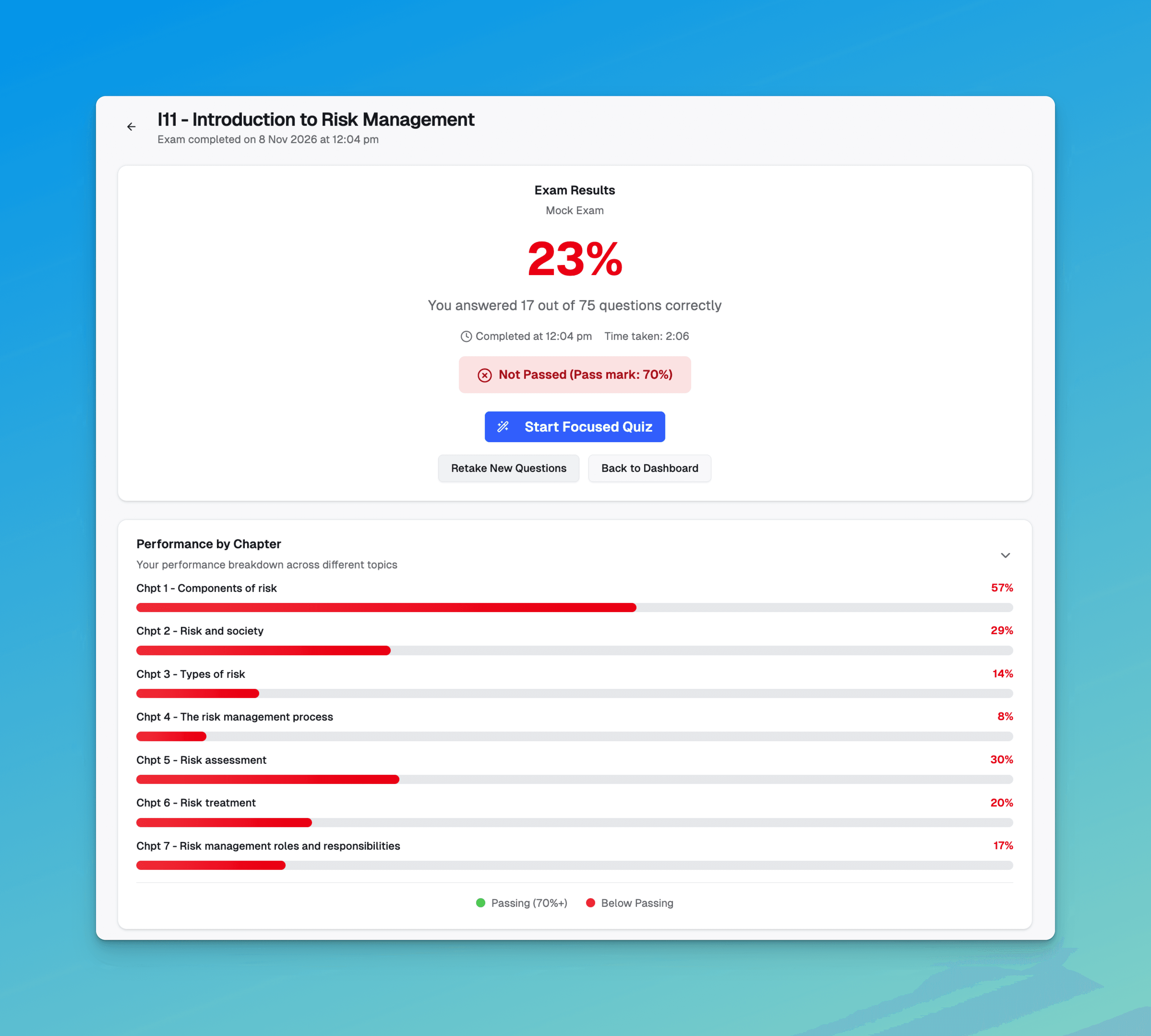
On ExamDen.uk, a timed mock shows your score against the 70% pass mark, and which learning outcomes are below it
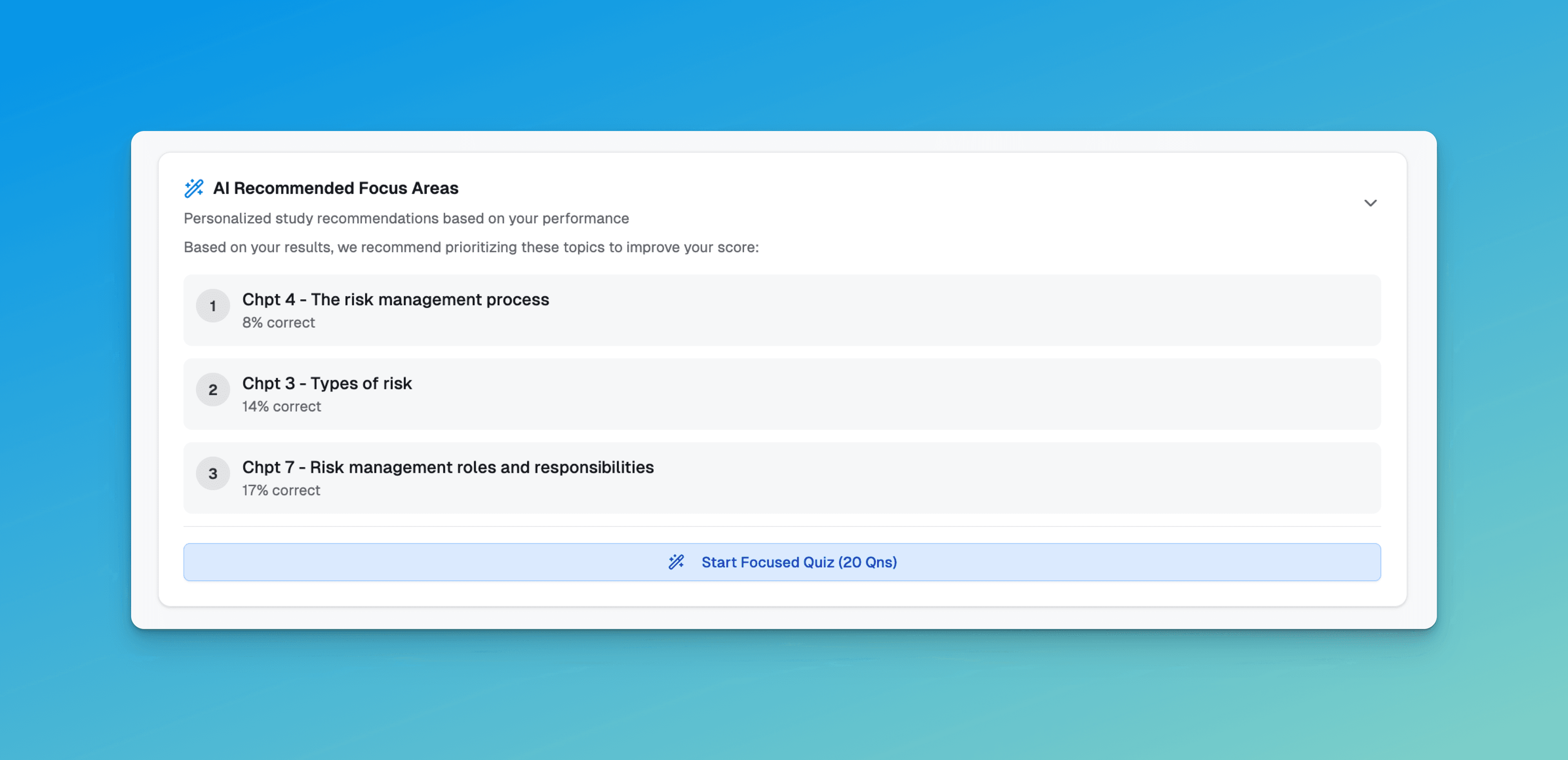
On ExamDen.uk, those weak learning outcomes become a short focus list for your next revision session
Common Mistakes That Cost Marks
1. Skipping the theory in LO1.
28% of the exam tests what risk is — including sociological concepts like the "risk society" and behavioural concepts like risk perception. Candidates who focus only on practical risk management miss a quarter of the marks.
2. Confusing loss prevention and loss reduction.
Loss prevention stops losses happening (e.g. fire prevention training). Loss reduction limits the severity of losses that do happen (e.g. sprinkler systems that contain a fire). The distinction matters in LO4.
3. Mixing up risk appetite and risk tolerance.
Risk appetite is the overall level of risk an organisation is willing to accept. Risk tolerance is the acceptable variation around specific risk metrics. The board sets appetite; individual risk owners work within tolerance.
4. Neglecting LO6 (business continuity).
Only 4 questions, but they're straightforward if you know the terminology (BIA, RTO, RPO, MTPD). They're free marks — don't skip them.
5. Not knowing the governance structures.
LO5 tests the UK Corporate Governance Code, ERM frameworks and risk management structures (centralised, decentralised, hybrid). These are tested directly and frequently.
How I11 Fits Into the Cert CII
I11 is the risk management unit in the CII Certificate in Insurance (Cert CII). It's relevant for anyone in a risk, compliance, operations or governance role — or anyone who wants to understand how organisations manage risk beyond just buying insurance.
The regulatory and legal content in IF1 provides useful background, and the broking practice covered in I10 complements I11's treatment of risk transfer through insurance.
Start Practising
The fastest way to know whether you're ready for I11 is to take a timed mock. ExamDen's I11 question bank has hundreds of exam-style questions with AI that pinpoints which learning outcomes you need to work on.
Want to try a few questions first? Here are 5 free I11 mock questions with answers. If you're looking for past papers, read why the CII doesn't release them, and what to use instead.
For registration, fees and booking, see our guide to registering for CII exams.
CII I11 FAQs
Ready to Put This Strategy Into Action? 💯
Practise with exam-style I11 questions, timed mocks and AI that shows you which learning outcomes to revise.

The ExamDen.uk Team
ExamDen.uk builds exam-style question banks and timed mocks for CeMAP, Cert CII and CII R01–R05, helping UK professionals prepare for their financial services exams.