CII I11 Revision Guide (2026): Learning Outcomes and Exam Tips
CII I11 revision guide: all 6 learning outcomes explained with question counts, priority topics and exam tips for the Introduction to Risk Management exam.
This I11 revision guide covers every learning outcome in the exam, in order of question weight. Use it during your final revision to check that you've covered each topic and know where to focus your remaining study time.
For a broader study plan and common mistakes, see our complete I11 study guide. For practice questions, try these 5 free I11 mock questions.
📋 I11 Exam Recap
- 75 standalone MCQs in 2 hours — no case studies
- Pass mark: 70% (at least 53 out of 75)
- 6 learning outcomes
- LO1 (concept of risk) is 28% of the exam alone
---
LO1: The Concept of Risk — 21 Questions (28%)
The largest learning outcome. This is where I11 differs most from other Cert CII units — it tests theory, not just practice.
- Pure risk vs speculative risk. Pure risk: only loss or no loss (e.g. fire, flood). Speculative risk: loss, gain or no change (e.g. investment, new product launch). Insurance covers pure risk; speculative risk is generally uninsurable.
- Fundamental risk vs particular risk. Fundamental: affects society broadly (e.g. recession, pandemic). Particular: affects specific individuals or organisations (e.g. a factory fire). The distinction matters for whether insurance or government intervention is appropriate.
- Frequency and severity. Frequency: how often losses occur. Severity: how large each loss is. An underwriter assesses both. A low-frequency, high-severity risk (rare but catastrophic) may require more attention than a high-frequency, low-severity one (frequent but minor).
- Hazard types. Physical hazard: tangible features that increase risk (e.g. wooden construction, proximity to a river). Moral hazard: dishonesty or intent to profit from insurance (e.g. arson, over-valuation). Morale hazard: carelessness arising from having insurance (e.g. not locking doors because "the insurance will cover it").
- Risk perception. How people assess risk — influenced by experience, media coverage, dread factor, and cognitive biases. The availability heuristic: risks that are easy to recall (plane crashes, terrorism) are perceived as more likely than they are.
- The risk society. Ulrich Beck's term for a society dominated by anxiety about risk. Beck argued that modern society is more risk-averse, not because it's riskier, but because awareness and anxiety have grown.
- The role of insurance. Pooling of risk, the law of large numbers, insurable interest. Why insurance works for pure risks but not speculative ones. The contribution of insurance to economic stability.
Quick test: What is the difference between moral hazard and morale hazard? Give an example of each.
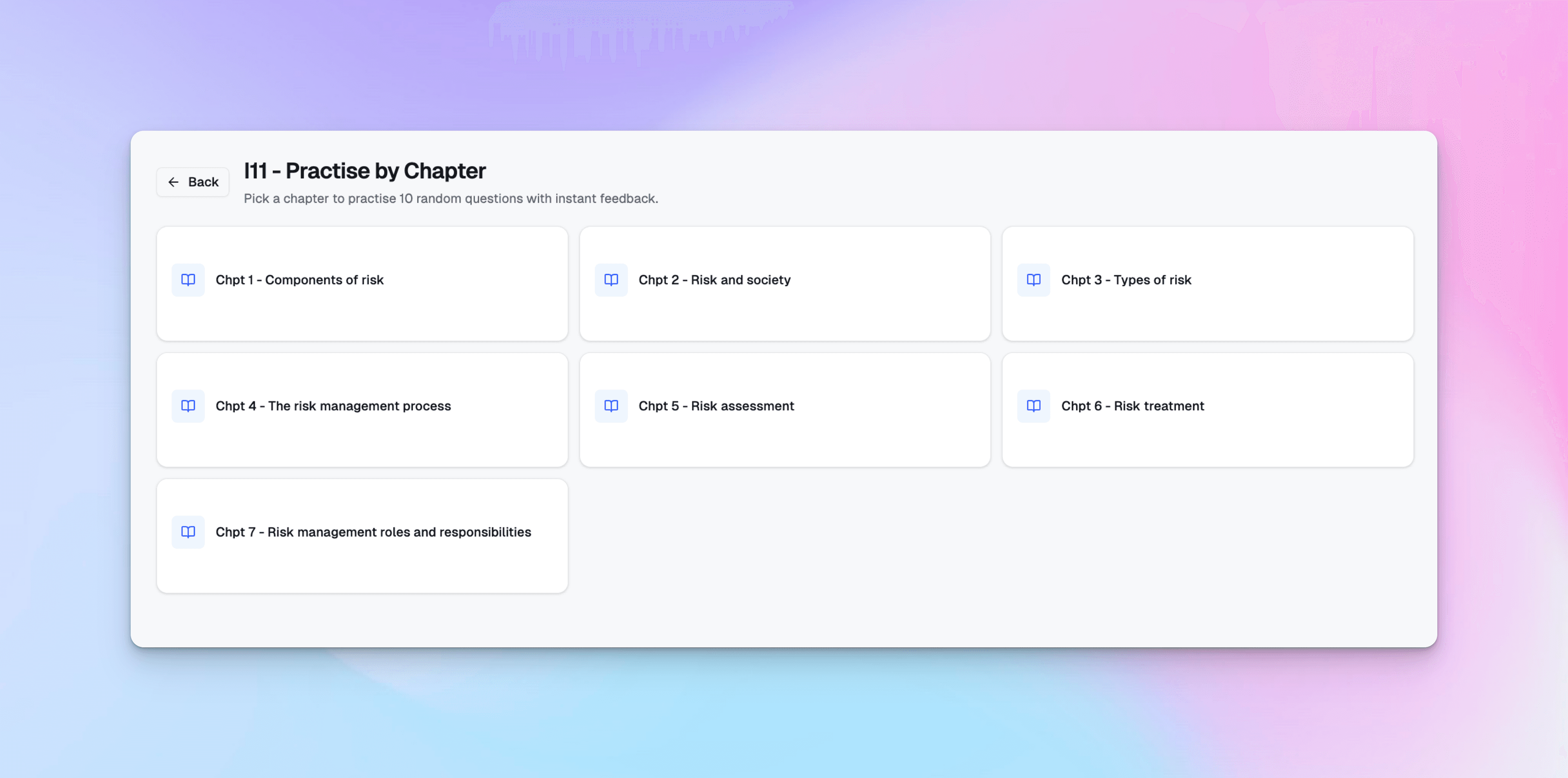
On ExamDen.uk, practise one learning outcome at a time to build confidence before a full timed mock
LO4: How Risk Can Be Treated — 16 Questions (21%)
- Avoidance (Terminate). Eliminating the risk entirely by not undertaking the activity. Example: a company decides not to enter a dangerous market. Limitation: avoidance also eliminates any potential benefit.
- Reduction (Treat). Lowering the frequency or severity of a risk. Loss prevention: measures to stop a loss occurring (fire alarms, training, safety procedures). Loss reduction: measures to limit the severity of a loss that does occur (sprinklers, fire doors, emergency plans).
- Transfer. Shifting the financial consequence of a risk to another party. Insurance is the primary mechanism. Other forms: contractual transfer (indemnity clauses), hedging. What makes a risk insurable: pure risk, insurable interest, measurable loss, large number of similar exposures.
- Retention (Tolerate). Accepting the risk and funding any losses internally. Planned retention: deliberate decision with reserves set aside. Unplanned retention: risks that are retained by default because they're unrecognised or uninsured.
- Self-insurance. Setting aside funds internally to meet losses. A self-insurance fund is not insurance — there's no risk transfer. Used when insurance is unavailable, too expensive, or when the organisation is large enough to absorb losses.
- Captive insurance. A subsidiary set up to insure the parent company's risks. Types: single-parent captive, group captive, rent-a-captive. Benefits: cost control, access to reinsurance markets, cover for otherwise uninsurable risks.
- Risk financing. How retained risk is funded: provisions, reserves, contingency funds. Catastrophe bonds. The relationship between risk retention and risk financing.
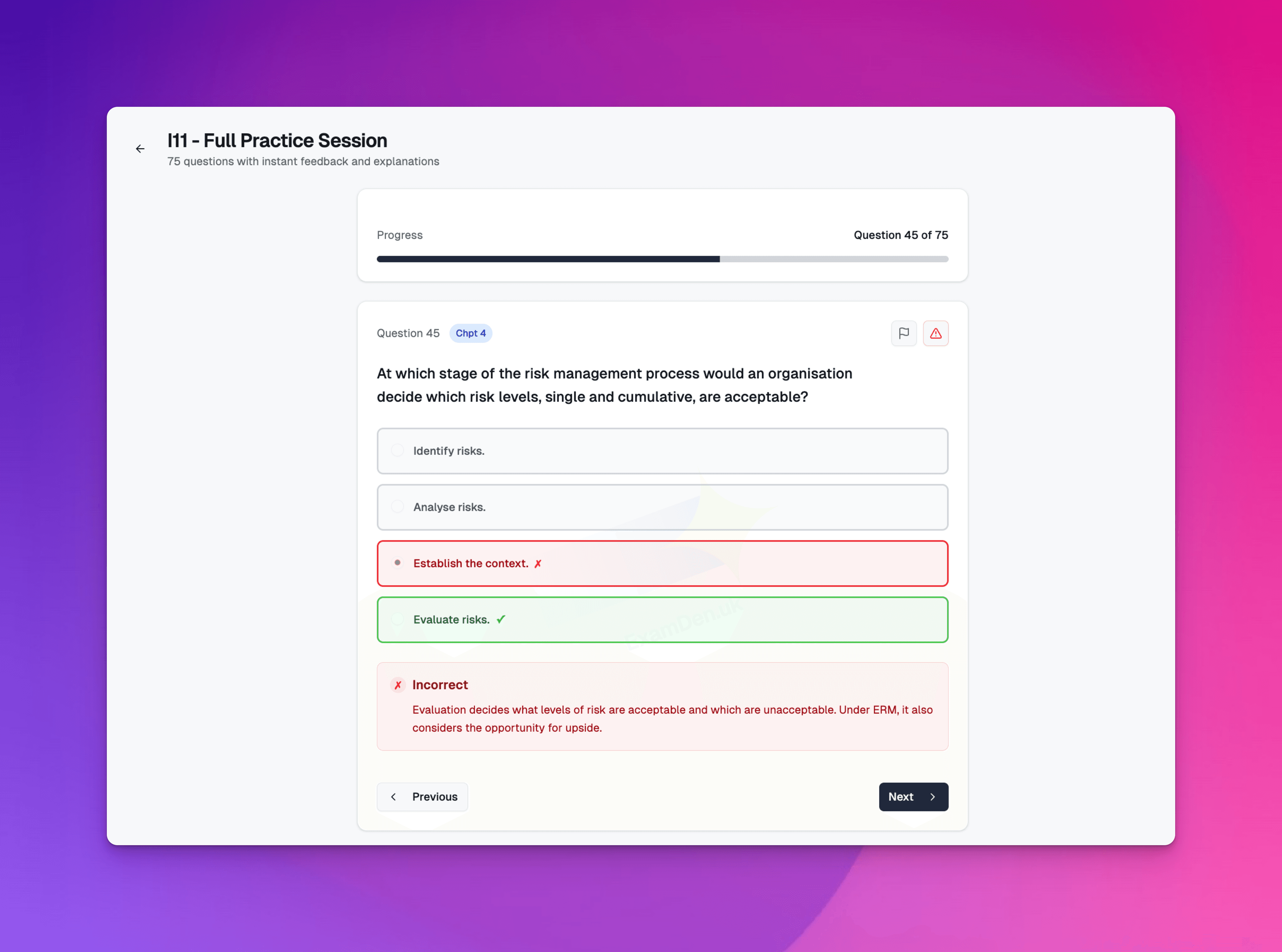
On ExamDen.uk, every question comes with a detailed explanation linked to the relevant learning outcome
🎯 Practise Like the Real Exam
ExamDen.uk tracks your score by learning outcome so you see exactly where you're losing marks. No more guessing which topics to revise.
Start I11 Practice →LO2: Risk Identification and Analysis — 12 Questions (16%)
- SWOT analysis. Strengths, Weaknesses, Opportunities, Threats. An internal and external overview. Useful for strategic risk identification but lacks depth for operational risks.
- PESTLE analysis. Political, Economic, Social, Technological, Legal, Environmental. Identifies external factors that create risk. Used alongside SWOT for a more complete picture.
- Risk registers. The central record of identified risks. Each entry: risk description, owner, likelihood, impact, existing controls, treatment plan, status. Registers must be maintained — risks change over time.
- Risk mapping (probability/impact matrix). A 2D grid plotting risks by likelihood (x-axis) and impact (y-axis). High-likelihood, high-impact risks go to the top-right — they need treatment first. A visual prioritisation tool.
- Scenario analysis. "What if" exercises. Best-case, worst-case and most-likely scenarios. Stress testing specific assumptions. Useful for risks that are hard to quantify with historical data.
- Loss data. Using historical loss records to identify patterns, trends and emerging risks. Internal data (the organisation's own losses) vs external data (industry benchmarking). Limitations: past losses don't predict the future perfectly.
LO5: Risk Management in Practice — 12 Questions (16%)
- UK Corporate Governance Code. The board must carry out a robust assessment of principal and emerging risks, describe them in the annual report and confirm how they're managed. The "comply or explain" approach.
- Enterprise Risk Management (ERM). A holistic, organisation-wide approach. Key frameworks: COSO ERM and ISO 31000. ERM breaks down silos — instead of each department managing its own risks in isolation, the organisation takes a unified view.
- ISO 31000. The international standard for risk management. Key principles: creating value, being part of decision-making, being systematic and structured. The risk management process: establish context → identify → analyse → evaluate → treat → monitor and review.
- Risk management structures. Centralised: one team manages all risk. Decentralised: each business unit manages its own. Hybrid: business units manage risk locally while a central team (reporting to the CRO) sets standards through a group risk policy. Hybrid is the most common in large organisations.
- The CRO. Chief Risk Officer: responsible for the risk management framework, reporting to the board on risk exposures, ensuring compliance with risk policies. Independence from business lines is important.
- Consumer Duty. The FCA's requirement for firms to deliver good outcomes. Applied to open products from 31 July 2023 and closed products from 31 July 2024. Four outcomes: products and services, price and value, consumer understanding, consumer support.
- SM&CR. Senior Managers and Certification Regime. Individual accountability for senior managers. Conduct rules that apply to all staff.
- Risk culture. The values, beliefs, knowledge and attitudes about risk that shape behaviour. Influenced by leadership "tone from the top", incentives, training, and accountability. A risk-mature culture balances risk-taking with appropriate controls.
LO3: Risk Evaluation — 10 Questions (13%)
- Qualitative vs quantitative assessment. Qualitative: high/medium/low ratings based on judgement. Quantitative: numerical probabilities, expected monetary values, statistical models. Most organisations use a blend.
- Risk appetite. The amount and type of risk an organisation is willing to take in pursuit of its objectives. Set by the board. Expressed as appetite statements (e.g. "we accept no risk of regulatory non-compliance").
- Risk tolerance. The acceptable variation around specific risk objectives. Tighter than appetite — it defines the boundaries within which risk owners must operate.
- Cost-benefit analysis. Comparing treatment costs against expected losses. If a £50,000 sprinkler system prevents an expected £500,000 loss, the cost-benefit ratio is clear. When treatment costs exceed the expected benefit, retention may be rational.
- Gross, net and target risk. Gross (inherent): risk before any controls. Net (residual): risk after existing controls. Target: the desired level after planned additional treatment. Risk evaluation compares net risk against target to decide what further action is needed.
LO6: Business Continuity Management — 4 Questions (5%)
Small but specific. Know the terminology and you'll pick up easy marks.
- Business continuity planning (BCP). A documented plan to maintain or restore critical operations after a disruption. Stages: business impact analysis → strategy → plan → test → maintain.
- Business Impact Analysis (BIA). Identifies critical processes, their dependencies and the impact of disruption over time. Determines the Maximum Tolerable Period of Disruption (MTPD).
- Recovery Time Objective (RTO). The target time to restore a process after disruption. Drives the recovery strategy (e.g. if RTO is 4 hours, you need standby systems, not a rebuild plan).
- Recovery Point Objective (RPO). The maximum acceptable data loss, measured in time. An RPO of 1 hour means you need backups at least every hour.
- Crisis management. Immediate response to a live incident. Communication plans (internal and external), incident command, media handling.
- Testing. Tabletop exercises (discussion-based), simulation drills (walk-through), full rehearsals (live test). An untested plan may not work when needed.
Quick test: A firm's RTO for its customer database is 2 hours and its RPO is 30 minutes. What does this mean in practice?
Final Revision Checklist
Before exam day, make sure you can:
- Define pure vs speculative risk and explain why insurance only covers pure risk
- Distinguish moral hazard from morale hazard with examples
- Explain Beck's "risk society" and what it means for risk perception
- Name the four risk treatment strategies with examples of each
- Explain loss prevention vs loss reduction with examples
- Describe a captive insurance company and when one might be used
- Explain a risk register and a risk map — what information each contains
- Distinguish risk appetite from risk tolerance
- Describe the UK Corporate Governance Code's risk requirements for boards
- Define RTO, RPO, MTPD and BIA — the four key BCM terms
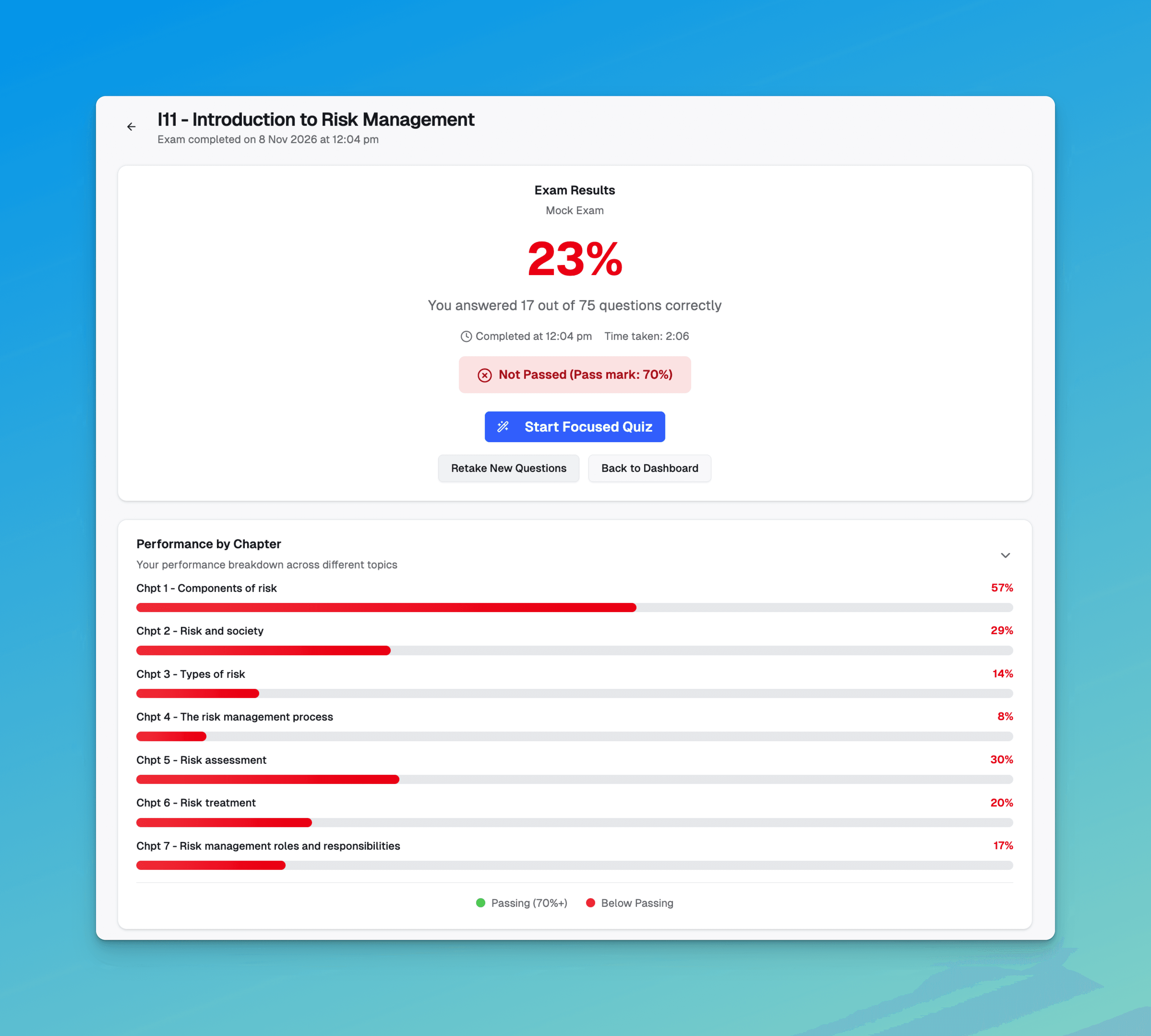
On ExamDen.uk, a timed mock shows your score against the 70% pass mark, and which learning outcomes are below it
For more on study strategy and common mistakes, see our I11 study guide. To start practising, visit ExamDen's I11 question bank.
I11 Revision FAQs
Ready to Put This Strategy Into Action? 💯
Revise smarter. Practise I11 by learning outcome and let AI pinpoint the topics you need to revisit.

The ExamDen.uk Team
ExamDen.uk builds exam-style question banks and timed mocks for CeMAP, Cert CII and CII R01–R05, helping UK professionals prepare for their financial services exams.