Free CII IF5 Mock Exam Questions with Answers (2026)
Try 6 free IF5 practice questions with answers and explanations — 3 standalone MCQs and a case study with 3 questions, covering FSCS, the RTA, contributory negligence and the MIB.
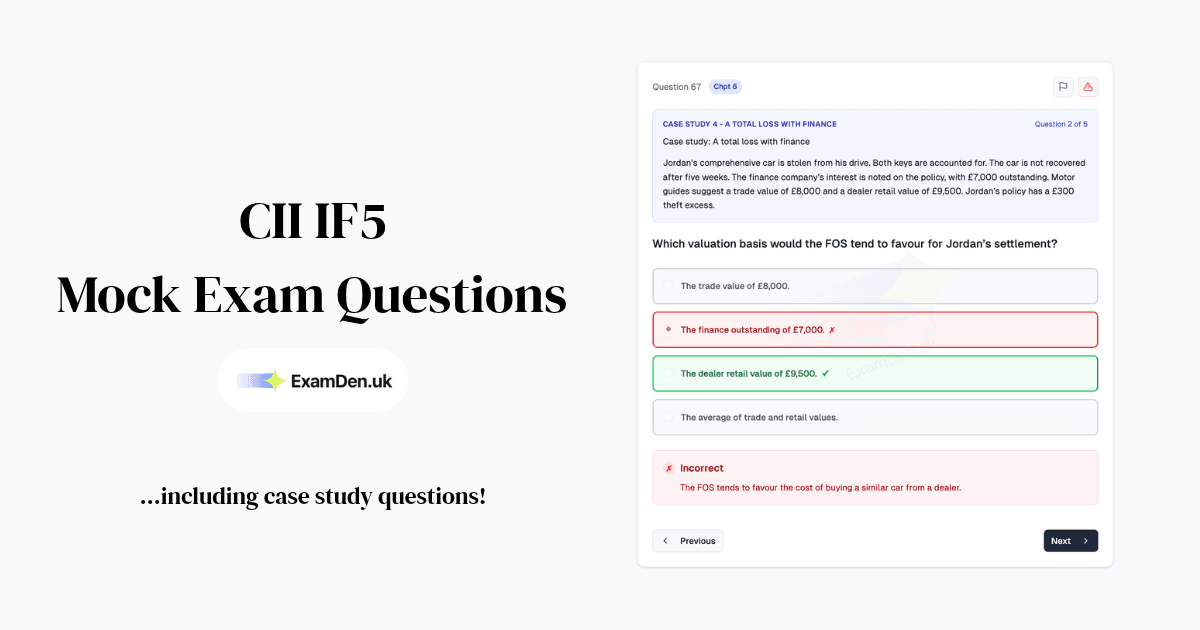
Looking for free CII IF5 practice questions? Here are 6 exam-style questions — 3 standalone MCQs (Section A style) and 3 case study questions (Section B style) — with answers and detailed explanations.
IF5 is the only Cert CII unit most candidates encounter that has case studies. The exam has two sections: 50 standalone MCQs in Section A, and 5 case studies (each with 5 questions) in Section B. Below you'll see both formats.
📝 IF5 Exam Quick Facts
- 75 questions in 2 hours: 50 standalone MCQs + 5 case studies × 5 questions
- Pass mark: 70% (at least 53 out of 75)
- No multiple-response questions: every question is pick one from four
- Syllabus: motor market, products, legal & regulatory, underwriting & rating, claims, ICT
---
Section A Style: Standalone Questions
Question 1: LO9 — Claims Procedures
After paying a third-party claim only because of the Road Traffic Act, what document would the insurer want the uninsured driver to sign?
A. A statement of fact signed by the policyholder
B. A consent and indemnity letter
C. A CRU1 form
D. A satisfaction note
Click to reveal answer
✓ Correct Answer: B
The insurer would want the uninsured driver to sign a consent and indemnity letter.
Under section 151 of the Road Traffic Act 1988, an insurer must satisfy a third-party judgment even if the policy doesn't cover the driver. The consent and indemnity letter records the uninsured driver's agreement for the insurer to handle the claim and their obligation to reimburse the insurer — though recovery is often difficult in practice.
Question 2: LO5 — Legal & Regulatory
A motor insurer fails, and the policyholder has an unpaid £5,000 own-damage claim. Assuming she is eligible, how much will the FSCS pay?
A. £0
B. £2,500
C. £4,500
D. £5,000
Click to reveal answer
✓ Correct Answer: C
The FSCS will pay £4,500.
The FSCS pays 100% of compulsory motor insurance claims (third-party liability under the RTA) but only 90% of non-compulsory claims. Own-damage cover is not compulsory — it's part of comprehensive cover that goes beyond the RTA minimum.
£5,000 × 90% = £4,500. This compulsory vs non-compulsory split is a common IF5 exam question.
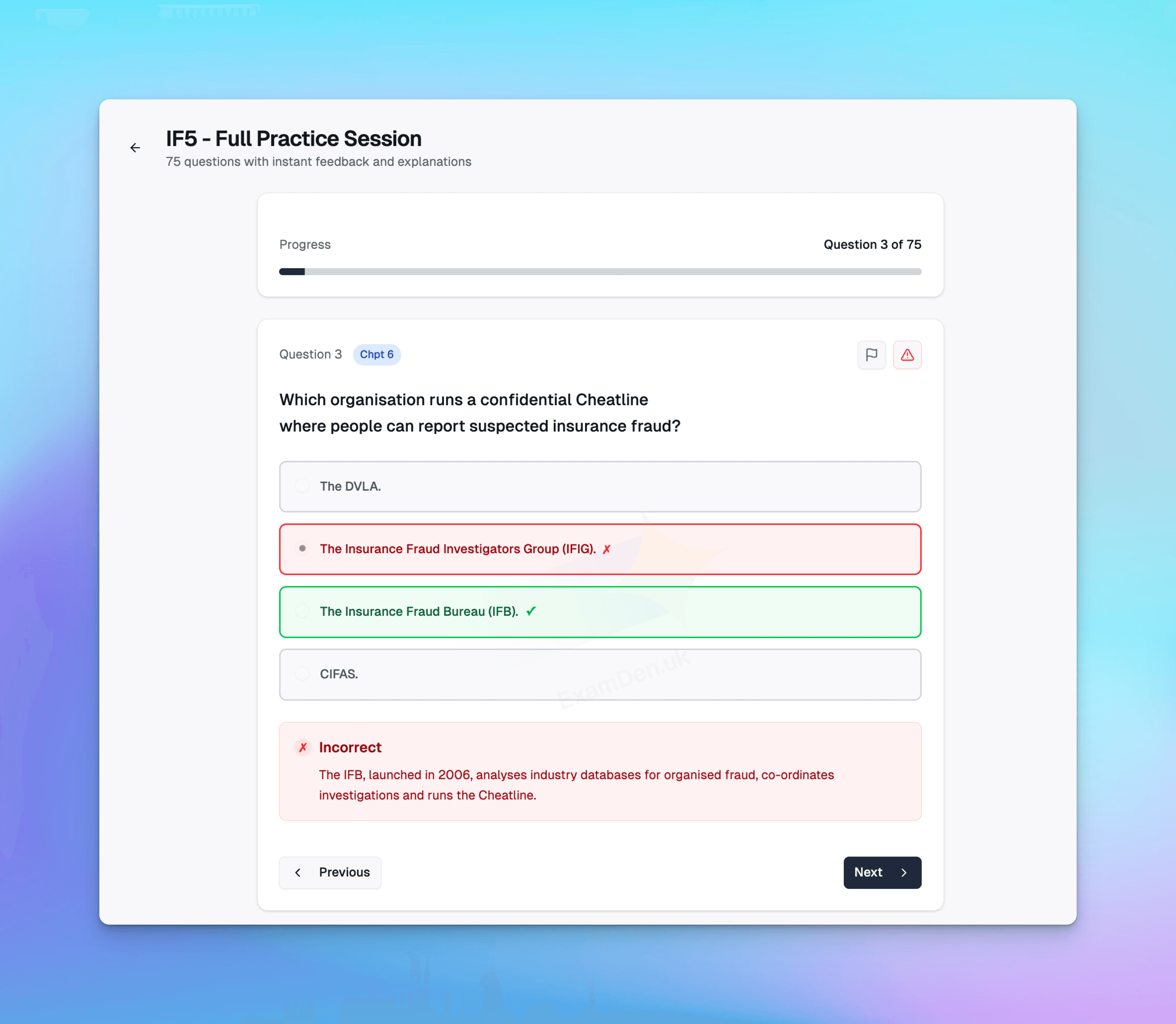
On ExamDen.uk, every question comes with a detailed explanation, like the sample questions above
Question 3: LO5 — Legal & Regulatory
Which Act allows a court to reduce a claimant's damages where they were partly to blame for their own injuries?
A. The Compensation Act 2006
B. The Third Parties (Rights against Insurers) Act 2010
C. The Civil Liability Act 2018
D. The Law Reform (Contributory Negligence) Act 1945
Click to reveal answer
✓ Correct Answer: D
The Law Reform (Contributory Negligence) Act 1945.
The 1945 Act allows a court to reduce damages to reflect the claimant's share of responsibility. In motor claims, this commonly applies to seat-belt cases (failure to wear a seat belt typically reduces damages by 15–25%) and helmet cases. The Civil Liability Act 2018 deals with whiplash tariffs, not contributory negligence.
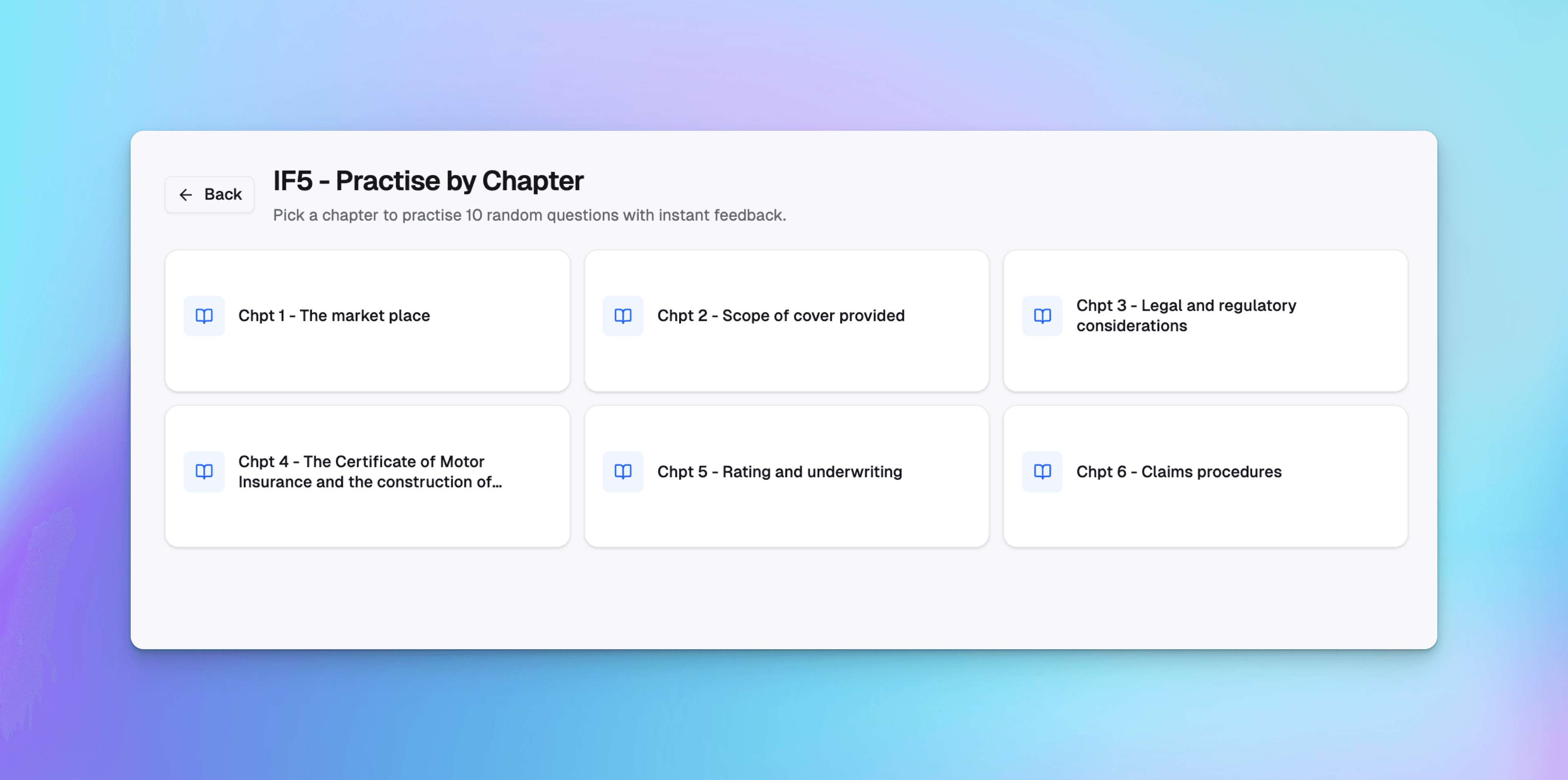
On ExamDen.uk, practise one learning outcome at a time, then sit a full mock in the real two-section format
🎯 Practise Like the Real Exam
ExamDen.uk tracks your score by learning outcome so you see exactly where you're losing marks. No more guessing which topics to revise.
Start IF5 Practice →Section B Style: Case Study Questions
In the real exam, Section B presents a scenario and asks 5 questions about it. Below is a sample case study with 3 questions so you can see how the format works.
📋 Case Study: Uninsured and Hit-and-Run Drivers
Priya drives her car home on a public road. At a junction an uninsured driver, Dan, runs into the back of her car, injuring her neck and causing £3,000 damage.
Two weeks later, while her car is parked outside her flat, an unknown driver hits it and drives off. Priya reports the second incident to the police the next morning.
A police officer later stops Dan driving the same car, which is still not on the Motor Insurance Database.
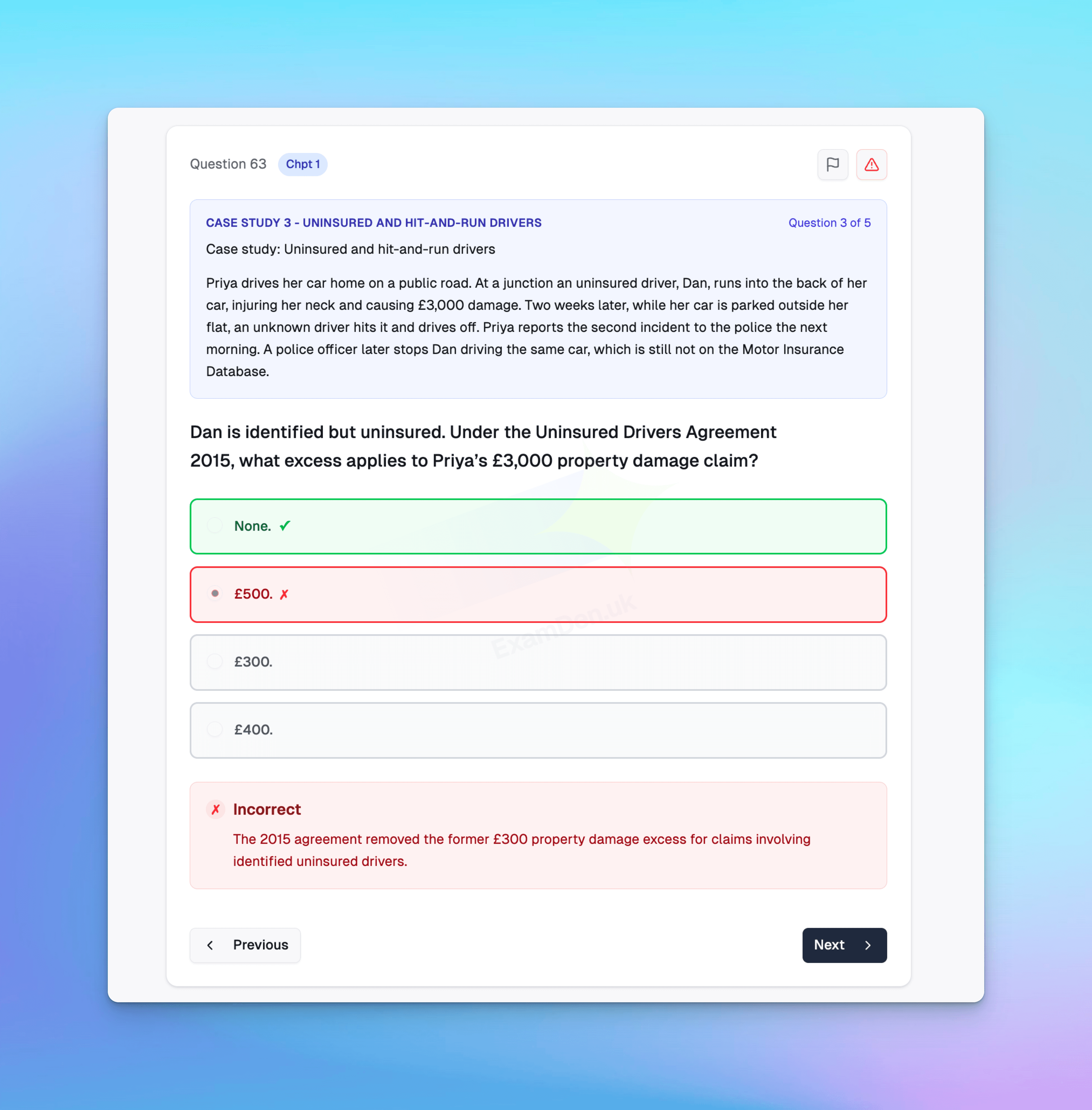
On ExamDen.uk, case study questions present a scenario with multiple linked questions, just like Section B of the real IF5 exam
Question 4: Compensator of Last Resort
Which body is the compensator of last resort for Priya's injury claim against Dan?
A. The Financial Ombudsman Service
B. The Motor Insurers' Bureau
C. The DVLA
D. The Financial Services Compensation Scheme
Click to reveal answer
✓ Correct Answer: B
The Motor Insurers' Bureau (MIB).
The MIB compensates victims of uninsured and untraced drivers where no insurer is liable. Dan is identified but uninsured, so Priya's injury claim falls under the Uninsured Drivers Agreement 2015. The FSCS covers insurer insolvency, not uninsured drivers. The FOS handles complaints against regulated firms. The DVLA is not a compensator.
Question 5: Section 143 Offence
Which offence did Dan commit by driving the car without cover?
A. Using a vehicle without insurance, under section 143
B. Failing to give notice of proceedings, under section 152
C. Failing to stop after an accident, under section 170
D. Driving with a defective vehicle, under section 148
Click to reveal answer
✓ Correct Answer: A
Section 143 of the Road Traffic Act 1988.
Section 143 makes it an offence to use, or cause or permit the use of, a motor vehicle on a road or public place without a policy of insurance that satisfies the requirements of the Act. Dan was driving without any insurance at all — a straightforward section 143 offence. Section 170 (failing to stop) is a separate offence Dan may also have committed, but the question asks specifically about driving without cover.
Question 6: Uninsured Drivers Agreement 2015
Dan is identified but uninsured. Under the Uninsured Drivers Agreement 2015, what excess applies to Priya's £3,000 property damage claim?
A. None
B. £500
C. £300
D. £400
Click to reveal answer
✓ Correct Answer: A
No excess applies.
The Uninsured Drivers Agreement 2015 removed the former £300 property damage excess that applied under the previous agreement. Where the uninsured driver is identified, the MIB now pays property damage claims in full with no excess. This is a key change from the old agreement that is commonly tested.
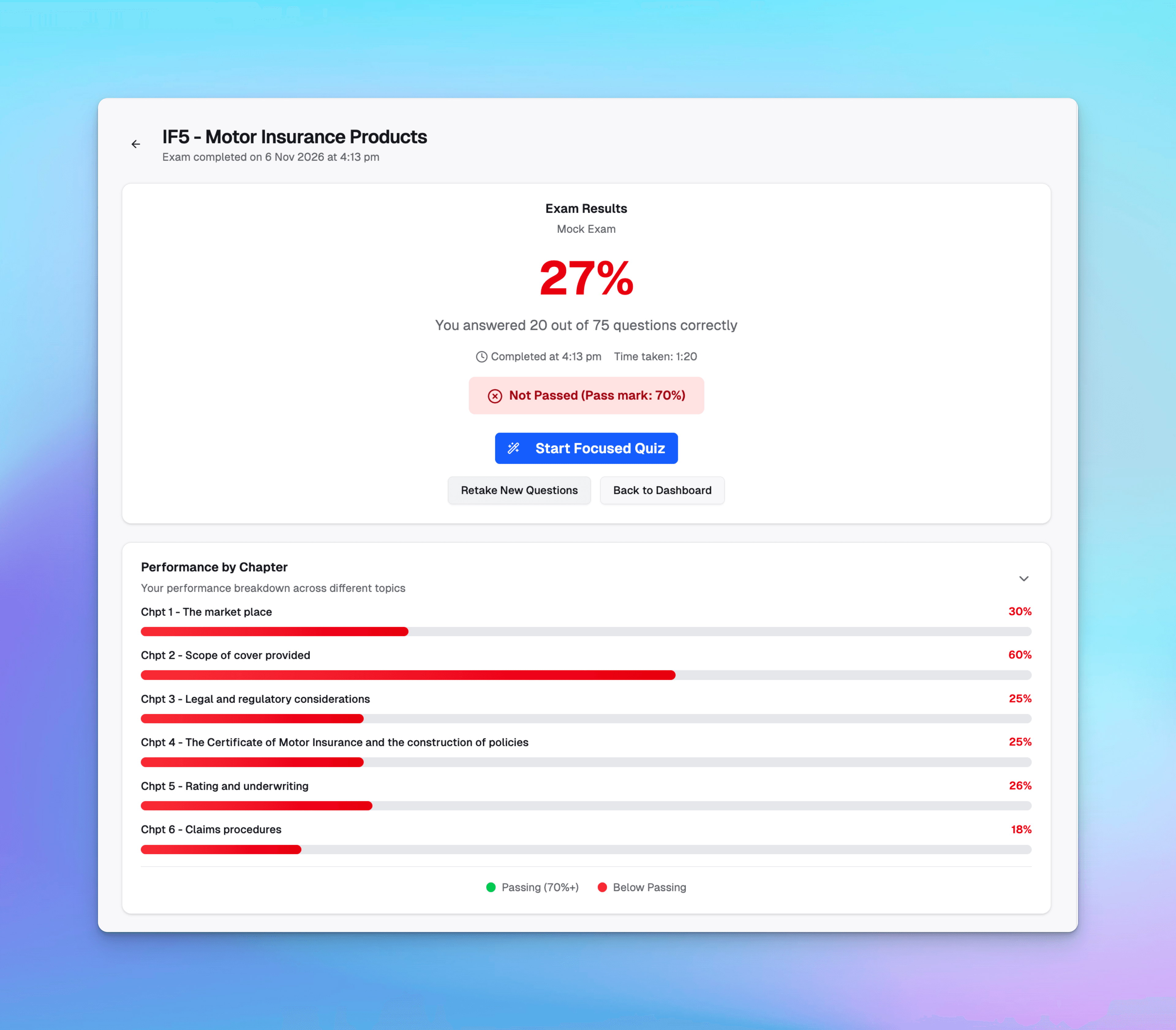
On ExamDen.uk, a timed mock shows your score against the 70% pass mark, and which learning outcomes are below it
How Did You Do?
These 6 questions cover only a fraction of the IF5 syllabus — and the real exam has 75 questions across both standalone MCQs and case studies.
For a full study plan and learning outcome breakdown, see our complete IF5 study guide. If you want to practise more, ExamDen's IF5 question bank has hundreds of exam-style questions — including case studies — with timed mocks and AI that tracks your weak learning outcomes.
For a revision-ready overview of every learning outcome, see our IF5 revision guide. Wondering about the difficulty level? Read Is IF5 Hard? for a full breakdown.
IF5 Practice Questions FAQs
Ready to Put This Strategy Into Action? 💯
Try hundreds more exam-style IF5 questions — including case studies — with timed mocks and AI-driven learning outcome tracking.

The ExamDen.uk Team
ExamDen.uk builds exam-style question banks and timed mocks for CeMAP, Cert CII and CII R01–R05, helping UK professionals prepare for their financial services exams.