CII IF5 Revision Guide (2026): Learning Outcomes and Exam Tips
CII IF5 revision guide: all 12 learning outcomes explained with question counts, priority topics and exam tips for the Motor Insurance Products exam, including case study strategy.
This IF5 revision guide covers every learning outcome in the exam, in order of question weight. Use it during your final revision to check that you've covered each topic and know where to focus your remaining study time.
For a broader study plan and common mistakes, see our complete IF5 study guide. For practice questions, try these 6 free IF5 mock questions.
📋 IF5 Exam Recap
- 75 questions in 2 hours — 50 standalone MCQs (Section A) + 5 case studies × 5 questions (Section B)
- Pass mark: 70% (at least 53 out of 75)
- 12 learning outcomes in 6 topic areas
- "Understand" LOs → Section A; "Apply" LOs → Section B case studies
---
LO7: Risk Assessment, Rating & Underwriting (Understand) — 15 Questions (20%)
- Rating factors. Age (under 25 highest risk), driving experience, vehicle insurance group (1–50), postcode (theft and accident rates), claims history, occupation, annual mileage, vehicle modifications.
- No claims discount. Typically earned at 1 year per step, up to 5+ years. Protected NCD: pay extra to avoid losing discount after a claim, but the premium can still rise. Step-back scales: a claim may drop you back 2–3 years rather than to zero.
- Telematics. Black-box, plug-in and smartphone-based. Data collected: speed, braking, cornering, time of driving, mileage. How it affects pricing and claims. Data protection implications.
- Proposal process. Statement of fact vs proposal form. Duty under CIDRA 2012: consumers must take reasonable care not to make misrepresentations. Qualifying vs deliberate/reckless misrepresentation and the remedies available.
- Fraud. Staged accidents (crash-for-cash), ghost broking (fake policies), fronting (naming an experienced driver as policyholder to reduce premium when a young driver is the main user). Red flags and detection.
- Commercial motor. Fleet underwriting: experience-rated, fleet size, driver management. Motor trade: road risk, internal risk, combined. Haulage and courier: goods-in-transit, operator's licence, hired-in vehicles.
Quick test: A 19-year-old with no NCD in an insurance group 32 car — which rating factors increase the premium, and why?
LO8: Risk Assessment, Rating & Underwriting (Apply) — 8 Questions (11%)
LO8 tests the same underwriting content through case studies. Expect scenarios involving:
- A young driver's first policy — identify the relevant rating factors
- A fleet operator's renewal — assess the risk and suggest terms
- A suspected fronting case — identify the indicators and consequences
- Telematics data — interpret driving behaviour and its rating impact
Study approach: After revising the LO7 knowledge, practise applying it to scenarios. Read the facts, identify which rating factors and underwriting principles are relevant, then answer the question.
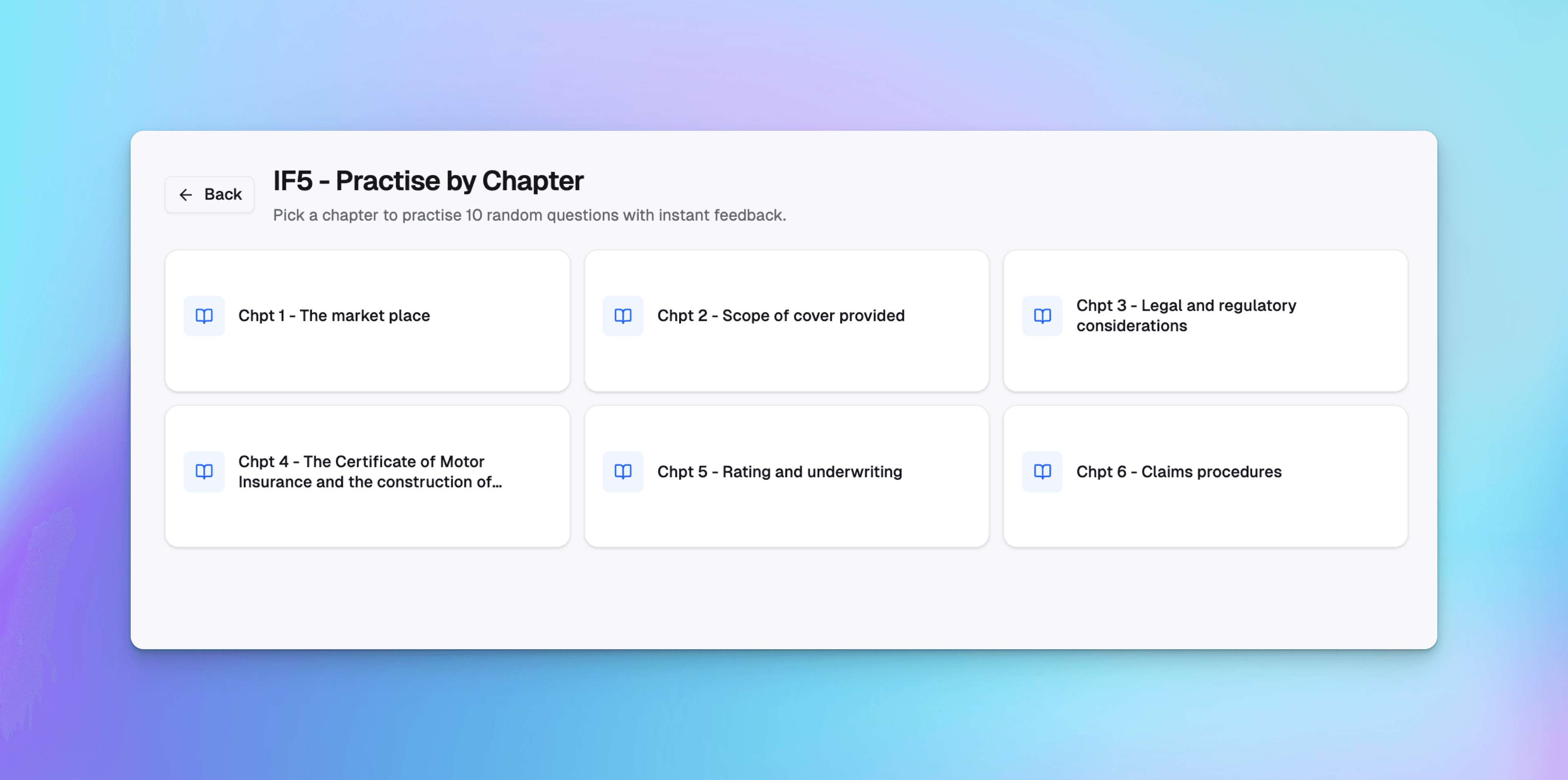
On ExamDen.uk, practise one learning outcome at a time, then sit a full mock in the real two-section format
LO9: Claims Procedures (Understand) — 11 Questions (15%)
- FNOL. What information to collect: policy number, date/time/location of incident, description of damage, third-party details, police reference (if applicable), injuries. Validating cover at FNOL.
- Damage assessment. Engineer's inspection, approved repairer networks, repair vs total loss threshold (typically when repair cost exceeds a percentage of the vehicle's market value).
- Total loss categories. Category A: scrap only (entire vehicle crushed). Category B: body shell crushed, usable parts salvaged. Category S: structural damage, repairable, must be re-inspected before returning to road. Category N: non-structural damage, repairable, no mandatory re-inspection.
- Personal injury claims. Whiplash reforms under the Civil Liability Act 2018: fixed tariff for whiplash injuries lasting up to 2 years, Official Injury Claim (OIC) portal for claims up to £5,000, ban on pre-medical offers to settle.
- Credit hire. Providing replacement vehicles to not-at-fault claimants. Credit hire rates vs basic hire rates (BHR). The GTA (General Terms of Agreement) between insurers and credit hire companies.
- MIB. Uninsured Drivers Agreement 2015 (identified uninsured driver — no property damage excess, full PI compensation). Untraced Drivers Agreement 2017 (hit-and-run — no property damage for untraced drivers, PI compensation available).
- Subrogation. Knock-for-knock agreements: each insurer pays its own policyholder's claim and waives subrogation against the other insurer. Why this is efficient and how it works.
Quick test: A vehicle is assessed at £3,500 market value and the repair estimate is £4,000. What total loss category might apply?
LO10: Claims Procedures (Apply) — 6 Questions (8%)
Case study scenarios for claims might include:
- An accident involving an uninsured driver — which body compensates, what evidence is needed
- A hit-and-run — what the victim can claim and from whom
- A total loss — determining the category and settlement amount
- A credit hire situation — whether the hire charges are reasonable
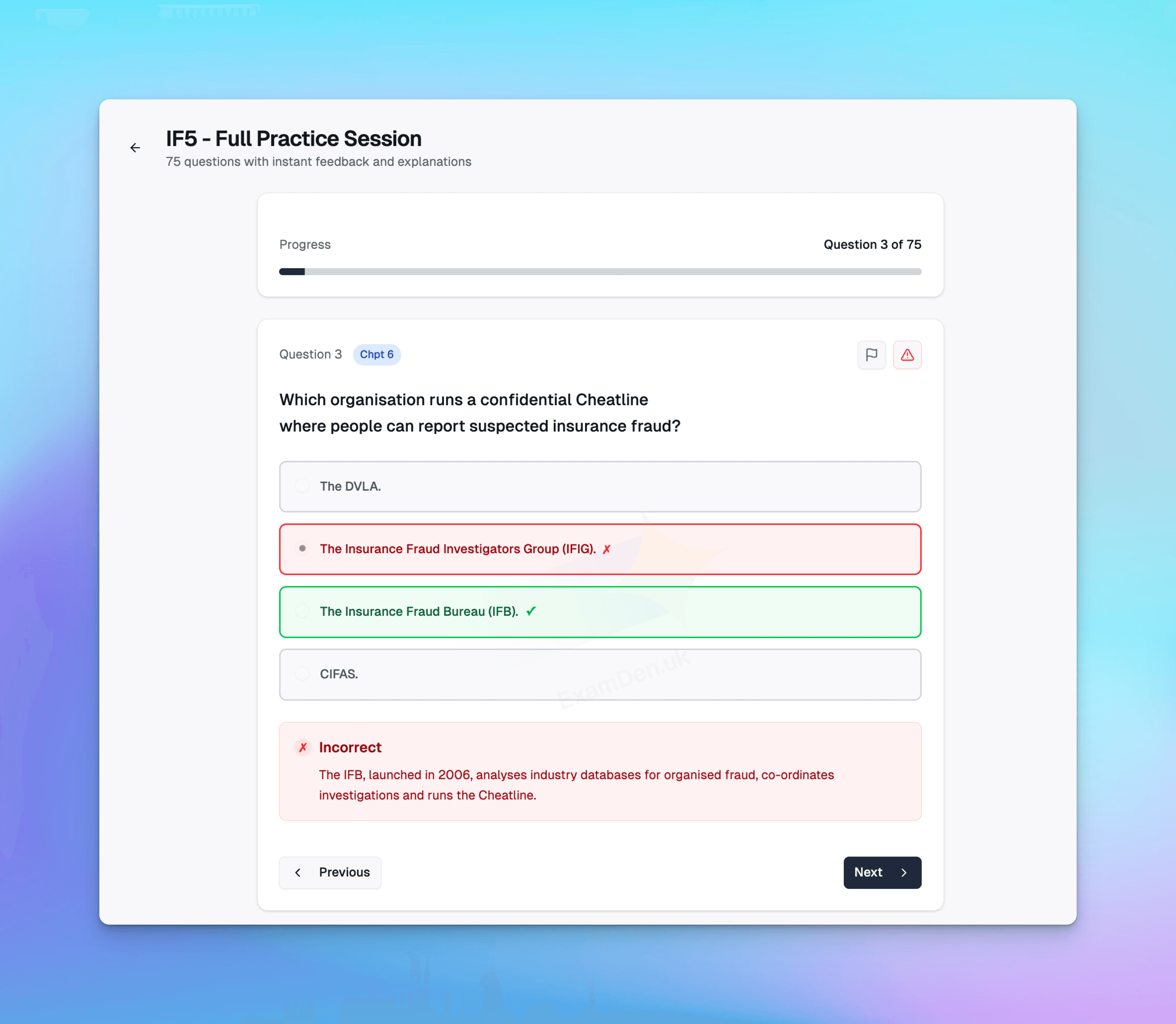
On ExamDen.uk, every question comes with a detailed explanation linked to the relevant learning outcome
🎯 Practise Like the Real Exam
ExamDen.uk tracks your score by learning outcome so you see exactly where you're losing marks. No more guessing which topics to revise.
Start IF5 Practice →LO5: Legal & Regulatory (Understand) — 11 Questions (15%)
- Road Traffic Act 1988. Section 143: offence to use a vehicle without insurance. Section 145: minimum cover required (TP injury + property on roads/public places). Section 151: insurer must satisfy judgments even if policy void/voidable. Section 152: conditions for section 151 to apply (notice of proceedings). Section 170: duty to stop and report accidents.
- FSCS. Compulsory motor claims: 100% compensation. Non-compulsory (own-damage, windscreen, personal accident): 90% compensation. Know the split.
- CIDRA 2012. Consumer duty: take reasonable care not to make misrepresentations. Qualifying misrepresentation: proportionate remedy (return premium, adjust terms, avoid from inception). Deliberate/reckless: insurer can avoid from inception and retain premium.
- Civil Liability Act 2018. Whiplash tariff for injuries ≤ 2 years. OIC portal. Ban on pre-medical offers.
- Law Reform (Contributory Negligence) Act 1945. Damages reduced by claimant's share of fault. Seat-belt cases: typically 15–25% reduction.
- Enterprise Act 2016. Implied term: insurer must pay claims within a reasonable time. Damages for late payment.
- Motor Insurance Database. Legal requirement to update within 7 days. Used for ANPR enforcement and continuous insurance enforcement.
Quick test: Under CIDRA 2012, what's the difference between a qualifying misrepresentation and a deliberate/reckless one, and what remedies does each give the insurer?
LO6: Legal & Regulatory (Apply) — 5 Questions (7%)
Case study scenarios for legal might include:
- An uninsured driver stopped by police — which offence, which section
- An insurer arguing misrepresentation — whether it's qualifying or deliberate/reckless
- An accident where the claimant was partly at fault — contributory negligence calculation
- An insurer insolvency — how much the FSCS pays for each claim type
LO3: Scope of Cover (Understand) — 6 Questions (8%)
- Levels of motor cover. Third-party only: RTA minimum, TP injury and property damage liability. TPFT: adds fire and theft cover for the insured vehicle. Comprehensive: adds own-damage (accidental damage, vandalism), windscreen, personal accident, sometimes breakdown.
- Policy documents. Certificate of motor insurance (legal proof of cover, must carry or produce within 7 days). Policy schedule (details: vehicle, named drivers, NCD, excess, endorsements). Policy wording (terms, conditions, exclusions).
- Common extensions. Driving other cars (DOC), windscreen cover (no NCD impact), personal accident, medical expenses, personal belongings, courtesy car.
- Common exclusions. Use while under the influence of drink/drugs, racing/speed testing, use for hire/reward (unless specifically covered), use outside territorial limits, vehicles in an unroadworthy condition.
- Motor Insurance Database (MID). Who updates it, when, what data it holds. ANPR cameras cross-reference against MID. Continuous Insurance Enforcement: offence to keep a registered vehicle without insurance (unless SORN).
LO4: Scope of Cover (Apply) — 3 Questions (4%)
Case studies may test whether a specific loss is covered under a given policy level, or whether an exclusion applies to a particular set of facts.
LO1: The Motor Insurance Market (Understand) — 5 Questions (7%)
- Distribution channels. Direct (insurer-to-consumer), broker (independent intermediary), aggregator (comparison website), bancassurance, affinity groups, Lloyd's.
- Market participants. Composite insurers, specialist motor insurers, Lloyd's syndicates, captives, mutual insurers, MGAs (managing general agents).
- Regulatory framework. FCA (conduct), PRA (prudential). Senior Managers and Certification Regime. ICOBS for general insurance.
- Market trends. Telematics growth, electric and hybrid vehicles (battery cover, charging infrastructure liability), autonomous vehicles (Automated and Electric Vehicles Act 2018), mobility-as-a-service.
LO2: The Motor Insurance Market (Apply) — 2 Questions (3%)
Only 2 case study questions, but they may test your understanding of how market structure affects a consumer's experience — for example, comparing advice from a broker vs a direct insurer.
LO11: ICT (Understand) — 2 Questions (3%)
- Online quotation. How aggregators collect data, generate quotes and earn commission. The impact on price transparency and competition.
- Claims technology. Digital FNOL, video assessments, straight-through processing, AI fraud detection.
- Data. MID, ANPR, telematics data, CUE (Claims and Underwriting Exchange).
LO12: ICT (Apply) — 1 Question (1%)
One case study question on ICT — likely testing how technology applies to a specific underwriting or claims scenario.
LO11 + LO12 is only 3 questions total. Cover the basics but don't over-invest revision time here.
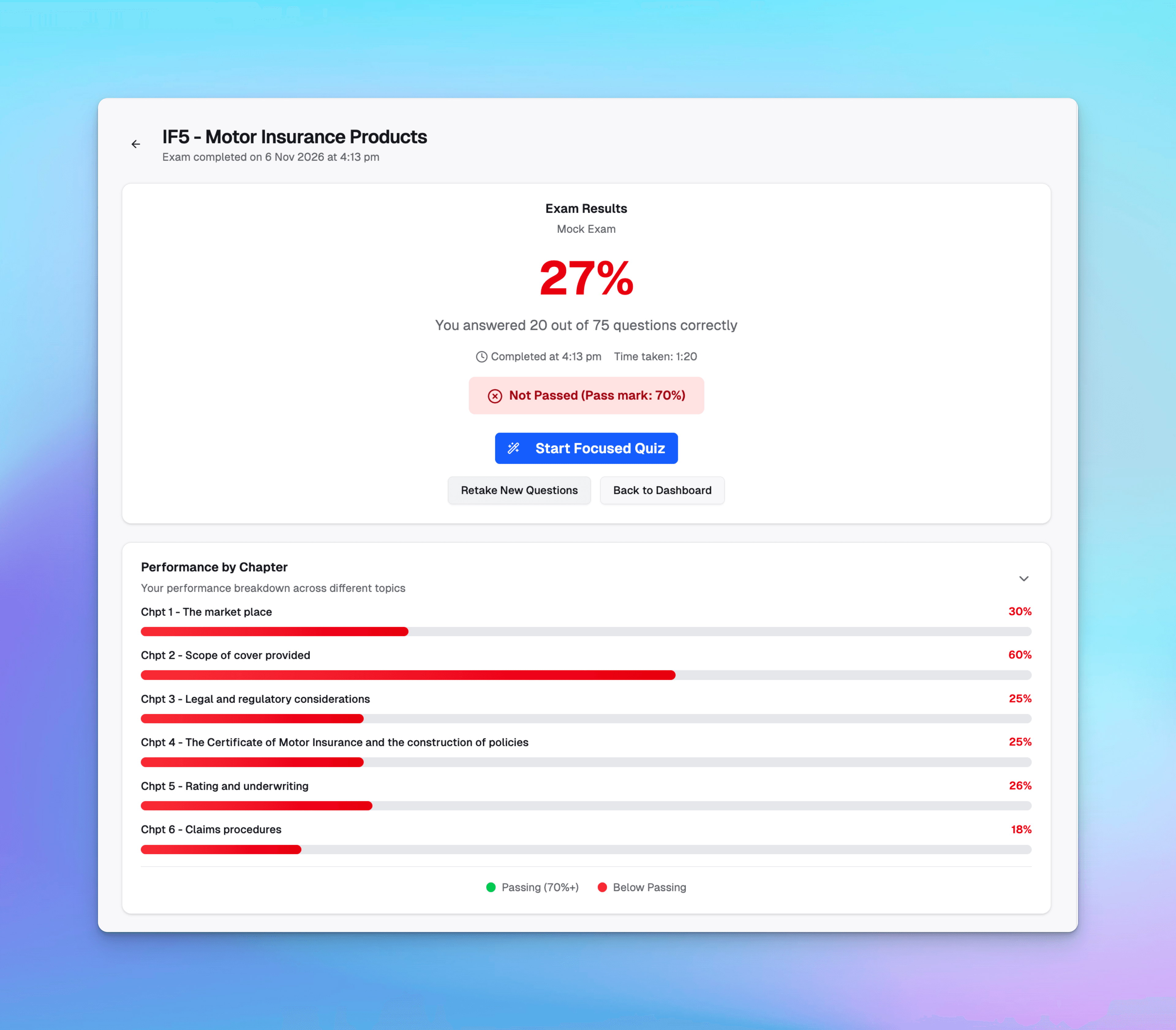
On ExamDen.uk, a timed mock shows your score against the 70% pass mark, and which learning outcomes are below it
Case Study Strategy
Section B is a third of the exam. Here's how to approach case studies:
- Read the scenario once, carefully. Note the key facts: who is involved, what happened, what type of policy, what dates and amounts are mentioned.
- Read each question, then re-read the relevant part of the scenario. Don't rely on memory — go back to the text.
- Apply the principle to the specific facts. The answer depends on the scenario, not just general knowledge.
- Watch for distractors. Case studies often include irrelevant details to test whether you can identify what matters.
- Manage your time. Read the scenario once (2–3 minutes), then answer the 5 questions (about 90 seconds each).
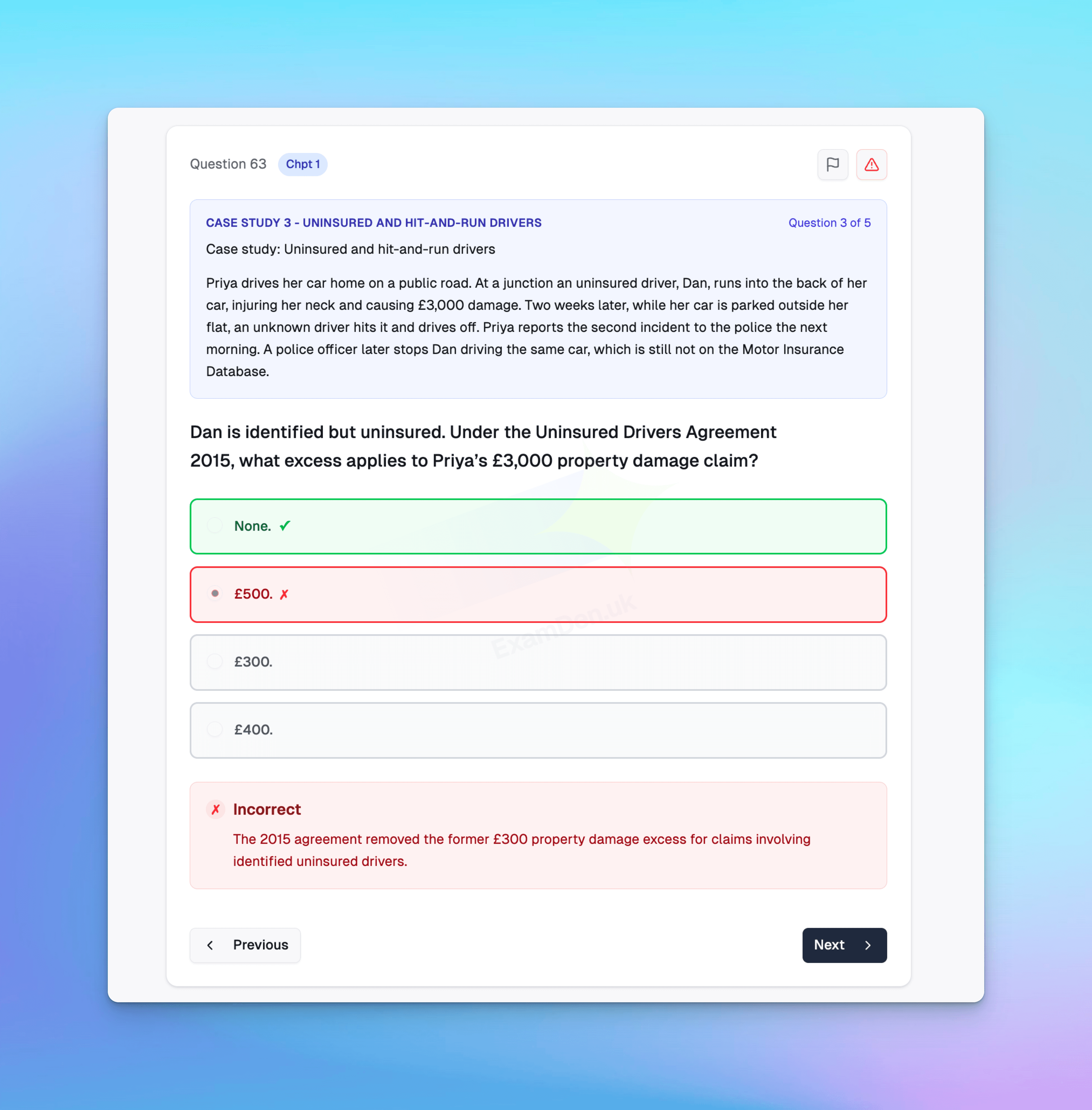
On ExamDen.uk, case study questions present a scenario with multiple linked questions, just like Section B of the real IF5 exam
Final Revision Checklist
Before exam day, make sure you can:
- Name the main rating factors and explain how each affects the premium
- Explain NCD — earning, protection, step-back
- List the total loss categories — A, B, S, N — and what each means
- Describe the MIB's role and the key terms of the 2015 and 2017 agreements
- Explain the FSCS split — 100% compulsory, 90% non-compulsory
- Cite the key RTA sections — 143, 145, 151, 170
- Explain CIDRA 2012 — qualifying vs deliberate/reckless misrepresentation
- Describe the Civil Liability Act 2018 whiplash reforms
- Complete at least one full timed mock with case studies — 75 questions, 2 hours
- Practise at least 5 case studies separately — building your scenario-reading technique
For more on study strategy and common mistakes, see our IF5 study guide. For the claims counterpart, see our IF4 study guide. To start practising, visit ExamDen's IF5 question bank.
IF5 Revision FAQs
Ready to Put This Strategy Into Action? 💯
Revise smarter. Practise IF5 by learning outcome — including case studies — and let AI pinpoint the topics you need to revisit.

The ExamDen.uk Team
ExamDen.uk builds exam-style question banks and timed mocks for CeMAP, Cert CII and CII R01–R05, helping UK professionals prepare for their financial services exams.