How to Pass CII IF5 (2026): Study Guide and Exam Tips
A practical guide to passing CII IF5 — covering the two-section exam format with case studies, all 12 learning outcomes, the 70% pass mark, motor insurance products and common mistakes.
IF5 — Motor Insurance Products — is the specialist motor unit of the Cert CII (Certificate in Insurance). It covers private motor, motorcycle and commercial motor insurance — from the market and products through underwriting, claims and regulation.
IF5 is different from the Cert CII exams you may have already taken: it includes case studies. The exam has two sections — 50 standalone MCQs in Section A, and 5 case studies with 5 questions each in Section B. Every question is still standard multiple-choice (pick one from four), but the Section B questions all relate to a scenario you need to read and apply your knowledge to.
📋 IF5 Quick Summary
- 75 questions in 2 hours: 50 standalone MCQs (Section A) + 5 case studies × 5 questions (Section B)
- Pass mark: 70% (at least 53 out of 75)
- 12 learning outcomes in 6 topic areas — paired as "understand" and "apply"
- Heaviest area: Risk assessment, rating & underwriting (LO7 + LO8) — 23 questions (31%)
- On-demand exam: book almost any day, sit at a test centre or online with a remote invigilator
IF5 Exam Format
IF5 has two sections:
Section A — 50 standard MCQs. These test your understanding of motor insurance knowledge. Each question stands alone — read the question, pick the best answer from four options.
Section B — 5 case studies, each followed by 5 MCQs. Each case study presents a scenario — a set of facts about a driver, a policy, an accident or a claim — and the questions test your ability to apply your knowledge to that specific scenario. You need to read the scenario carefully because the answers depend on the details given.
All 75 questions are standard multiple-choice (pick one from four). There are no multiple-response questions. The pass mark is 70% — you need at least 53 out of 75 correct, meaning you can get 22 wrong. No marks are deducted for incorrect answers, so always attempt every question.
The exam is 2 hours — 96 seconds per question on average. Budget extra reading time for the case study scenarios in Section B by keeping a steady pace through Section A.
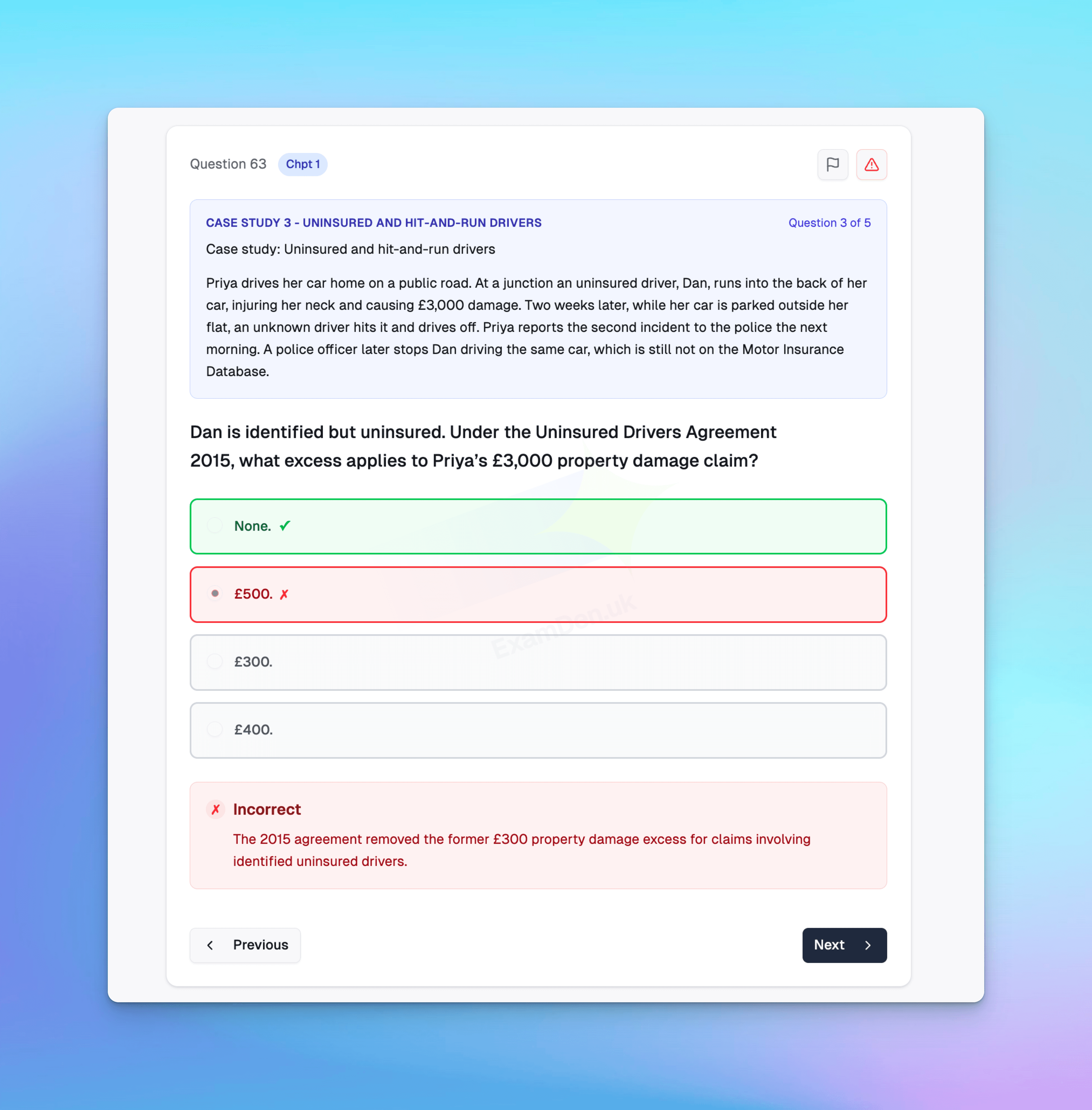
On ExamDen.uk, case study questions present a scenario with multiple linked questions, just like Section B of the real IF5 exam
Question Distribution by Topic Area
IF5 has 12 learning outcomes arranged in 6 topic areas. Each area has an "understand" LO (tested mainly in Section A) and an "apply" LO (tested mainly in Section B's case studies).
| Topic Area | LOs | Questions | % of exam |
|---|---|---|---|
| Risk assessment, rating & underwriting | LO7 + LO8 | 15 + 8 = 23 | 31% |
| Claims procedures | LO9 + LO10 | 11 + 6 = 17 | 23% |
| Legal & regulatory | LO5 + LO6 | 11 + 5 = 16 | 21% |
| Scope of cover | LO3 + LO4 | 6 + 3 = 9 | 12% |
| The motor insurance market | LO1 + LO2 | 5 + 2 = 7 | 9% |
| Information & communication technology | LO11 + LO12 | 2 + 1 = 3 | 4% |
The top three areas — underwriting, claims and legal — account for 56 out of 75 questions (75%). Risk assessment and underwriting alone is nearly a third of the exam.
---
LO7 + LO8: Risk Assessment, Rating & Underwriting — 23 Questions (31%)
This is the largest topic area. LO7 (15 questions) tests understanding, LO8 (8 questions) tests application through case studies.
What it tests:
- Rating factors. Age, driving experience, vehicle group, postcode, claims history, occupation, annual mileage, vehicle modifications. How each factor affects the premium.
- No claims discount (NCD). How NCD is earned, protected NCD, step-back scales. Introductory discounts for young or new drivers.
- Telematics. Black-box and smartphone-based policies. How telematics data is used in rating — speed, braking, time of day, mileage. Privacy and data protection considerations.
- Proposal forms and disclosure. What must be disclosed. The duty of fair presentation under the Insurance Act 2015 and the qualifying misrepresentation rules for consumers under CIDRA 2012.
- Motor fraud. Staged accidents, ghost broking, fronting (a younger driver named as the main driver when they are not). Detection techniques and consequences.
- Commercial motor. Fleet rating, motor trade policies, haulage, courier and public hire. How commercial motor underwriting differs from private.
Study approach: LO7 + LO8 is nearly a third of the exam, so spend proportional study time here. Know the main rating factors and how each one moves the premium up or down.
LO9 + LO10: Claims Procedures — 17 Questions (23%)
What it tests:
- First notification of loss (FNOL). How claims are reported and registered. What information is collected at FNOL.
- Damage assessment. Repair vs total loss decisions. Engineers' reports. Approved repairer networks.
- Total loss categories. Category A (scrap), Category B (break — shell crushed, parts salvaged), Category S (structural — repairable), Category N (non-structural — repairable).
- Personal injury claims. Whiplash reforms under the Civil Liability Act 2018. The Official Injury Claim portal. Fixed tariff amounts for whiplash-type injuries.
- Credit hire. Providing replacement vehicles during repairs. Credit hire rates vs spot rates. The GTA (General Terms of Agreement).
- MIB. The Motor Insurers' Bureau — compensator of last resort for victims of uninsured and untraced drivers. The Uninsured Drivers Agreement 2015 and the Untraced Drivers Agreement 2017.
- Subrogation and recovery. Knock-for-knock agreements between insurers. Third-party recovery.
Study approach: Claims is the second-largest area. Focus on the claims workflow from FNOL to settlement, and know the total loss categories cold.
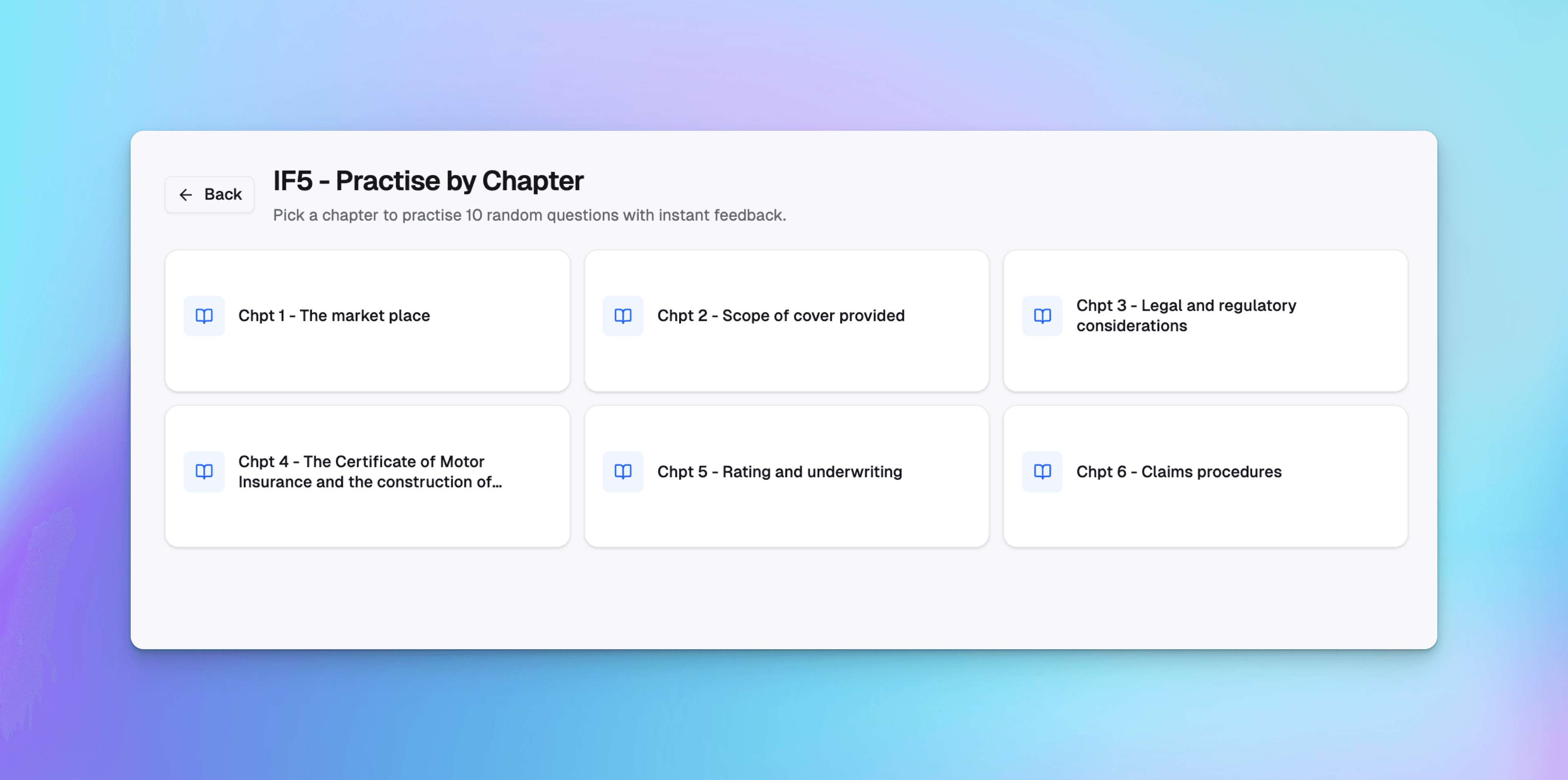
On ExamDen.uk, practise one learning outcome at a time, then sit a full mock in the real two-section format
LO5 + LO6: Legal & Regulatory — 16 Questions (21%)
What it tests:
- Road Traffic Act 1988. Section 143 (offence to use a vehicle without insurance), section 145 (requirements for motor policies), section 151 (insurer's duty to satisfy judgments), section 170 (duty to stop and report accidents).
- Compulsory insurance requirements. What the RTA minimum covers — third-party injury and property damage liability on roads and public places. What it does not cover (own-damage, personal injury to the driver).
- FCA regulation. ICOBS (Insurance Conduct of Business Sourcebook) and the Consumer Duty. Fair value, claims handling standards.
- FSCS. 100% of compulsory motor claims (third-party liability), 90% of non-compulsory claims (own-damage, windscreen). Know the split.
- Consumer Insurance (Disclosure and Representations) Act 2012 (CIDRA). Duty to take reasonable care not to make misrepresentations. Qualifying and deliberate/reckless misrepresentation.
- Enterprise Act 2016. Implied term for insurers to pay claims within a reasonable time.
Study approach: Motor has more legislation than most Cert CII units. Map out each Act and what it does — section 143 (no insurance offence), section 151 (insurer must pay judgments), CIDRA (consumer disclosure).
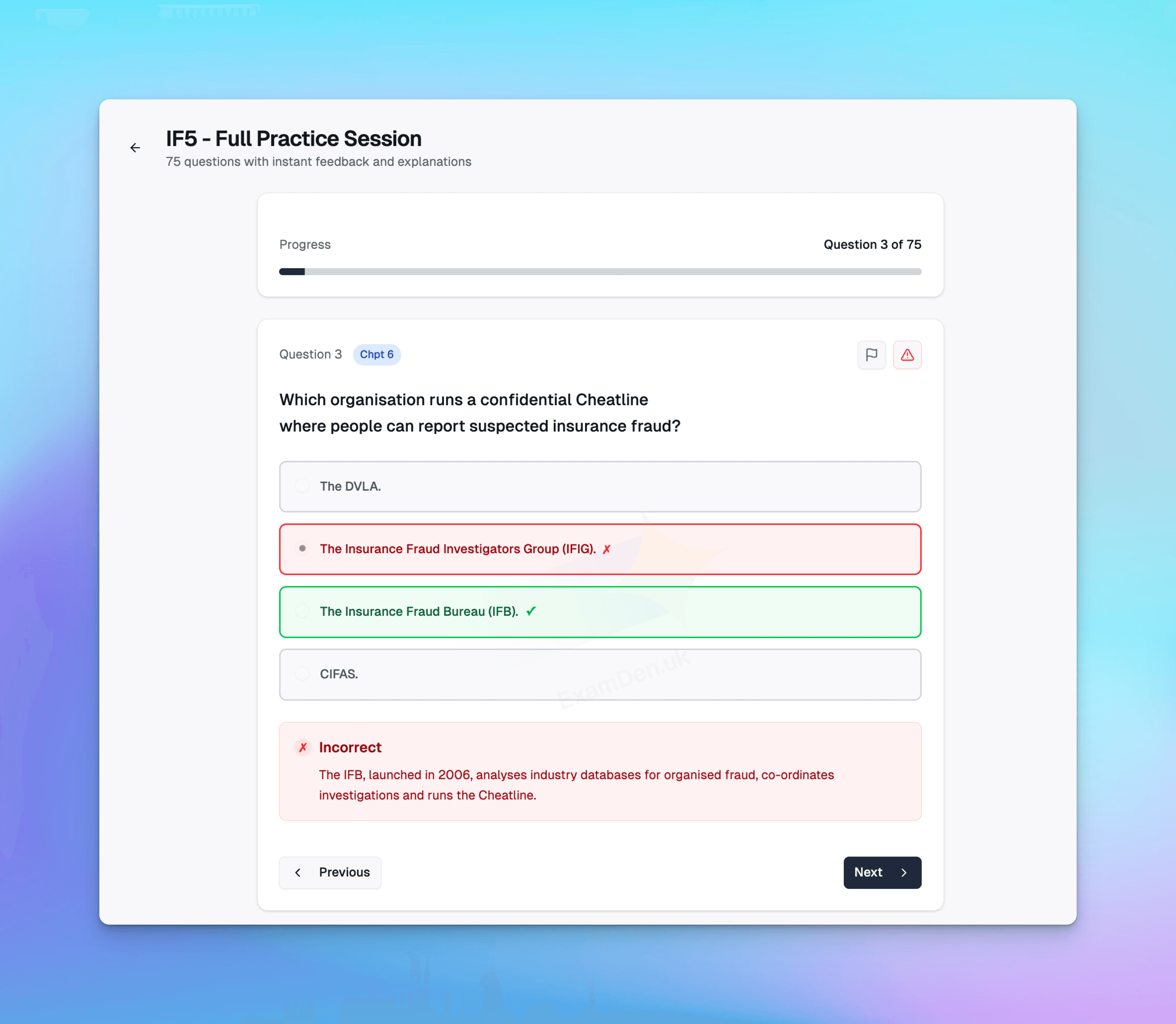
On ExamDen.uk, every question comes with a detailed explanation linked to the relevant learning outcome
🎯 Practise Like the Real Exam
ExamDen.uk tracks your score by learning outcome so you see exactly where you're losing marks. No more guessing which topics to revise.
Start IF5 Practice →LO3 + LO4: Scope of Cover — 9 Questions (12%)
What it tests:
- Levels of cover. Third-party only (RTA minimum), third-party fire and theft (TPFT), comprehensive. What each level includes and excludes.
- Policy structure. Certificate of insurance, policy schedule, policy wording. What each document contains and its legal significance.
- Standard and optional covers. Windscreen, personal accident, courtesy car, breakdown, legal expenses. How endorsements modify cover.
- Exclusions. Drink and drug driving, racing and speed testing, use for hire and reward, hazardous goods. The difference between general exclusions and policy-specific exclusions.
- Motor Insurance Database (MID). How the MID works, who maintains it, what information it holds. ANPR enforcement and continuous insurance enforcement.
LO1 + LO2: The Motor Insurance Market — 7 Questions (9%)
What it tests:
- Market structure. Direct insurers, brokers, aggregators (comparison sites), Lloyd's syndicates, captives. The role of each distribution channel.
- Market regulation. FCA authorisation, Senior Managers and Certification Regime. The role of the PRA for prudential regulation.
- Motor market trends. Telematics growth, electric vehicles (battery cover, charging infrastructure), autonomous vehicles and the Automated and Electric Vehicles Act 2018. How these trends affect underwriting and claims.
LO11 + LO12: ICT — 3 Questions (4%)
- Aggregators and online quotation. How comparison sites work, the data they collect, their impact on the motor market.
- Claims technology. FNOL apps, digital claims journeys, straight-through processing. How automation speeds up claims handling.
- MID and ANPR. Technology behind continuous insurance enforcement.
LO11 + LO12 is only 3 questions. Cover it, but don't spend disproportionate time here.
Common Mistakes That Cost Marks
1. Not practising case studies.
Section B is 25 out of 75 questions — a third of the exam. If you only practise standalone MCQs, you won't be used to extracting answers from a scenario. Read the scenario carefully — every detail is there for a reason.
2. Underestimating underwriting and rating.
LO7 + LO8 is 31% of the exam. Many candidates focus on the claims and legal content and underprepare for rating factors, NCD and telematics.
3. Confusing the legislation.
Motor insurance involves multiple Acts: RTA 1988, CIDRA 2012, Civil Liability Act 2018, Law Reform (Contributory Negligence) Act 1945, Enterprise Act 2016. Know which Act does what — they come up repeatedly.
4. Not knowing the FSCS split.
FSCS pays 100% of compulsory motor claims and 90% of non-compulsory. Own-damage is non-compulsory, so a £5,000 own-damage claim pays £4,500. This distinction appears in exam questions.
5. Ignoring the MIB agreements.
The Uninsured Drivers Agreement 2015 and the Untraced Drivers Agreement 2017 have specific rules about eligibility, time limits and excesses. Know the differences.
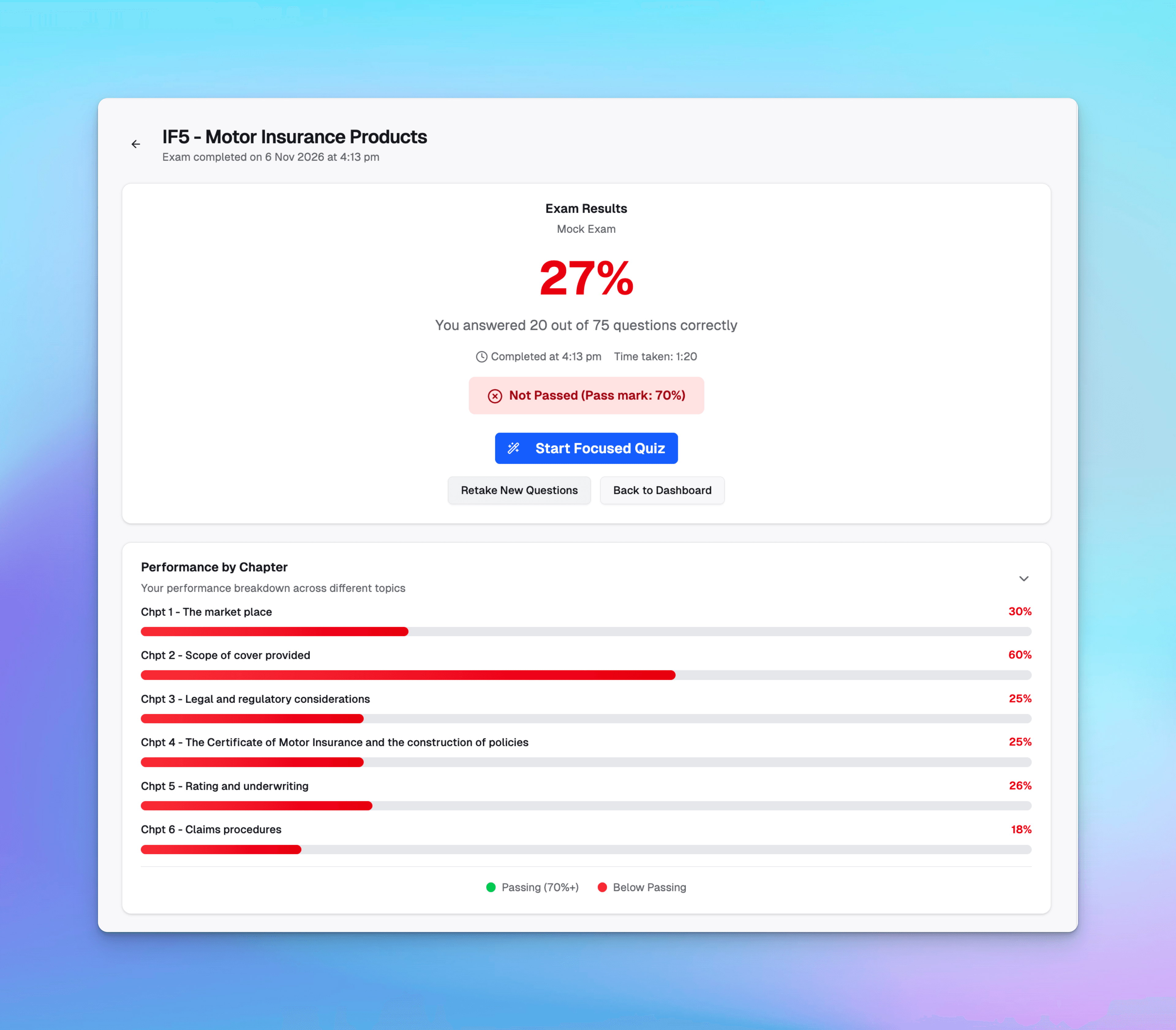
On ExamDen.uk, a timed mock shows your score against the 70% pass mark, and which learning outcomes are below it
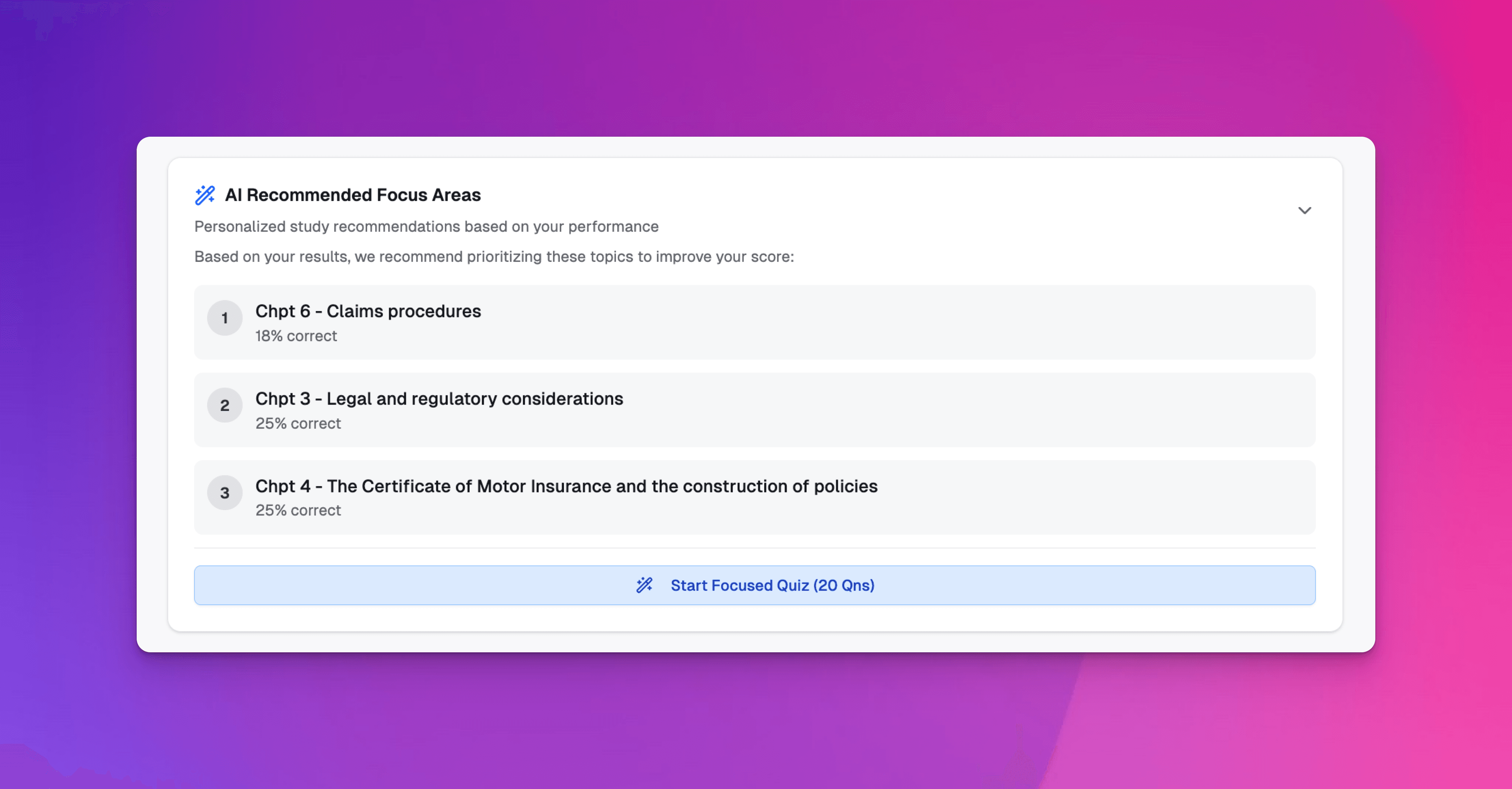
On ExamDen.uk, those weak learning outcomes become a short focus list for your next revision session
How IF5 Fits Into the Cert CII
IF5 is the motor specialist unit in the CII Certificate in Insurance (Cert CII). The legal foundations from IF1, the product knowledge from IF2, the underwriting principles from IF3 and the claims procedures from IF4 all feed into IF5. It takes the general insurance knowledge from those units and applies it specifically to motor.
IF5 pairs naturally with IF6 (Household Insurance Products) — together they cover the two major personal lines classes.
Start Practising
The fastest way to know whether you're ready for IF5 is to take a timed mock — including the case studies. ExamDen's IF5 question bank has hundreds of exam-style questions in both Section A and Section B format, with AI that pinpoints which learning outcomes you need to work on.
Want to try a few questions first? Here are 6 free IF5 mock questions with answers — including a case study. If you're looking for past papers, read why the CII doesn't release them, and what to use instead.
For registration, fees and booking, see our guide to registering for CII exams.
CII IF5 FAQs
Ready to Put This Strategy Into Action? 💯
Practise with exam-style IF5 questions, timed mocks, case studies and AI that shows you which learning outcomes to revise.

The ExamDen.uk Team
ExamDen.uk builds exam-style question banks and timed mocks for CeMAP, Cert CII and CII R01–R05, helping UK professionals prepare for their financial services exams.