Is CII R01 Hard? Pass Mark, Difficulty and What to Expect
An honest look at how hard CII R01 is — the 65% pass mark, why the breadth of the syllabus catches people, the multiple-response format and how R01 compares to the other diploma units.
R01 is the exam most people sit first in the CII Diploma, and the most common question before starting is: how hard is it?
The honest answer: R01 isn't the hardest CII exam, but it's harder than many candidates expect. The 65% pass mark sounds achievable — and it is, with the right preparation. What catches people is the sheer breadth of the syllabus and the 13 multiple-response questions that are marked all-or-nothing.
📋 The Short Answer
- Pass mark: 65% (the CII can adjust this slightly per paper)
- Format: 100 questions in 2 hours — 87 standard MCQs + 13 multiple-response
- What makes it hard: 11 learning outcomes covering a wide range of topics, plus the multiple-response format
- What makes it manageable: no case studies, no written answers — it's entirely multiple choice
The R01 Pass Mark: What 65% Actually Means
R01 needs 65% to pass. With 100 questions, that means you need at least 65 correct — or put another way, you can get 35 wrong.
Thirty-five wrong answers sounds like a generous margin. But here's the catch:
| If you score… | You can get wrong… | Out of 100 |
|---|---|---|
| 65% (pass) | 35 | 100 |
| 70% | 30 | 100 |
| 75% (comfortable) | 25 | 100 |
The margin feels comfortable until you account for the breadth of the exam. R01 has 11 learning outcomes. If you skip or underrevise two of them — say LO3 (legal concepts, 9 questions) and LO6 (regulatory framework, 9 questions) — and score poorly on both, you've already used up 10–15 of your 35-question buffer before you've even started on topics you do know.
Add the 13 multiple-response questions, which are harder than standard MCQs, and the margin shrinks further.
What Makes R01 Difficult
1. The breadth of the syllabus
R01 is the regulation paper. It doesn't test one deep topic — it tests 11 learning outcomes spanning:
- How UK financial services work (markets, institutions, the economy)
- Legal concepts (contracts, negligence, duty of care, trusts, AML)
- How the FCA and PRA regulate (permissions, enforcement, SM&CR)
- The advice process (suitability, disclosure, Consumer Duty)
- Professional ethics (CII Code, ethical vs compliance-driven behaviour)
Many candidates underestimate the breadth because they focus on the topics they find interesting (usually regulation) and skim the ones that feel less relevant (usually legal concepts or the financial services industry structure). The exam tests all of it.
2. The multiple-response questions
R01 has 13 multiple-response questions — all in LO6 (5 questions) and LO7 (8 questions). These ask "select all that apply" from a list of options.
The marking is all-or-nothing: you must select every correct option and no incorrect ones to score the mark. Selecting three out of four correct options scores zero. So does selecting all four correct options plus one wrong one.
This makes these 13 questions significantly harder than standard MCQs. On a standard question, you have a 25% chance of guessing correctly. On a multiple-response question with four options, there are 16 possible combinations — and only one is right.
3. The detail in LO5
LO5 — the financial regulators' responsibilities — is worth 29 questions on its own. Nearly a third of the exam. It covers:
- FCA and PRA objectives, powers and responsibilities
- The Senior Managers and Certification Regime (SM&CR)
- FCA enforcement (fines, public censure, criminal prosecution)
- The Financial Ombudsman Service (FOS) — jurisdiction, award limits, binding vs non-binding
- The Financial Services Compensation Scheme (FSCS) — compensation limits by product type
- Complaint handling rules and timescales
The volume of specific figures and limits in LO5 is where candidates lose marks. FSCS compensation limits, FOS award limits, complaint handling timescales — these are all testable, and getting them mixed up is easy.
4. Application, not just recall
R01 doesn't just ask you to recite rules. Many questions present a scenario — "An adviser has done X in situation Y, what should they do?" — and expect you to apply the correct principle. This is particularly true in LO6 and LO7, where the multiple-response questions often describe an advice scenario and ask which steps the adviser must take.
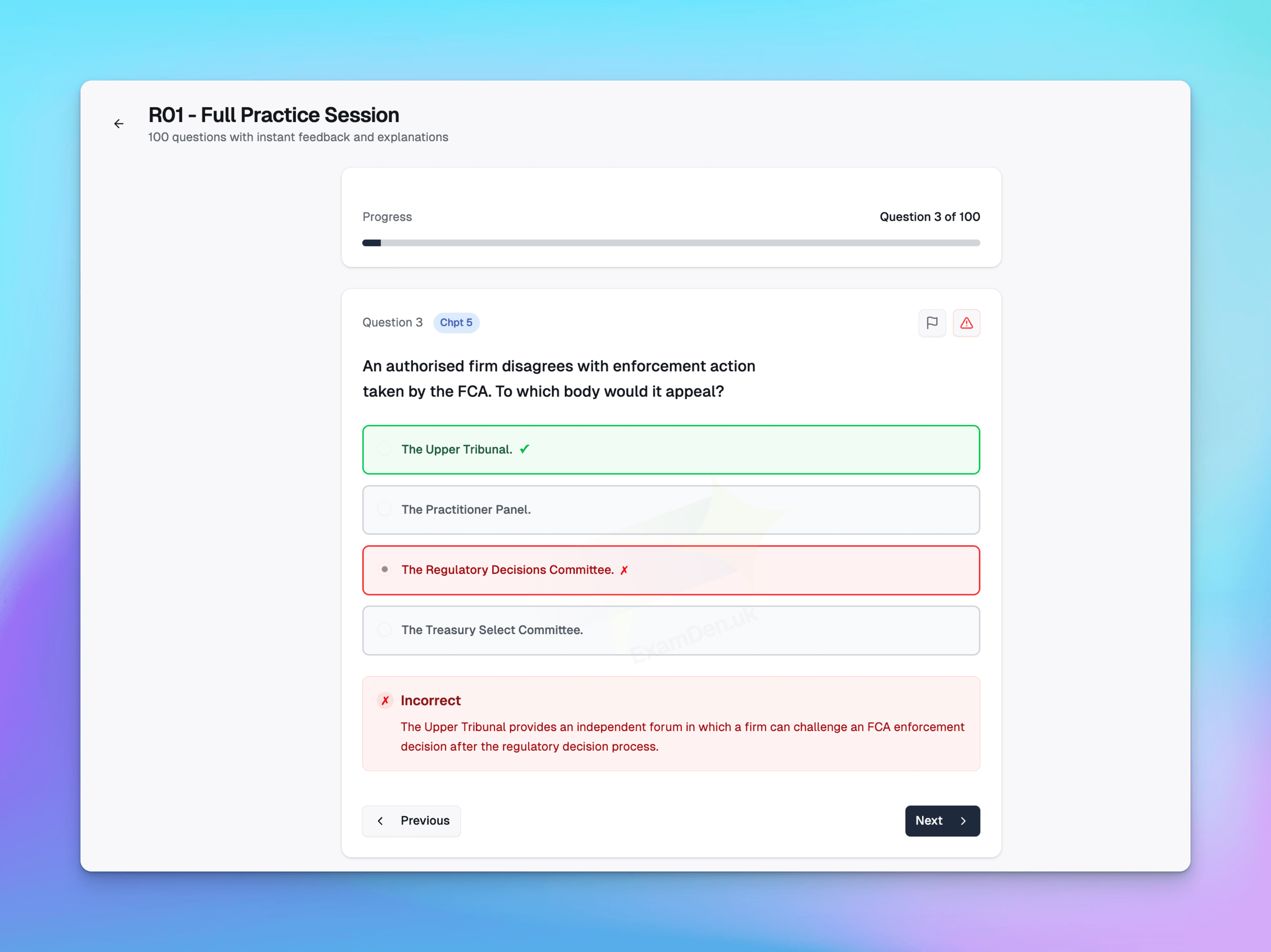
On ExamDen.uk, every question comes with a clear explanation linked to the relevant learning outcome
How R01 Compares to the Other Diploma Units
| Unit | Questions | Time | Pass Mark | Multiple Response | Difficulty (common view) |
|---|---|---|---|---|---|
| R01 | 100 | 2 hours | 65% | 13 | Broad but manageable |
| R02 | 100 | 2 hours | 65% | Yes | Calculations + theory |
| R03 | 50 | 1 hour | 65% | Yes | Tax detail is dense |
| R04 | 50 | 1 hour | 65% | Yes | Pension rules are complex |
| R05 | 50 | 1 hour | 70% | None | Higher pass mark, but no multiple-response |
R01 is generally considered the most accessible starting point because the content is conceptual rather than calculation-heavy. R02 adds investment maths. R03 tests detailed tax rules. R04 covers pension legislation. R05 has a higher pass mark (70%) but no multiple-response questions and is RQF Level 3 rather than Level 4.
Most candidates find R01 easier than R02 or R03, but harder than they expected going in — mainly because of the breadth.
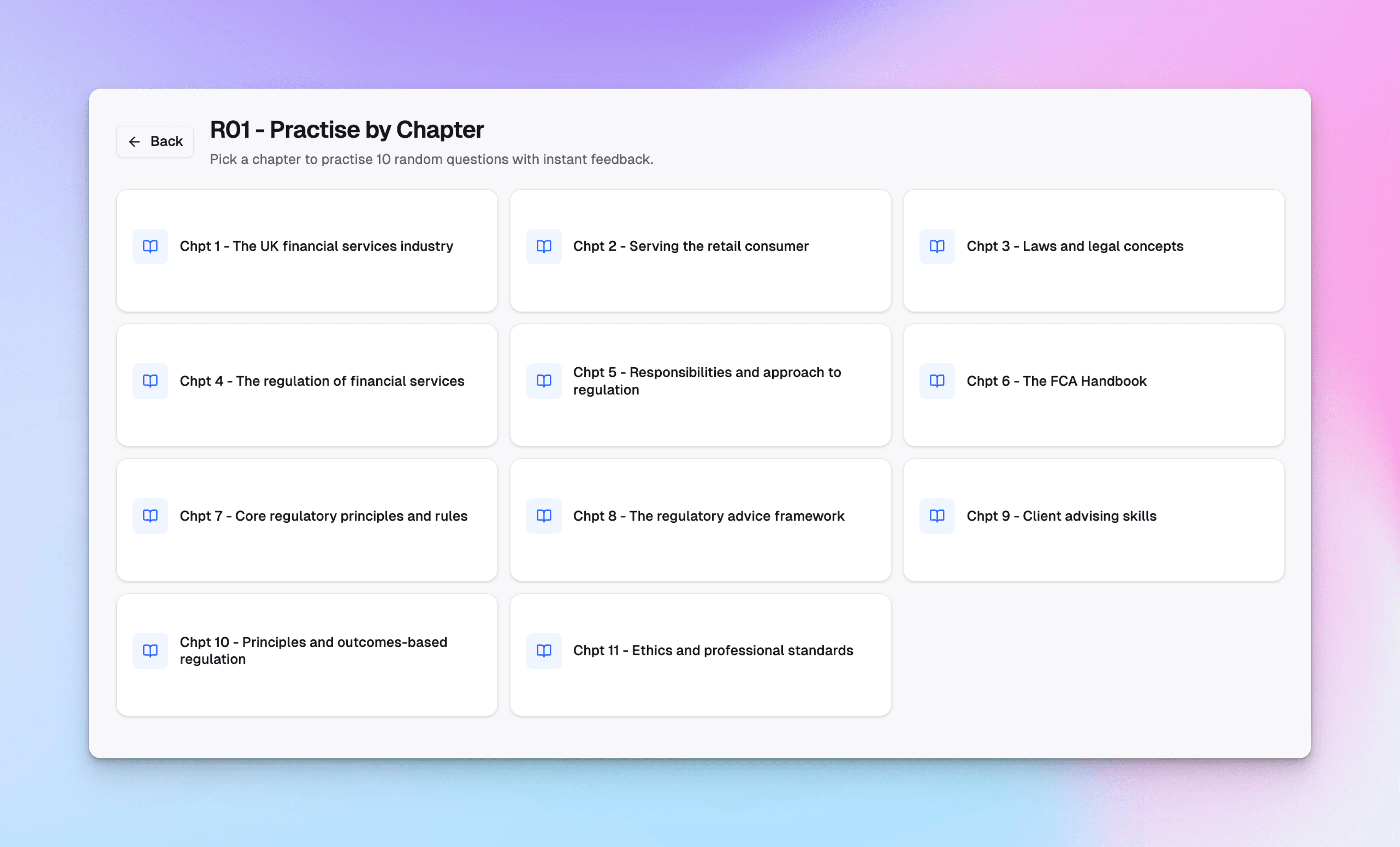
On ExamDen.uk, practise one learning outcome at a time, then sit a full mock in the real question count and time limit
What Actually Determines Whether You Pass
Based on candidate feedback and forum discussions, the biggest predictors of success are:
- Covering all 11 learning outcomes. Candidates who skip topics fail. The exam tests everything, and skipping even a small LO (like LO10 or LO11) means giving away easy marks.
- Practising multiple-response questions specifically. The 13 questions in LO6 and LO7 are the hardest part of R01 for most candidates. Practise the "select all that apply" format until you're comfortable with it.
- Doing timed mocks. Two hours for 100 questions is 72 seconds each. Candidates who only do untimed practice often run out of time or rush the final questions.
- Learning the specific figures. FSCS limits, FOS limits, complaint timescales, insider dealing penalties — R01 tests these. Make flashcards or a summary sheet for the numbers you need to know.
- Reading question wording carefully. The CII emphasises key words in bold (maximum, minimum, normally) and uses capitals for negatives (NOT, CANNOT). Missing these changes the answer completely.
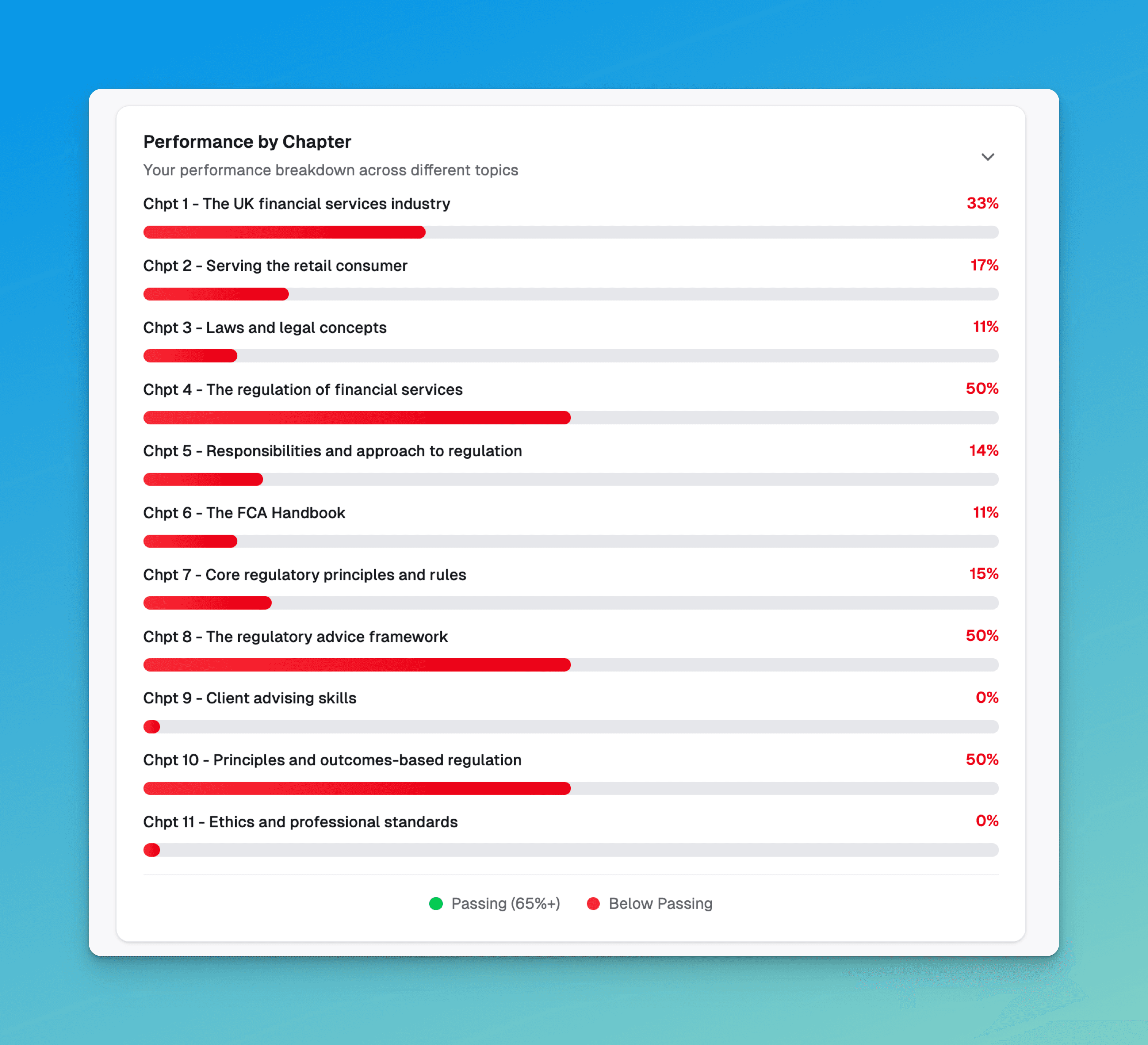
On ExamDen.uk, a timed mock shows your score against the 65% pass mark, and which learning outcomes are below it
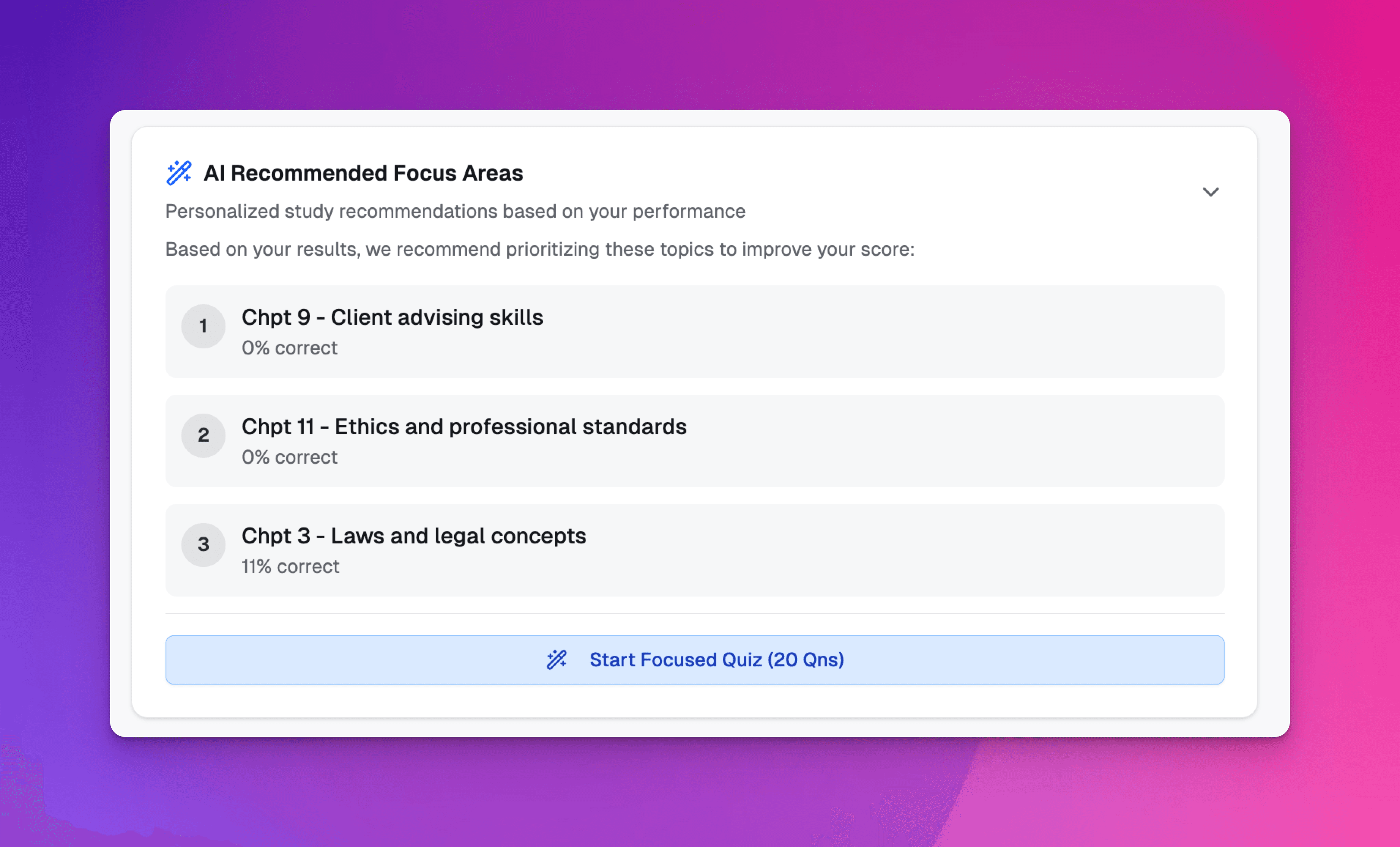
On ExamDen.uk, those weak learning outcomes become a short focus list for your next revision session
How to Prepare
For a full study plan, learning outcome breakdown and common mistakes, see our complete R01 study guide. If you're in revision mode, our R01 revision guide walks through every learning outcome with what to focus on.
If you want to see the question style before committing to full study, try these 5 free R01 mock questions.
For registration, fees and booking, see our guide to registering for CII exams.
R01 Difficulty FAQs
Ready to Put This Strategy Into Action? 💯
Find out if you're ready. Take a timed mock and see exactly where you stand against the 65% pass mark.

The ExamDen.uk Team
ExamDen.uk builds exam-style question banks and timed mocks for CeMAP, Cert CII and CII R01–R05, helping UK professionals prepare for their financial services exams.