Free CII IF6 Mock Exam Questions with Answers (2026)
Try 6 free IF6 practice questions with answers and explanations — 3 standalone MCQs and a case study with 3 questions, covering nuisance, premium rating, underinsurance, rebuild cost and subsidence.
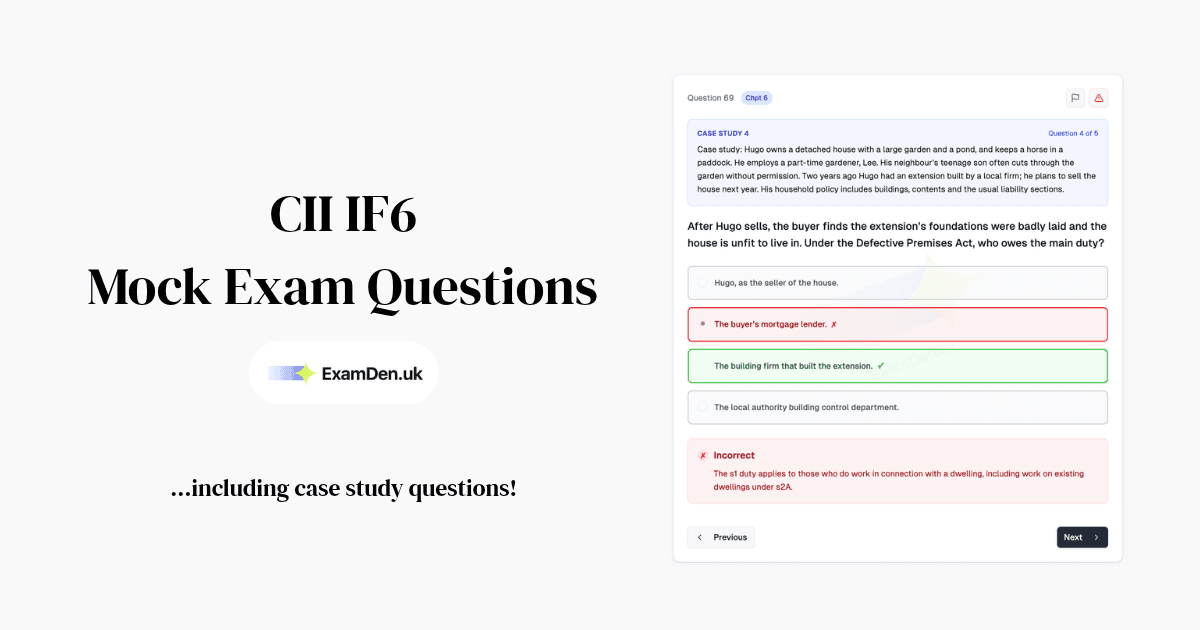
Looking for free CII IF6 practice questions? Here are 6 exam-style questions — 3 standalone MCQs (Section A style) and a case study with 3 questions (Section B style) — with answers and detailed explanations.
Like IF5, IF6 includes case studies. Section A has 50 standalone MCQs and Section B has 5 case studies with 5 questions each. Below you'll see both formats.
📝 IF6 Exam Quick Facts
- 75 questions in 2 hours: 50 standalone MCQs + 5 case studies × 5 questions
- Pass mark: 70% (at least 53 out of 75)
- No multiple-response questions: every question is pick one from four
- Syllabus: scope of cover, legal & regulatory, underwriting & rating, claims procedures
---
Section A Style: Standalone Questions
Question 1: LO3 — Legal & Regulatory
Roots from Ola's neighbour's trees gradually spread and crack the foundations of her house.
Which tort is this most likely to be?
A. Negligence
B. Strict liability
C. Nuisance
D. Trespass
Click to reveal answer
✓ Correct Answer: C
This is most likely private nuisance.
Encroaching tree roots that interfere with the use and enjoyment of land constitute private nuisance. While trespass might seem plausible, trespass requires a direct, physical intrusion — the gradual spread of roots is an indirect interference, which falls under nuisance. This distinction between torts is commonly tested in IF6.
Question 2: LO5 — Risk Assessment & Underwriting
A contents premium is rated at £2.50 per £1,000 sum insured.
What is the premium for £40,000 cover, before tax?
A. £40
B. £80
C. £100
D. £125
Click to reveal answer
✓ Correct Answer: C
The premium is £100.
£40,000 ÷ £1,000 = 40 units. 40 × £2.50 = £100. This is a straightforward premium rating calculation — the kind that appears in IF6's underwriting section. Remember, this is the premium before Insurance Premium Tax (IPT) is added.
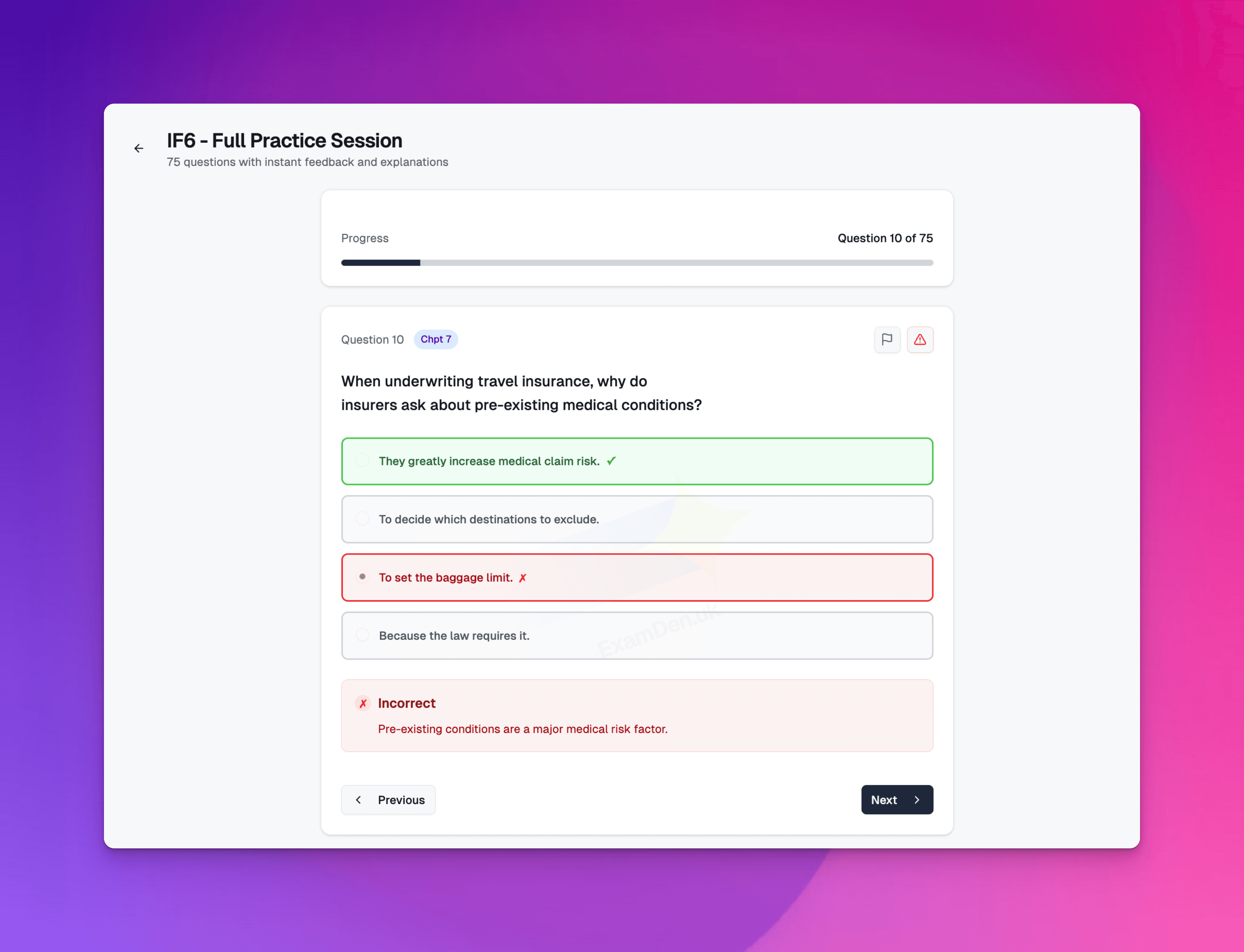
On ExamDen.uk, every question comes with a detailed explanation, like the sample questions above
Question 3: LO5 — Underinsurance and Average
Contents worth £30,000 are insured for £24,000, with a 15% under-insurance tolerance before average applies. A £2,000 claim is made.
Ignoring the excess, what is paid?
A. £1,600
B. £1,700
C. £1,800
D. £2,000
Click to reveal answer
✓ Correct Answer: A
The insurer pays £1,600.
First, check whether average applies. The sum insured (£24,000) is 80% of the true value (£30,000). The tolerance is 15%, meaning average only kicks in if the sum insured falls below 85% of the true value. 80% is below 85%, so average applies.
Claim paid = £2,000 × (£24,000 ÷ £30,000) = £2,000 × 0.80 = £1,600. The tolerance threshold is a common IF6 twist — always check whether the underinsurance exceeds the tolerance before applying average.
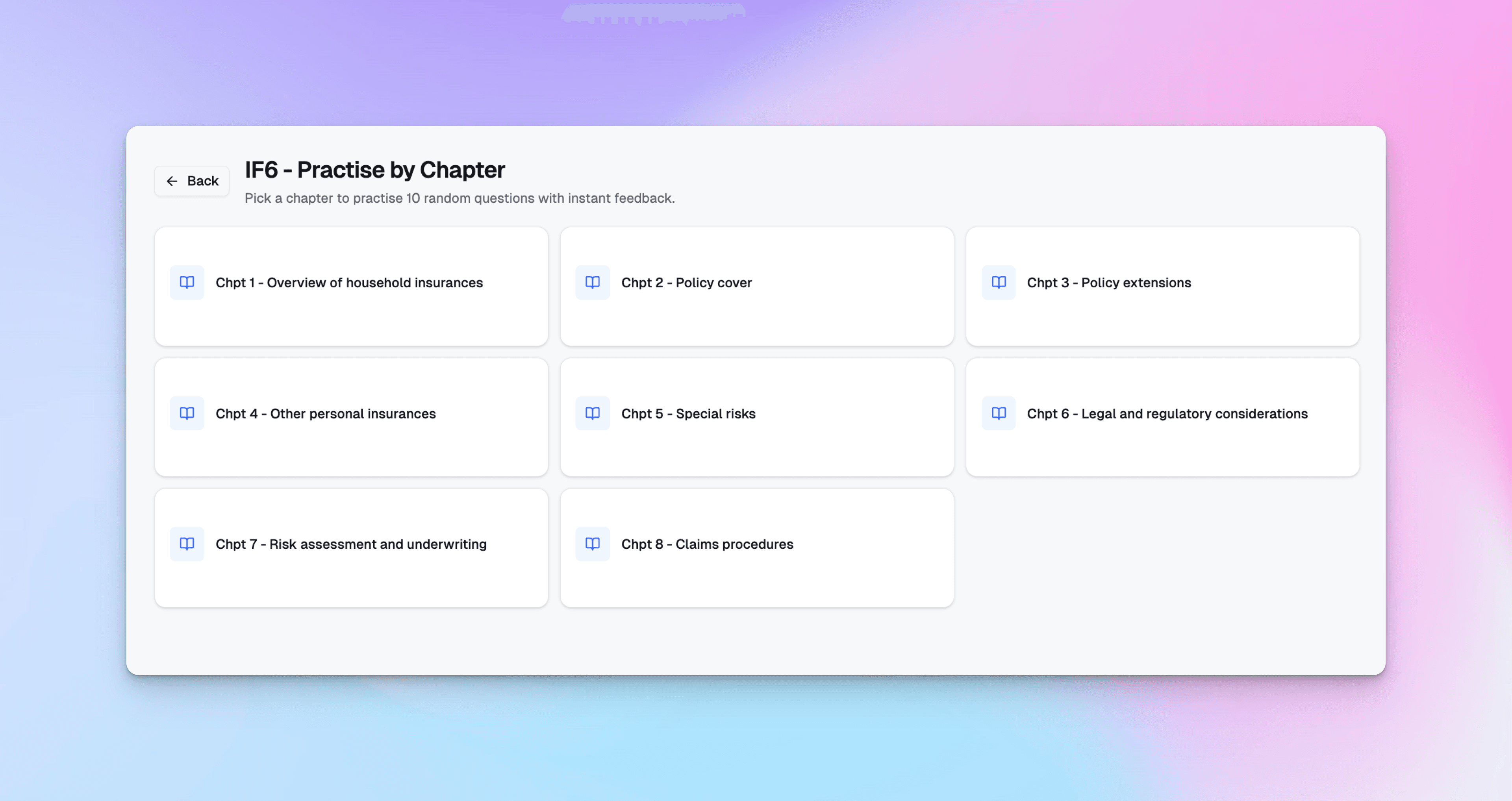
On ExamDen.uk, practise one learning outcome at a time, then sit a full mock in the real two-section format
🎯 Practise Like the Real Exam
ExamDen.uk tracks your score by learning outcome so you see exactly where you're losing marks. No more guessing which topics to revise.
Start IF6 Practice →Section B Style: Case Study Questions
In the real exam, Section B presents a scenario and asks 5 questions about it. Below is a sample case study with 3 questions so you can see how the format works.
📋 Case Study: Nina's New Home
Nina, 34, is buying a 1920s terraced house near a river for £350,000. A surveyor estimates the rebuild cost at £210,000.
The house has a slate roof, solid brick walls and a large oak tree 5 metres away. She will run a bookkeeping business from the spare room and plans to take in a lodger.
She has one previous escape of water claim, three years ago.
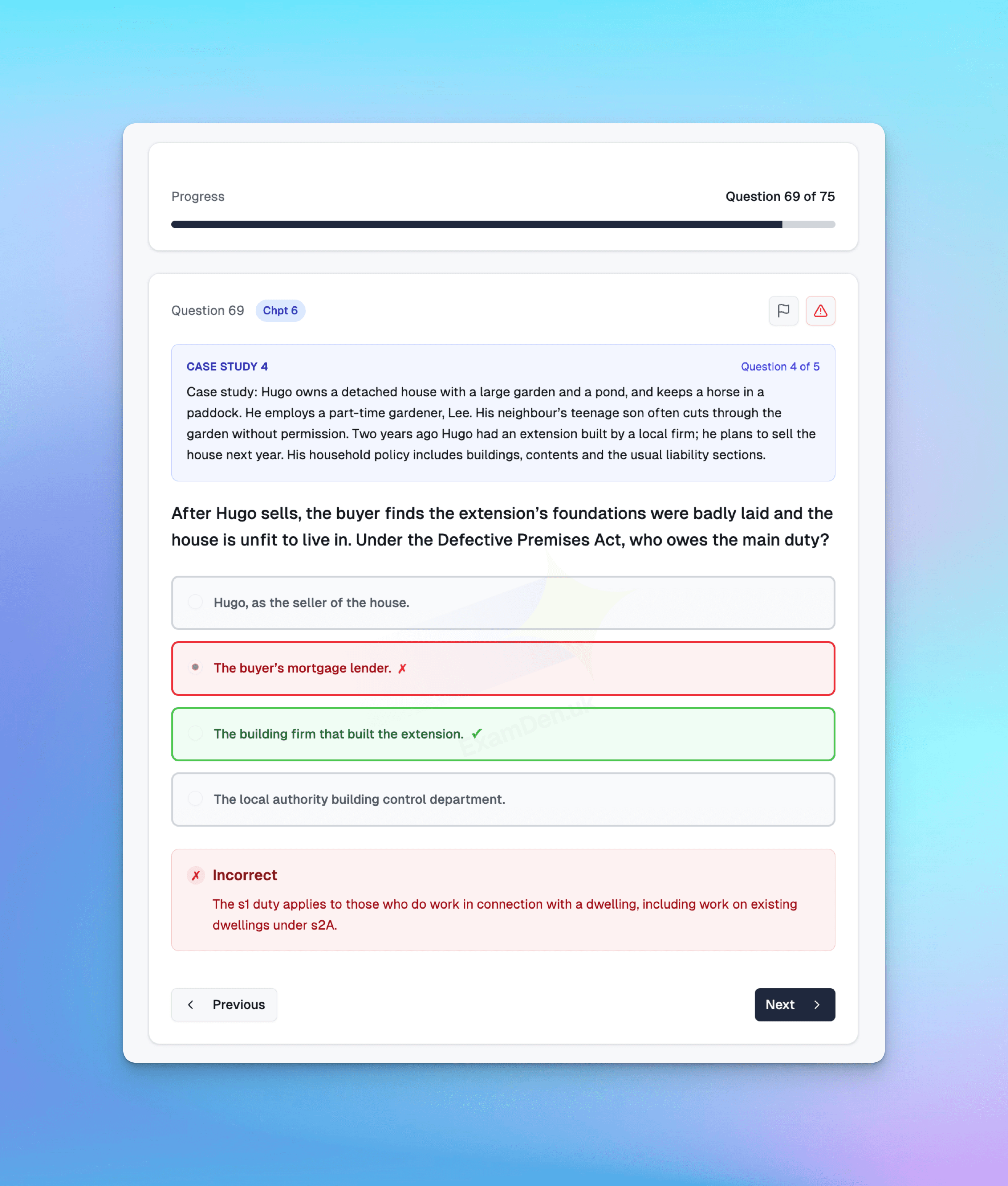
On ExamDen.uk, case study questions present a scenario with multiple linked questions, just like Section B of the real IF6 exam
Question 4: Buildings Sum Insured
What should the buildings sum insured be based on?
A. £350,000, the purchase price
B. £280,000, a midpoint figure
C. £210,000, the rebuild cost
D. The mortgage amount
Click to reveal answer
✓ Correct Answer: C
The buildings sum insured should be based on the rebuild cost — £210,000.
Buildings insurance covers the cost of rebuilding the property, not its market value or purchase price. The market value (£350,000) includes the land, location and market conditions — none of which are relevant to rebuilding. Using the purchase price would result in over-insurance. This is a fundamental IF6 principle that candidates must know.
Question 5: Subsidence Risk
Which feature is most likely to concern the insurer about subsidence?
A. The slate roof
B. The solid brick walls
C. Her age and occupation
D. The oak tree close to the house
Click to reveal answer
✓ Correct Answer: D
The oak tree close to the house is the main subsidence concern.
Large trees near a property are a significant subsidence risk factor, especially on clay soils. Tree roots extract moisture from the soil, causing it to shrink — this can crack foundations. An oak tree just 5 metres from the house would be flagged during underwriting. The slate roof and solid brick walls are standard construction features (positive indicators), and Nina's age and occupation are not subsidence factors.
Question 6: Claims History Disclosure
How should Nina handle her previous escape of water claim when applying?
A. Answer accurately, including it
B. Leave it out, as it was under £1,000
C. Leave it out, as it was a different house
D. Mention it only if a survey is arranged
Click to reveal answer
✓ Correct Answer: A
Nina must answer accurately and include the previous claim.
Under CIDRA 2012, a consumer must take reasonable care not to make misrepresentations when answering the insurer's questions. If the application asks about previous claims, Nina must answer truthfully — regardless of the amount, the property or whether a survey is involved. The insurer can also check CUE (Claims and Underwriting Exchange), which would show the claim anyway. Failing to disclose could give the insurer grounds for a proportionate remedy.
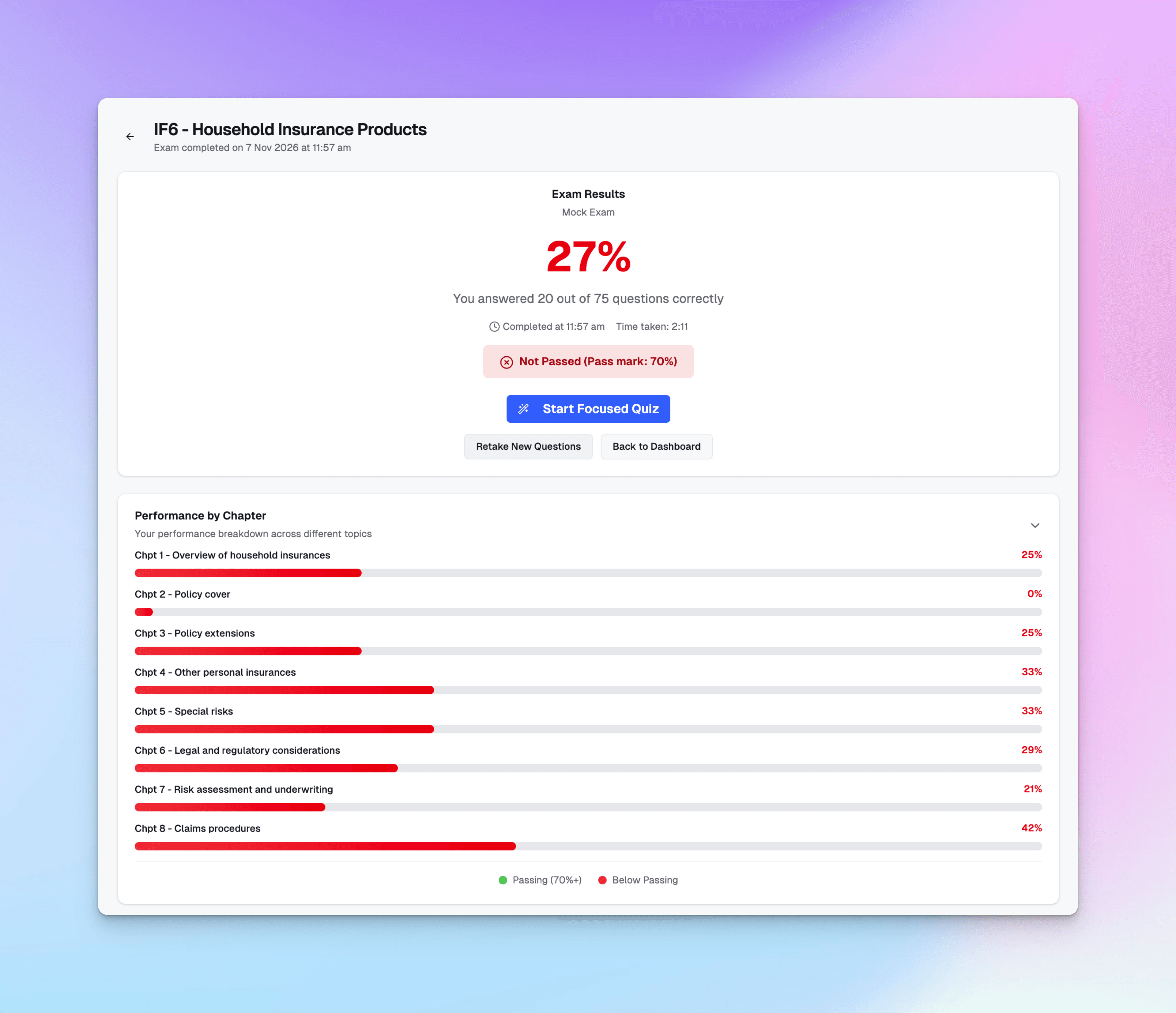
On ExamDen.uk, a timed mock shows your score against the 70% pass mark, and which learning outcomes are below it
How Did You Do?
These 6 questions cover only a fraction of the IF6 syllabus — and the real exam has 75 questions across both standalone MCQs and case studies, with underwriting alone worth 37%.
For a full study plan and learning outcome breakdown, see our complete IF6 study guide. If you want to practise more, ExamDen's IF6 question bank has hundreds of exam-style questions — including case studies — with timed mocks and AI that tracks your weak learning outcomes.
For a revision-ready overview of every learning outcome, see our IF6 revision guide. Wondering about the difficulty level? Read Is IF6 Hard? for a full breakdown.
IF6 Practice Questions FAQs
Ready to Put This Strategy Into Action? 💯
Try hundreds more exam-style IF6 questions — including case studies — with timed mocks and AI-driven learning outcome tracking.

The ExamDen.uk Team
ExamDen.uk builds exam-style question banks and timed mocks for CeMAP, Cert CII and CII R01–R05, helping UK professionals prepare for their financial services exams.