How to Pass CII IF6 (2026): Study Guide and Exam Tips
A practical guide to passing CII IF6 — covering the two-section exam format with case studies, all 8 learning outcomes, the 70% pass mark, household insurance products and common mistakes.
IF6 — Household Insurance Products — is the specialist household unit of the Cert CII (Certificate in Insurance). It covers buildings, contents, personal possessions, liability, and associated products like travel, pets and caravans — from the scope of cover through underwriting, claims and regulation.
Like IF5 (Motor), IF6 includes case studies. The exam has two sections — 50 standalone MCQs in Section A, and 5 case studies with 5 questions each in Section B. Every question is standard multiple-choice (pick one from four), but the Section B questions relate to a scenario you need to read and apply your knowledge to.
IF6 has the heaviest underwriting weighting of any Cert CII unit. Risk assessment, rating and underwriting (LO5 + LO6) accounts for 28 out of 75 questions — 37% of the exam.
📋 IF6 Quick Summary
- 75 questions in 2 hours: 50 standalone MCQs (Section A) + 5 case studies × 5 questions (Section B)
- Pass mark: 70% (at least 53 out of 75)
- 8 learning outcomes in 4 topic areas — paired as "understand" and "apply"
- Heaviest area: Risk assessment, rating & underwriting (LO5 + LO6) — 28 questions (37%)
- On-demand exam: book almost any day, sit at a test centre or online with a remote invigilator
IF6 Exam Format
IF6 has two sections:
Section A — 50 standard MCQs. These test your understanding of household insurance knowledge. Each question stands alone.
Section B — 5 case studies, each followed by 5 MCQs. Each case study presents a scenario — a homeowner, a property, a claim or a policy situation — and the questions test your ability to apply your knowledge to that specific scenario. You need to read the scenario carefully because the answers depend on the details given.
All 75 questions are standard multiple-choice (pick one from four). There are no multiple-response questions. The pass mark is 70% — you need at least 53 out of 75 correct, meaning you can get 22 wrong. No marks are deducted for incorrect answers, so always attempt every question.
The exam is 2 hours — 96 seconds per question on average. Budget extra reading time for the case study scenarios in Section B by keeping a steady pace through Section A.
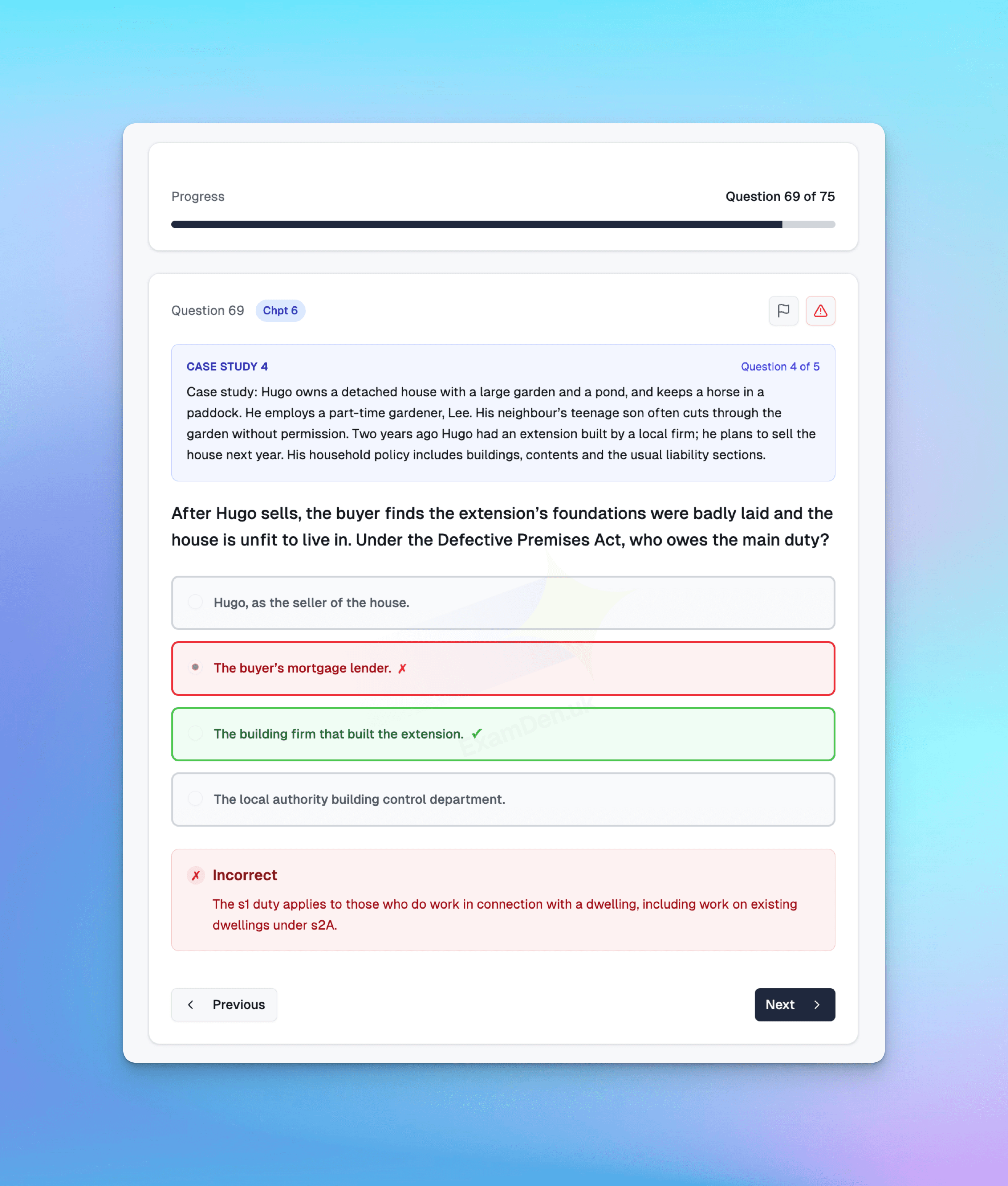
On ExamDen.uk, case study questions present a scenario with multiple linked questions, just like Section B of the real IF6 exam
Question Distribution by Topic Area
IF6 has 8 learning outcomes arranged in 4 topic areas. Each area has an "understand" LO (tested mainly in Section A) and an "apply" LO (tested mainly in Section B's case studies).
| Topic Area | LOs | Questions | % of exam |
|---|---|---|---|
| Risk assessment, rating & underwriting | LO5 + LO6 | 19 + 9 = 28 | 37% |
| Scope of cover | LO1 + LO2 | 12 + 6 = 18 | 24% |
| Legal & regulatory | LO3 + LO4 | 11 + 6 = 17 | 23% |
| Claims procedures | LO7 + LO8 | 8 + 4 = 12 | 16% |
Underwriting alone is over a third of the exam — the highest concentration in any Cert CII unit. The top three areas account for 63 out of 75 questions (84%).
---
LO5 + LO6: Risk Assessment, Rating & Underwriting — 28 Questions (37%)
This is the dominant topic area. LO5 (19 questions) tests understanding, LO6 (9 questions) tests application through case studies.
What it tests:
- Construction. Standard construction (brick/stone walls, tile/slate roof) vs non-standard (timber frame, thatched, flat roof, prefabricated). How construction type affects risk and premium.
- Security. Locks (mortice deadlocks, window locks), alarms (bells-only vs monitored), CCTV, neighbourhood watch. Minimum security requirements and how they affect cover.
- Flood Re. The government/industry scheme that enables insurers to offer affordable flood cover to high-risk residential properties. How the scheme works, eligibility, the transition plan.
- Surveys. When insurers require building surveys — typically for high-value, non-standard construction or older properties. What surveys cover.
- Basis of cover. Indemnity (market value, deducting wear and tear), reinstatement (cost of rebuilding to current standards), new-for-old (replacement with equivalent new item). When each applies.
- Sum insured. Buildings: rebuild cost (not market value). Contents: total replacement value. How index linking automatically adjusts sums insured for inflation.
- Insurance Premium Tax (IPT). Standard rate, higher rate for travel insurance. How IPT is applied to household policies.
- CIDRA 2012. Consumer duty to take reasonable care not to make misrepresentations. Qualifying vs deliberate/reckless misrepresentation and the insurer's remedies.
- Insurance Act 2015. Proportionate remedies for non-disclosure.
- Renewal. FCA pricing practices rules. Clear disclosure of previous and new premium. Automatic renewal requirements.
Study approach: At 37% of the exam, this is where you pass or fail IF6. Know the rating factors, understand Flood Re, and be clear on the basis of cover (indemnity vs reinstatement vs new-for-old).
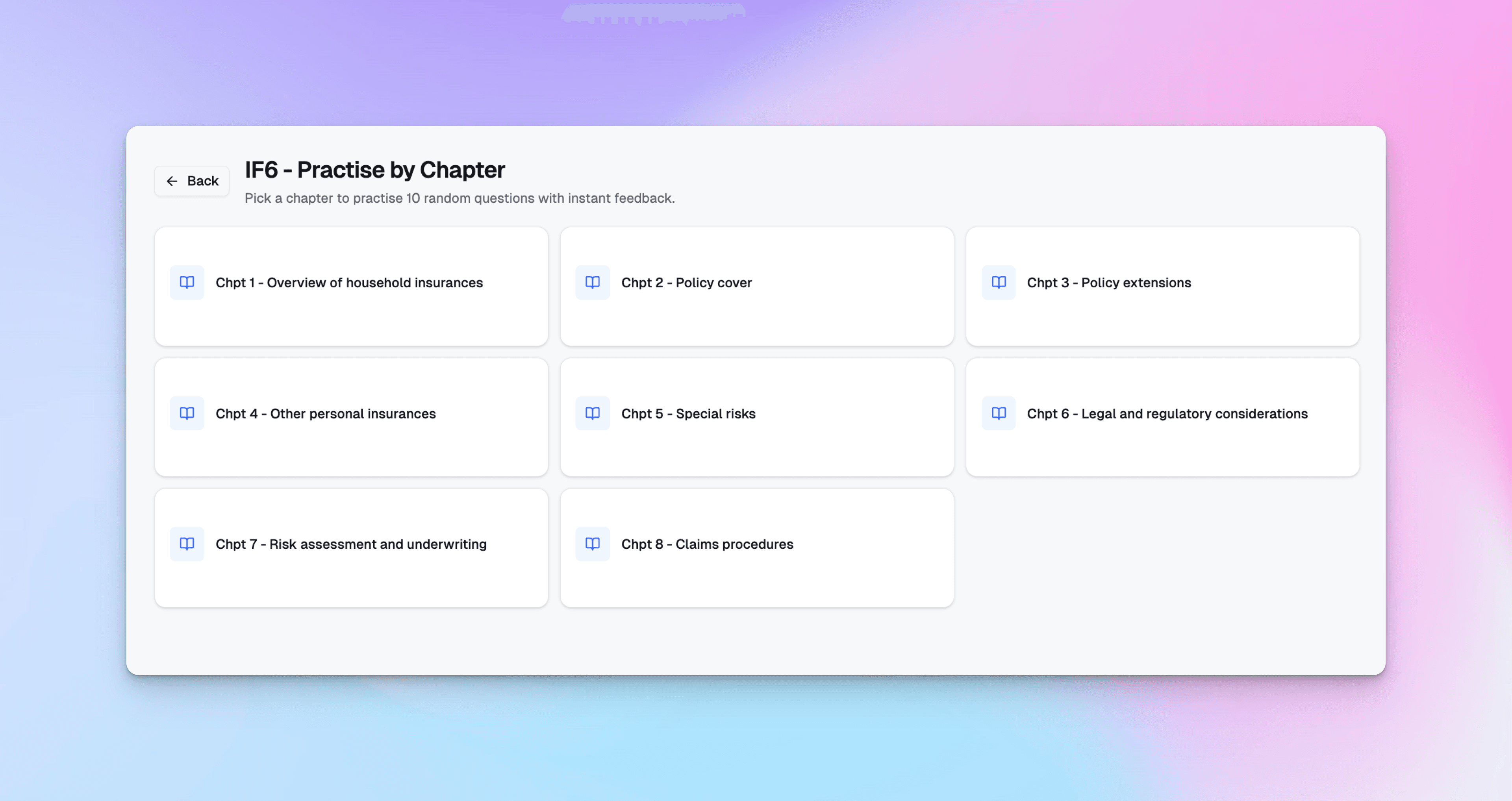
On ExamDen.uk, practise one learning outcome at a time, then sit a full mock in the real two-section format
LO1 + LO2: Scope of Cover — 18 Questions (24%)
What it tests:
- Buildings cover. Structure, fixtures permanently attached — fitted kitchens, bathrooms, built-in wardrobes, fitted carpets, decorations. Includes drains, pipes, cables, walls, gates, fences, drives, paths.
- Contents cover. Moveable items — furniture, clothing, electronics, soft furnishings, personal belongings. Typically covered on a new-for-old basis (excluding clothing, which is indemnity).
- Personal possessions. Items taken outside the home — jewellery, watches, laptops, cameras. Usually subject to single-article limits and an overall away-from-home limit.
- Caravans. Touring vs static. Cover includes accidental damage, theft, storm, third-party liability. Special considerations: site risks, towing cover, seasonal use.
- Travel. Medical expenses, cancellation, baggage, personal liability. Often an optional extension to household policies.
- Pets and horses. Veterinary fees, death/theft, third-party liability. Exclusions for pre-existing conditions.
- Mobile phones. Accidental damage, theft, loss. Often subject to excess and proof of ownership.
- Personal and owner's liability. Legal liability as a private individual (personal liability) and as a property owner/occupier (owner's liability). Typically £1m–£2m limit.
- Optional extensions. Money and credit cards, legal expenses, pedal cycles, helplines, sports equipment, frozen food.
- Special risks. Home working (business equipment, liability), holiday homes (UK and abroad, unoccupancy), blocks of flats (communal areas vs individual units), sharing/renting (lodgers, Airbnb), high net worth.
Study approach: The buildings vs contents distinction is fundamental. Know which items fall under each section — fitted carpets are buildings, freestanding rugs are contents.
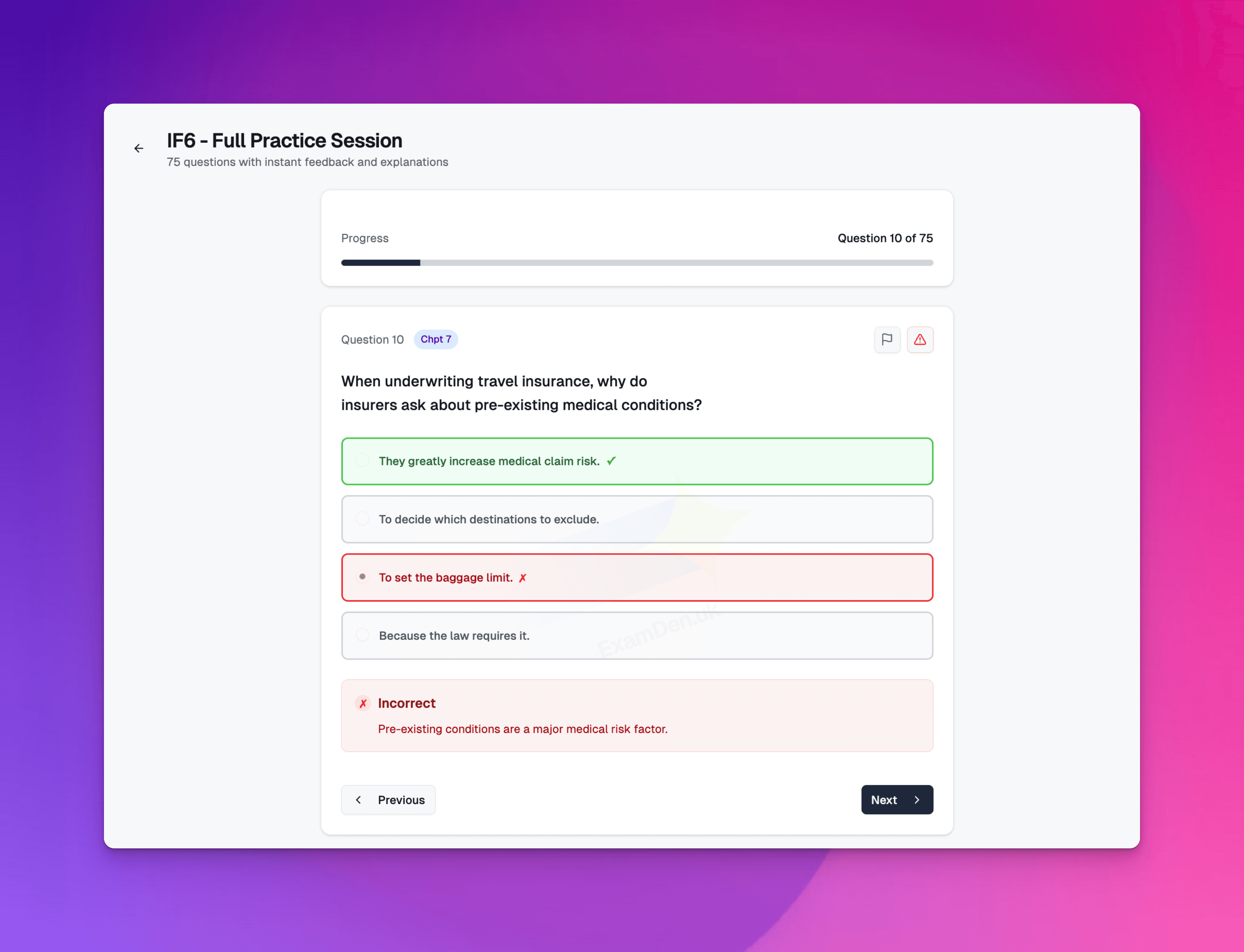
On ExamDen.uk, every question comes with a detailed explanation linked to the relevant learning outcome
🎯 Practise Like the Real Exam
ExamDen.uk tracks your score by learning outcome so you see exactly where you're losing marks. No more guessing which topics to revise.
Start IF6 Practice →LO3 + LO4: Legal & Regulatory — 17 Questions (23%)
What it tests:
- Occupiers' Liability Act 1957. Duty to lawful visitors — the occupier must take reasonable care to ensure visitors are reasonably safe. Covers invitees and licensees.
- Occupiers' Liability Act 1984. Duty to trespassers — a more limited duty, only where the occupier knows or should know of the danger, knows or should know the trespasser may come near it, and the risk is one against which the occupier could reasonably be expected to offer protection.
- Defective Premises Act 1972. Duties of builders, contractors and landlords to ensure premises are fit for habitation. Extends to anyone who takes on work connected with the provision of a dwelling.
- Animals Act 1971. Strict liability for damage caused by dangerous species. Keeper liability for non-dangerous species if the damage was of a kind the animal was likely to cause.
- Dangerous Dogs Act 1991. Criminal liability for owners of certain prohibited breeds and dogs dangerously out of control.
- Consumer Rights Act 2015. Unfair contract terms, transparency, fairness.
- Torts. Negligence (duty, breach, causation, remoteness), strict liability, nuisance (private and public), trespass (to land, person, goods), defamation.
- Limitation Act 1980. Contract: 6 years. Tort: 6 years (3 years for personal injury from date of knowledge).
- FCA regulation. ICOBS, Consumer Duty, fair value, positive customer outcomes.
Study approach: Household insurance has more liability legislation than most Cert CII units. Know the two Occupiers' Liability Acts cold — the 1957/1984 distinction (visitors vs trespassers) is a recurring exam question.
LO7 + LO8: Claims Procedures — 12 Questions (16%)
What it tests:
- Duties of the insured. Notify promptly, take reasonable steps to mitigate loss, not admit liability to third parties, provide documentation and proof of loss.
- Valid claims. The loss must be caused by an insured peril, the policy must be in force, the insured must have an insurable interest.
- Investigation. Loss adjusters, specialist investigators, surveyors. When to appoint, independence, professional standards.
- Settlement of losses. Indemnity basis (wear and tear deducted), new-for-old (replacement cost), reinstatement (rebuild cost). How betterment is handled.
- Claims by product type. Buildings (subsidence, storm, flood, fire), contents (theft, accidental damage), personal possessions, caravans, travel, pets, liability.
- Fraud. Prevention (policy terms, excess), detection (claims databases like CUE, IFB), consequences (forfeiture under Insurance Act 2015).
- FCA claims handling. Fair, prompt, not unreasonably declined. Enterprise Act 2016: pay within a reasonable time.
- Complaints. FCA rules, Financial Ombudsman Service, arbitration and alternative dispute resolution.
Study approach: Claims is the smallest area at 16%, but don't neglect it — 12 questions is still enough to affect your pass. Focus on the claims process by product type and the FCA requirements.
Common Mistakes That Cost Marks
1. Underestimating underwriting.
LO5 + LO6 is 37% of the exam — the highest underwriting weighting of any Cert CII unit. Candidates who spend equal time on all topics often underperform on underwriting.
2. Not practising case studies.
Section B is 25 out of 75 questions. If you only practise standalone MCQs, you won't be used to extracting answers from a scenario. Read the scenario carefully — details about construction type, sum insured and policy terms all matter.
3. Confusing buildings and contents.
Fitted kitchens, fitted carpets and built-in wardrobes are buildings. Freestanding furniture, rugs and electronics are contents. This distinction appears in both Section A and Section B questions.
4. Mixing up the Occupiers' Liability Acts.
1957 covers lawful visitors. 1984 covers trespassers with a more limited duty. Know the three conditions for the 1984 Act duty to arise.
5. Not knowing Flood Re.
Flood Re is a distinctive feature of UK household insurance. Know how the scheme works, which properties are eligible and what happens to premiums for high-risk homes.
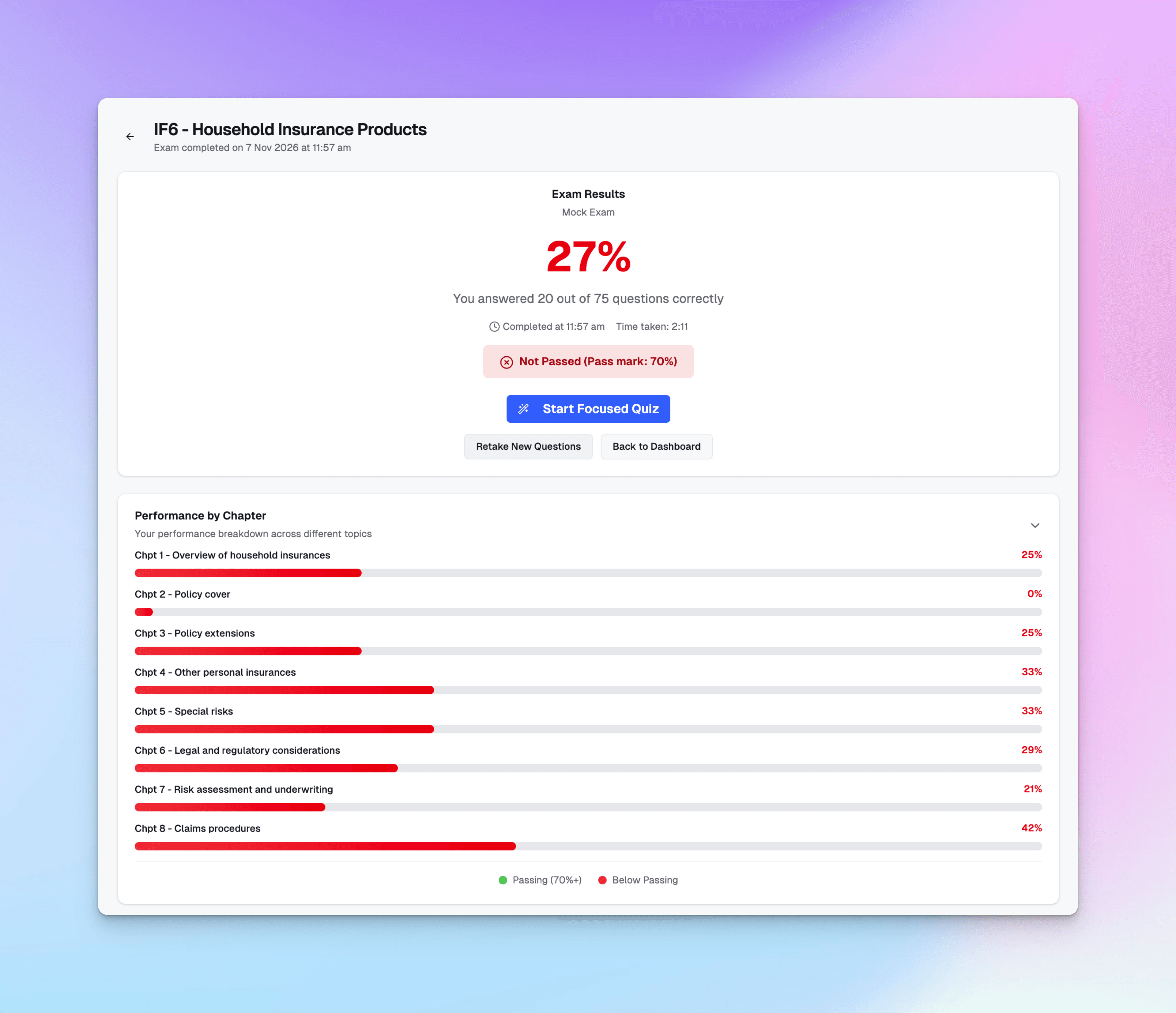
On ExamDen.uk, a timed mock shows your score against the 70% pass mark, and which learning outcomes are below it
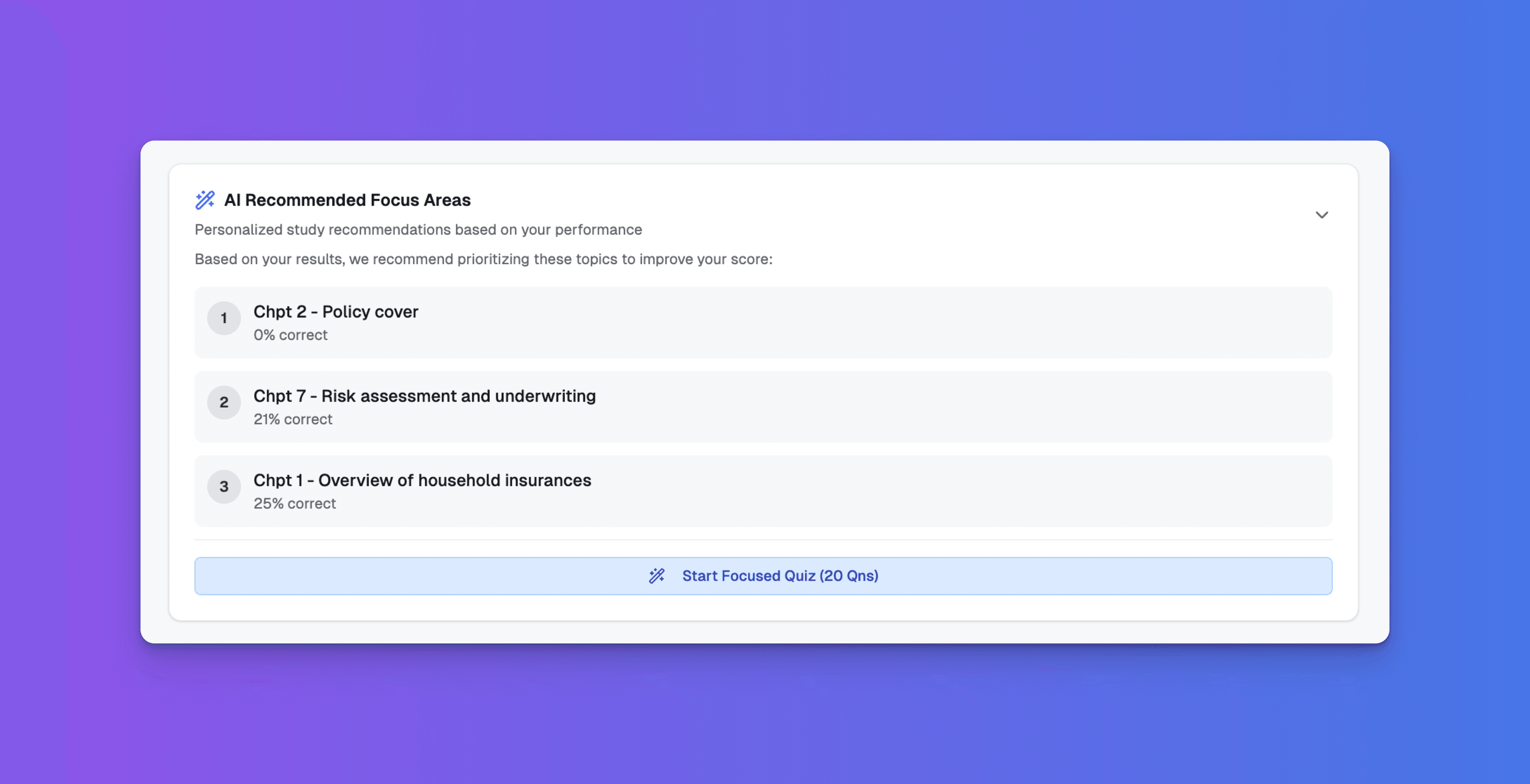
On ExamDen.uk, those weak learning outcomes become a short focus list for your next revision session
How IF6 Fits Into the Cert CII
IF6 is the household specialist unit in the CII Certificate in Insurance (Cert CII). It pairs naturally with IF5 (Motor Insurance Products) — together they cover the two major personal lines classes.
The legal foundations from IF1, the product knowledge from IF2 and the underwriting principles from IF3 all feed into IF6. Understanding general insurance principles makes the household-specific content much easier to learn.
Start Practising
The fastest way to know whether you're ready for IF6 is to take a timed mock — including the case studies. ExamDen's IF6 question bank has hundreds of exam-style questions in both Section A and Section B format, with AI that pinpoints which learning outcomes you need to work on.
Want to try a few questions first? Here are 6 free IF6 mock questions with answers — including a case study. If you're looking for past papers, read why the CII doesn't release them, and what to use instead.
For registration, fees and booking, see our guide to registering for CII exams.
CII IF6 FAQs
Ready to Put This Strategy Into Action? 💯
Practise with exam-style IF6 questions, timed mocks, case studies and AI that shows you which learning outcomes to revise.

The ExamDen.uk Team
ExamDen.uk builds exam-style question banks and timed mocks for CeMAP, Cert CII and CII R01–R05, helping UK professionals prepare for their financial services exams.