CII IF6 Revision Guide (2026): Learning Outcomes and Exam Tips
CII IF6 revision guide: all 8 learning outcomes explained with question counts, priority topics and exam tips for the Household Insurance Products exam, including case study strategy.
This IF6 revision guide covers every learning outcome in the exam, in order of question weight. Use it during your final revision to check that you've covered each topic and know where to focus your remaining study time.
For a broader study plan and common mistakes, see our complete IF6 study guide. For practice questions, try these 6 free IF6 mock questions.
📋 IF6 Exam Recap
- 75 questions in 2 hours — 50 standalone MCQs (Section A) + 5 case studies × 5 questions (Section B)
- Pass mark: 70% (at least 53 out of 75)
- 8 learning outcomes in 4 topic areas
- "Understand" LOs → Section A; "Apply" LOs → Section B case studies
---
LO5: Risk Assessment, Rating & Underwriting (Understand) — 19 Questions (25%)
The single largest LO in the exam. Know this content thoroughly.
- Construction types. Standard: brick/stone walls, tile/slate roof. Non-standard: timber frame, thatched, flat roof (>25% of total roof area), prefabricated (e.g. BISF, Airey), listed buildings. Non-standard construction means higher risk, higher premium, potentially specialist insurer.
- Security. Minimum requirements: 5-lever mortice deadlocks on external doors, key-operated window locks. Enhanced: intruder alarms (bells-only, monitored, NACOSS/NSI approved), CCTV, safes for valuables. Discounts for good security, requirements for high-value items.
- Flood Re. Eligibility: residential properties in council tax bands A–H, built before 1 January 2009. How it works: insurers cede the flood element to Flood Re at a fixed premium based on council tax band. Transition: designed to move to risk-reflective pricing by 2039. Not available for commercial, buy-to-let above 3 units, or properties built after 2009.
- Surveys. Requested by insurers for high-value properties, non-standard construction, older properties, subsidence-affected areas. Types: desktop, drive-by, full building survey.
- Basis of cover. Indemnity: market value, wear and tear deducted. Reinstatement: full cost of rebuilding to current standards. New-for-old: replacement with nearest equivalent new item. Buildings typically on reinstatement; contents on new-for-old (except clothing — often indemnity).
- Sum insured. Buildings: rebuild cost, not market value. Use BCIS (Building Cost Information Service) or surveyor. Contents: total replacement value of all contents. Personal possessions: specified items above single-article limits.
- Index linking. Automatically adjusts sums insured annually using a building cost index (buildings) or consumer price index (contents) to keep pace with inflation.
- IPT. Standard rate on household policies. Higher rate on travel insurance. IPT is included in the premium the customer pays.
- CIDRA 2012. Consumer duty to take reasonable care. Qualifying misrepresentation: proportionate remedy (return premium, adjust terms, avoid from inception depending on what insurer would have done). Deliberate/reckless: insurer can avoid and retain premium.
- Insurance Act 2015. Applies to non-consumer (business) insurance but the principles are tested. Proportionate remedies for non-disclosure.
- Renewal. FCA rules: disclose last year's premium and new premium clearly. Automatic renewal: must inform customers. Pricing practices: ban on price walking for renewals.
Quick test: A property has a timber-frame construction and a flat roof covering 40% of the building. How would an insurer classify this, and what impact does it have on the underwriting approach?
LO6: Risk Assessment, Rating & Underwriting (Apply) — 9 Questions (12%)
LO6 tests the same underwriting content through case studies. Expect scenarios involving:
- A non-standard construction property — identifying the risk factors and their impact on terms
- Underinsurance — calculating average (claim × sum insured ÷ value at risk)
- A Flood Re-eligible property — whether the scheme applies
- A renewal with changed circumstances — what disclosure is needed
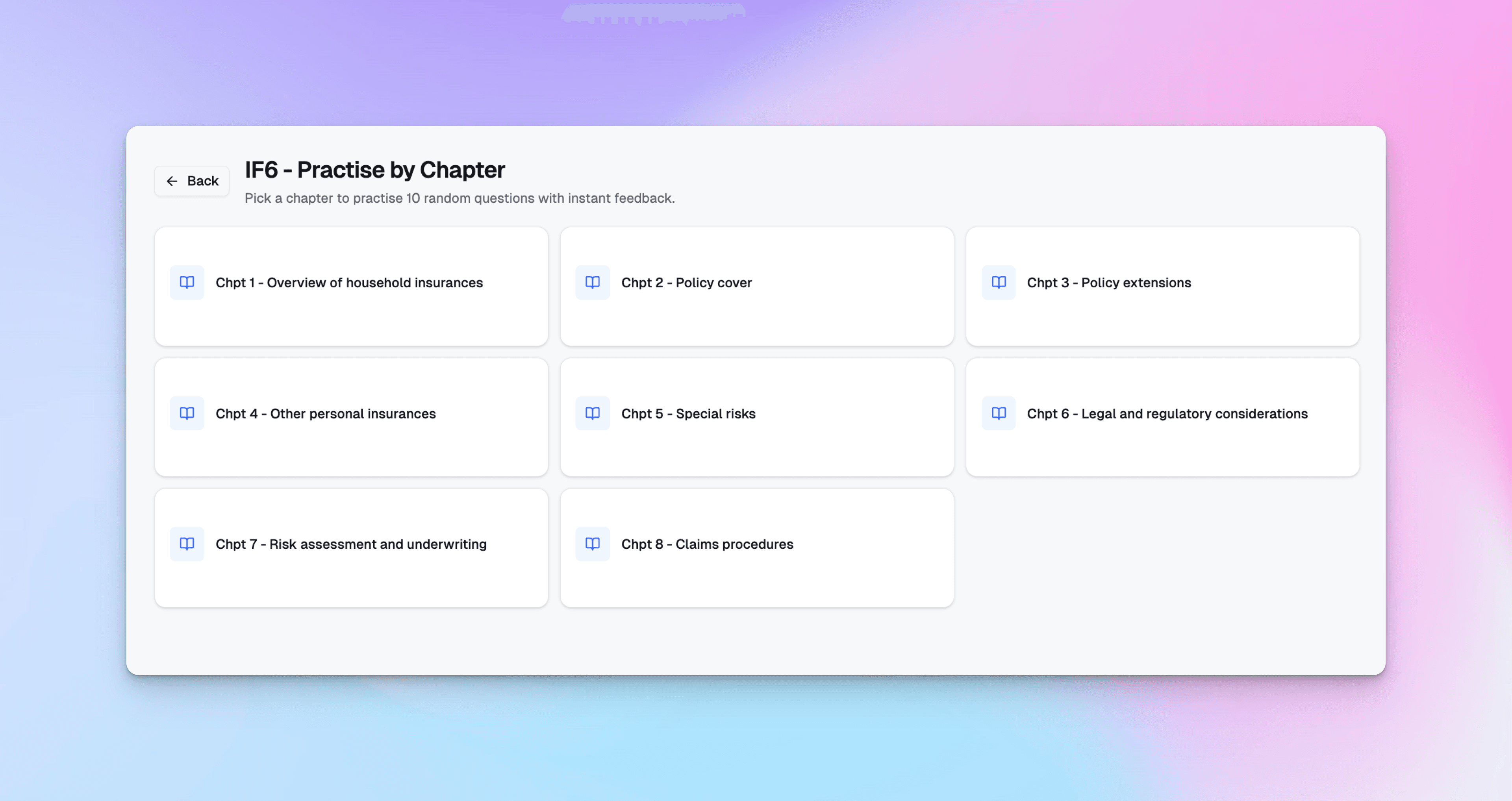
On ExamDen.uk, practise one learning outcome at a time, then sit a full mock in the real two-section format
LO1: Scope of Cover (Understand) — 12 Questions (16%)
- Buildings. Structure, roof, walls, floors, foundations, fixtures and fittings permanently attached (fitted kitchen, fitted bathroom, fitted carpets, built-in wardrobes). Also includes drains, pipes, cables, walls, gates, fences, drives, paths, patios, swimming pools, tennis courts.
- Contents. Moveable items in the home: furniture, clothing, soft furnishings, electronics, kitchenware, books, personal belongings. Standard cover: theft, fire, storm, flood, escape of water, accidental damage (if selected). New-for-old basis typically applies except clothing.
- Personal possessions. Items taken outside the home — jewellery, watches, laptops, cameras, mobile phones. Usually subject to single-article limit (e.g. £1,500) and overall away-from-home limit. Specified items can be added above the single-article limit with valuations.
- Caravans. Touring: accidental damage, theft, storm, third-party liability. Static: similar but site-specific risks. Towing cover, seasonal storage, awning and equipment cover.
- Travel. Medical expenses, cancellation/curtailment, baggage and personal effects, personal liability, legal expenses. Pre-existing medical conditions: must declare, may be excluded or loaded.
- Pets and horses. Veterinary fees (often capped), death from accident or illness, theft/straying, third-party liability. Pre-existing conditions excluded. Horses: higher limits, mortality, loss of use.
- Mobile phones. Accidental damage, theft, loss. Excess, proof of ownership requirements. Exclusions: cosmetic damage, unattended phones.
- Personal and owner's liability. Personal liability: legal liability as a private individual for injury or damage to third parties. Owner's liability: as a property owner. Typically £1m–£2m limit each.
- Optional extensions. Money (cash, travellers' cheques), credit cards (unauthorised use), legal expenses, pedal cycles, assistance helplines, sports equipment, frozen food (spoilage from breakdown).
- Special risks. Home working: business equipment cover, public/product liability extension. Holiday homes: unoccupancy conditions, local perils. Blocks of flats: freeholder/management company arranges buildings, individual arranges contents. Sharing/renting: lodgers, Airbnb (may void policy without endorsement). High net worth: specialist valuations, broader cover, higher limits, claims concierge.
Quick test: A homeowner runs a small business from a spare bedroom using a £3,000 computer. Would this be covered under standard contents? What would they need?
LO2: Scope of Cover (Apply) — 6 Questions (8%)
Case study scenarios for scope of cover might test:
- Whether a specific item is covered under buildings or contents
- Whether a personal possessions claim is within the single-article limit
- Whether a home-working exclusion applies
- Whether a holiday home situation requires a specialist policy
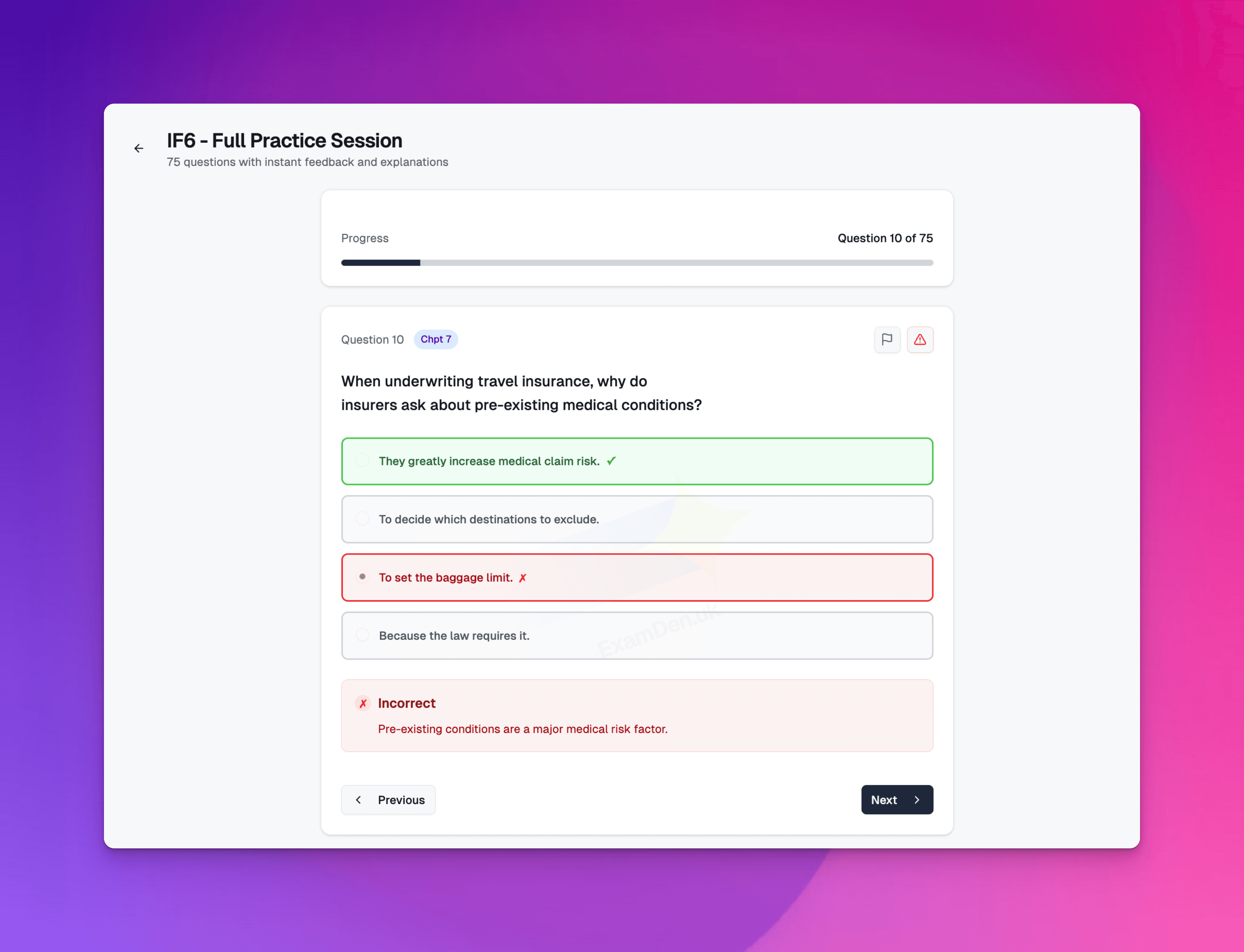
On ExamDen.uk, every question comes with a detailed explanation linked to the relevant learning outcome
🎯 Practise Like the Real Exam
ExamDen.uk tracks your score by learning outcome so you see exactly where you're losing marks. No more guessing which topics to revise.
Start IF6 Practice →LO3: Legal & Regulatory (Understand) — 11 Questions (15%)
- Occupiers' Liability Act 1957. Common duty of care to all lawful visitors. Occupier must take reasonable care to ensure visitors are reasonably safe for the purpose for which they are permitted to be there. Higher duty to children (allurement doctrine). Can restrict duty by warning notices (subject to reasonableness).
- Occupiers' Liability Act 1984. Duty to non-visitors (trespassers). Three conditions must be met: (1) occupier is aware of the danger or has reasonable grounds to believe it exists, (2) occupier knows or should know the non-visitor is in the vicinity or may come near the danger, (3) the risk is one against which the occupier may reasonably be expected to offer some protection. Duty is more limited than the 1957 Act — duty not to cause injury, not a duty to make safe.
- Defective Premises Act 1972. Section 1: duty on persons taking on building work to ensure the dwelling will be fit for habitation when completed. Section 3: landlord's duty of care regarding maintenance and repair. Section 4: duty of care owed by landlord to all persons who might be affected by defects.
- Animals Act 1971. Strict liability for damage by dangerous species (non-native, not commonly domesticated). Keeper liability for non-dangerous species where the damage was of a kind the animal was likely to cause (due to characteristics not normal to the species, or known to the keeper).
- Dangerous Dogs Act 1991. Prohibited breeds (Pit Bull Terrier, Japanese Tosa, Dogo Argentino, Fila Brasileiro). Criminal offence for a dog to be dangerously out of control in any place. Owner/keeper liability.
- Torts. Negligence: duty of care, breach, causation, remoteness. Nuisance: private (interference with use/enjoyment of land), public (affecting the public at large). Trespass: to land, to person, to goods. Strict liability: no need to prove fault. Defamation: libel (written), slander (spoken).
- Limitation Act 1980. Contract: 6 years from breach. Tort: 6 years from damage (3 years for personal injury from date of knowledge). Latent damage: 3 years from knowledge, 15-year longstop.
- Consumer Rights Act 2015. Unfair contract terms. Transparency requirement. Core terms exemption (if transparent and prominent).
- FCA regulation. ICOBS, Consumer Duty, fair value, positive customer outcomes. Claims handling: fair, prompt, not unreasonably declined.
Quick test: A child trespasser is injured by an unfenced swimming pool. Under which Act would the occupier's liability arise, and what three conditions must be satisfied?
LO4: Legal & Regulatory (Apply) — 6 Questions (8%)
Case studies might test:
- Whether a visitor or trespasser is owed a duty under the 1957 or 1984 Act
- Whether strict liability applies to a dog bite
- Whether a landlord has a duty under the Defective Premises Act
- Application of limitation periods to a specific set of facts
LO7: Claims Procedures (Understand) — 8 Questions (11%)
- Duties of the insured. Notify promptly, take steps to prevent further damage, not admit liability, provide documentation and proof of ownership, cooperate with the insurer's investigation.
- Requirements of a valid claim. The loss must be caused by an insured peril, the policy must be in force, the insured must have insurable interest, the claim must be notified within the policy terms.
- Investigation. Loss adjusters (act for insurer), surveyors, specialists. When to appoint: large or complex claims, suspected fraud, subsidence. The insurer's right to investigate before paying.
- Settlement of losses. Buildings: reinstatement (rebuild cost). Contents: new-for-old (replacement, except clothing — indemnity). Betterment: the insurer is not obliged to put the insured in a better position than before the loss.
- Claims by product type. Buildings: subsidence (monitoring, underpinning), storm (wind speed evidence), flood (Flood Re claims), escape of water, fire. Contents: theft (police report, proof of ownership), accidental damage. Personal possessions: receipts, photographs, valuations. Caravans, travel, pets, mobile phones: product-specific procedures.
- Fraud. Prevention: policy terms, excess, conditions precedent. Detection: CUE (Claims and Underwriting Exchange), IFB (Insurance Fraud Bureau), social media checks, forensic investigation. Consequences: forfeiture of fraudulent claim under Insurance Act 2015, criminal prosecution (Fraud Act 2006).
- FCA claims handling. ICOBS rules: fair, prompt, not unreasonably declined. Enterprise Act 2016: implied term to pay claims within a reasonable time. Consumer Duty: delivering good outcomes.
- Complaints. Internal complaints handling: acknowledge, investigate, respond within 8 weeks. FOS: eligible complainants, binding on insurer up to award limit. ADR: arbitration, mediation.
LO8: Claims Procedures (Apply) — 4 Questions (5%)
Case studies might test:
- Whether a subsidence claim is valid and how it would be investigated
- Whether the insurer can apply betterment to a settlement
- The correct settlement basis for a specific type of loss
- Whether a customer's complaint should be referred to the FOS
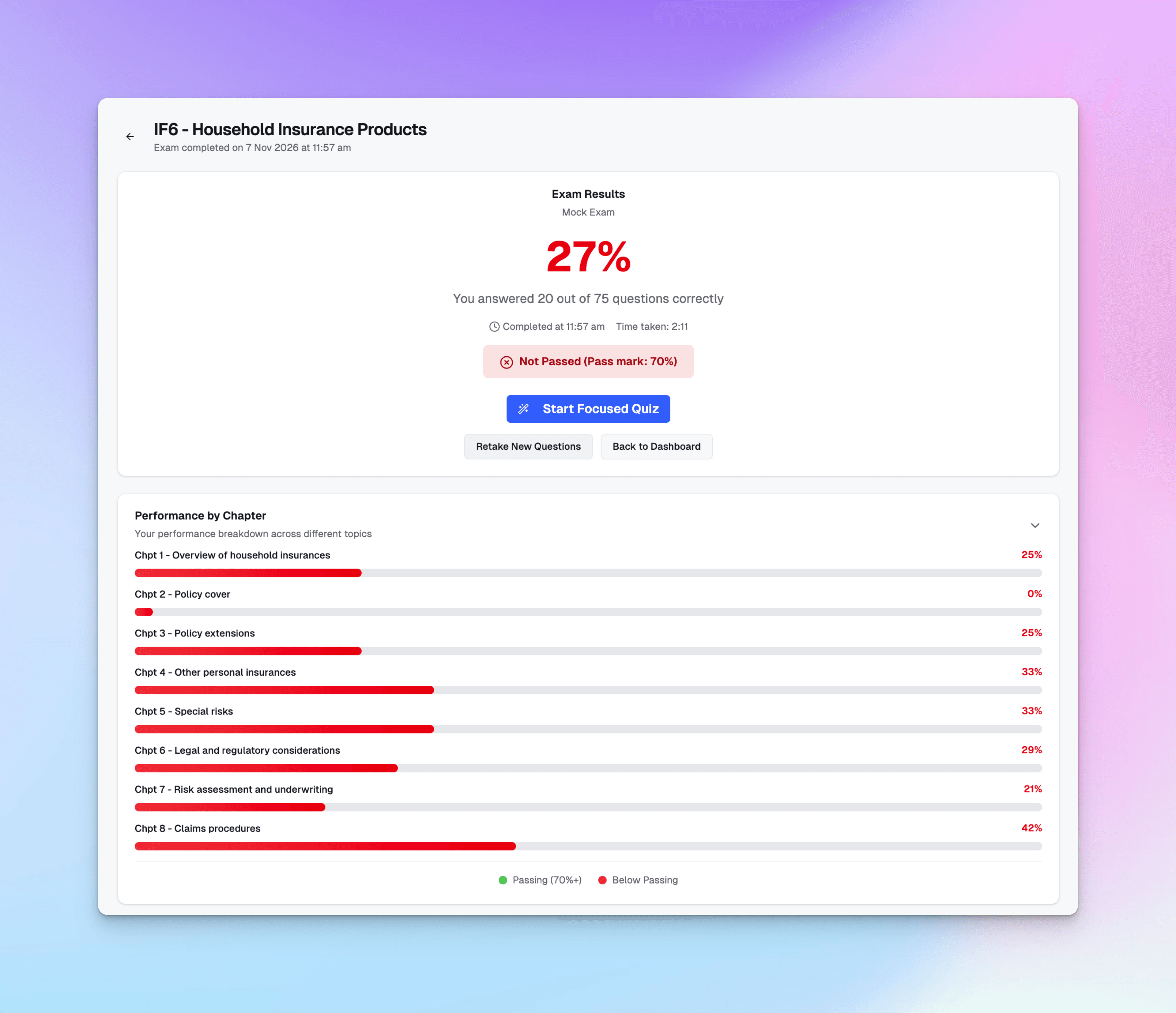
On ExamDen.uk, a timed mock shows your score against the 70% pass mark, and which learning outcomes are below it
Case Study Strategy
Section B is a third of the exam. Here's how to approach household case studies:
- Read the scenario once, carefully. Note the property type, construction, policy terms, sum insured and what happened.
- Read each question, then re-read the relevant part of the scenario. Don't rely on memory.
- Apply the principle to the specific facts. Is it buildings or contents? Is the property underinsured? Which Act applies?
- Watch for distractors. Case studies often include irrelevant details to test whether you can identify what matters.
- Manage your time. Read the scenario once (2–3 minutes), then answer the 5 questions (about 90 seconds each).
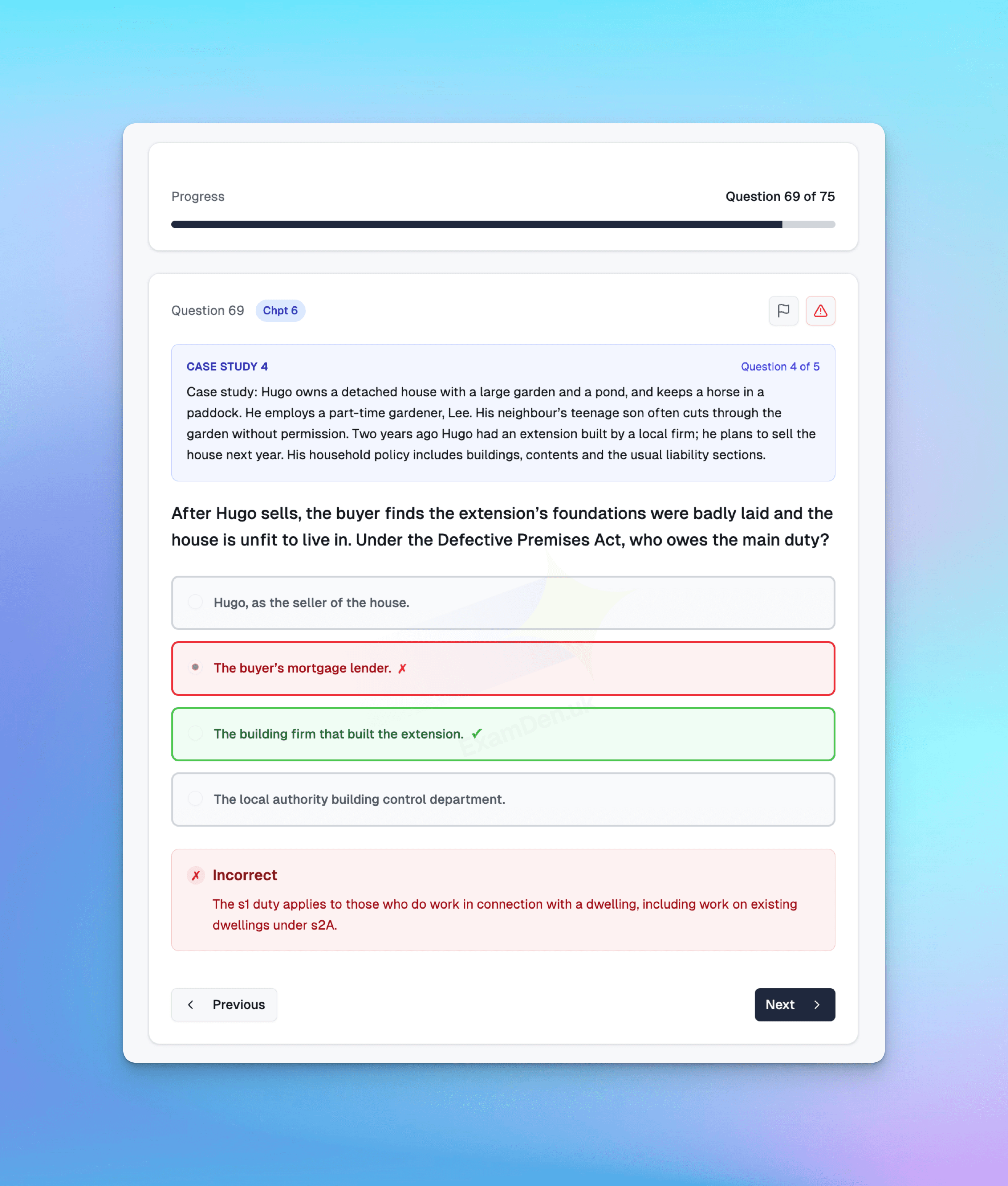
On ExamDen.uk, case study questions present a scenario with multiple linked questions, just like Section B of the real IF6 exam
Final Revision Checklist
Before exam day, make sure you can:
- Distinguish buildings from contents — fitted items vs freestanding
- Explain the three bases of cover — indemnity, reinstatement, new-for-old
- Describe how Flood Re works — eligibility, pricing, transition plan
- Calculate average — claim × (sum insured ÷ value at risk)
- Distinguish the Occupiers' Liability Acts — 1957 (visitors) vs 1984 (trespassers)
- Name the household-specific legislation — Animals Act 1971, Dangerous Dogs Act 1991, Defective Premises Act 1972
- Explain CIDRA 2012 — qualifying vs deliberate/reckless misrepresentation
- Describe the claims process for buildings, contents and liability claims
- Complete at least one full timed mock with case studies — 75 questions, 2 hours
- Practise at least 5 case studies separately — building your scenario-reading technique
For more on study strategy and common mistakes, see our IF6 study guide. For the motor counterpart, see our IF5 study guide. To start practising, visit ExamDen's IF6 question bank.
IF6 Revision FAQs
Ready to Put This Strategy Into Action? 💯
Revise smarter. Practise IF6 by learning outcome — including case studies — and let AI pinpoint the topics you need to revisit.

The ExamDen.uk Team
ExamDen.uk builds exam-style question banks and timed mocks for CeMAP, Cert CII and CII R01–R05, helping UK professionals prepare for their financial services exams.