How to Book CeMAP Exams and How Long It Takes to Qualify
Everything you need to know about registering for CeMAP, exam fees, how the on-demand Brightspace exams work, and realistic timelines from registration to qualification.
One of the most common questions new CeMAP candidates have is how to actually book the exams. The short answer: you don't book individual exam slots any more. Since the September 2025 restructure, CeMAP exams are on demand — you sit each unit whenever you're ready, online through LIBF's Brightspace platform.
This guide walks through the full process from registration to exam day, including fees, registration periods and realistic timelines.
📋 Key Points
- No exam booking required: your exam link is available on Brightspace whenever you're ready
- Remote invigilation: sit at home on your own laptop with a webcam
- Full CeMAP costs £735 (all 3 modules including materials and first exam per unit)
- Registration is 18 months for the full package, or 12 months per module
- Most candidates take 3–6 months to complete all three modules
Step 1: Register with LIBF
You register for CeMAP through LIBF's website (now part of Walbrook Institute London). You can register for the full qualification or module by module.
There are no entry requirements — you don't need prior qualifications, experience or a specific educational background. You just need to be able to study at Level 3 in English.
If your employer is paying, they can arrange corporate registration through corporate@libf.ac.uk.
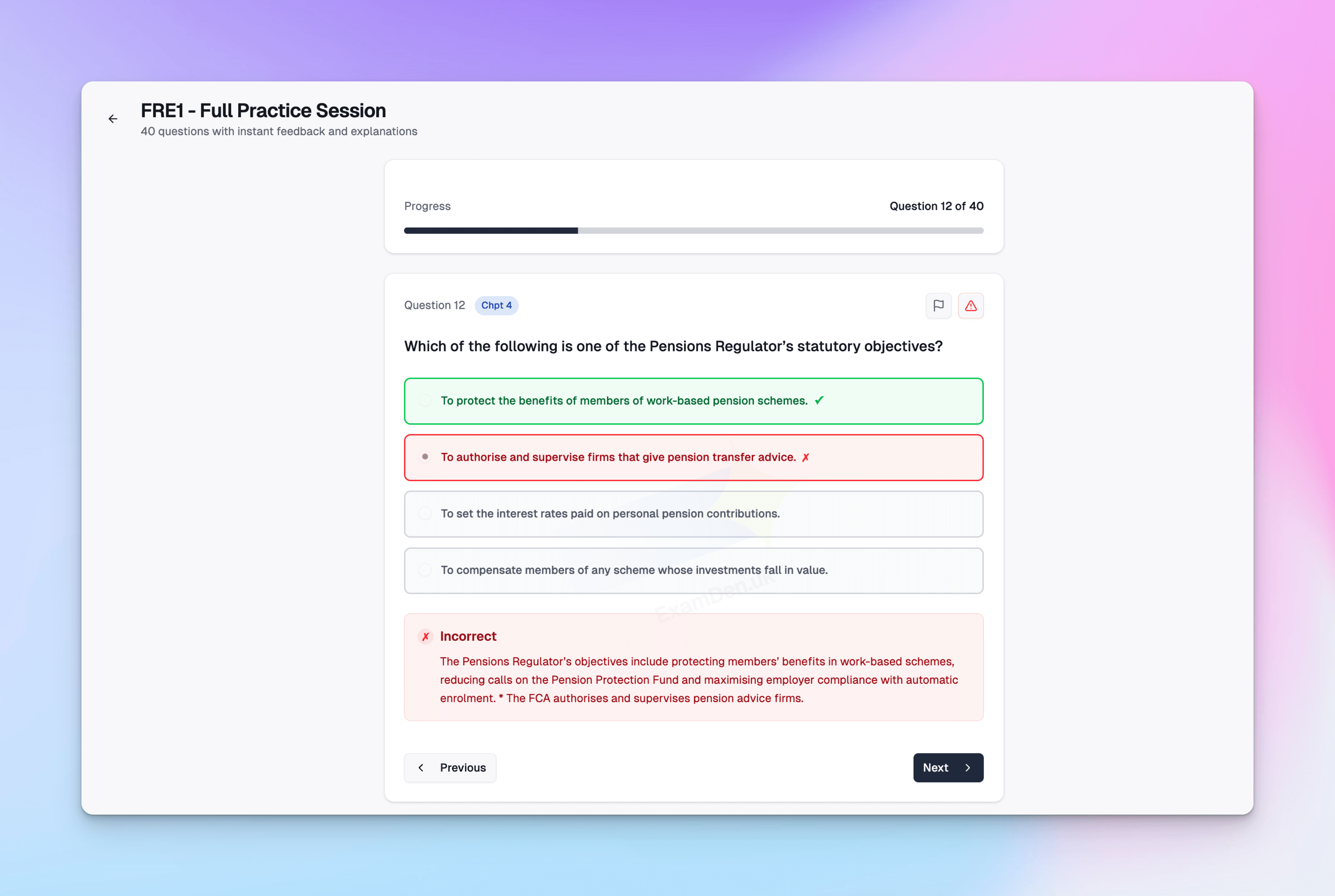
On ExamDen.uk, every question comes with a clear explanation linked to the relevant learning outcome
CeMAP Fees (as of October 2026)
| Option | Price |
|---|---|
| Full CeMAP (all 3 modules, includes materials and first exam per unit) | £735 |
| CeMAP 1 (FSRE) only | £330 |
| CeMAP 2 (MORT) only | £320 |
| CeMAP 3 (ASEW/ASSC) only | £160 |
| Module-by-module total | £810 |
The full package saves you £75 compared to registering module by module. It also gives you 18 months instead of 12.
Optional extras from LIBF
| Add-on | Price |
|---|---|
| Extra practice exams | £25 per unit / £40 per module |
| CeMAP Revision Tool | £90 (Module 1) / £120 (Modules 2+3) / £180 (all) |
| Ask the Expert | £72 for 3 months |
| Revision videos | £125 per module group |
| Audio revision | £50 per module group |
Each unit comes with one free specimen paper. If you want more practice beyond that, LIBF sells additional practice exams, or you can use an independent question bank like ExamDen.
Resit fees
Resits cost £120 per unit. You're limited to 3 attempts per week and 10 attempts in any 12-month period per failed unit. Those limits are generous, but at £120 a time, it adds up quickly — which is why doing enough practice before your first attempt matters.
💰 One resit costs £120. A month of extra practice with a question bank costs a fraction of that. Invest the time in mock exams before you sit the real thing.
Step 2: Study the Material
Once you register, you'll get access to LIBF's study materials through MyLIBF. There's no required study order, but LIBF recommends completing CeMAP 2 before CeMAP 3 because Module 3 is synoptic — it tests you on the mortgage content from MRT1 and MRT2.
Most candidates follow this order:
- CeMAP 1 (FRE1, then FRE2) — regulation and legal framework
- CeMAP 2 (MRT1, then MRT2) — mortgage products and practice
- CeMAP 3 (ASEW or ASSC) — applying everything in case studies
You don't need to pass one module before starting the next. Some candidates study CeMAP 1 and 2 in parallel, especially if they're already working in mortgages and find the CeMAP 2 content more intuitive.
For a full breakdown of what each module covers and how to study for it, see our complete CeMAP study guide, plus the detailed guides for CeMAP 1 (FRE1 and FRE2), CeMAP 2 (MRT1 and MRT2) and CeMAP 3 (ASEW/ASSC).
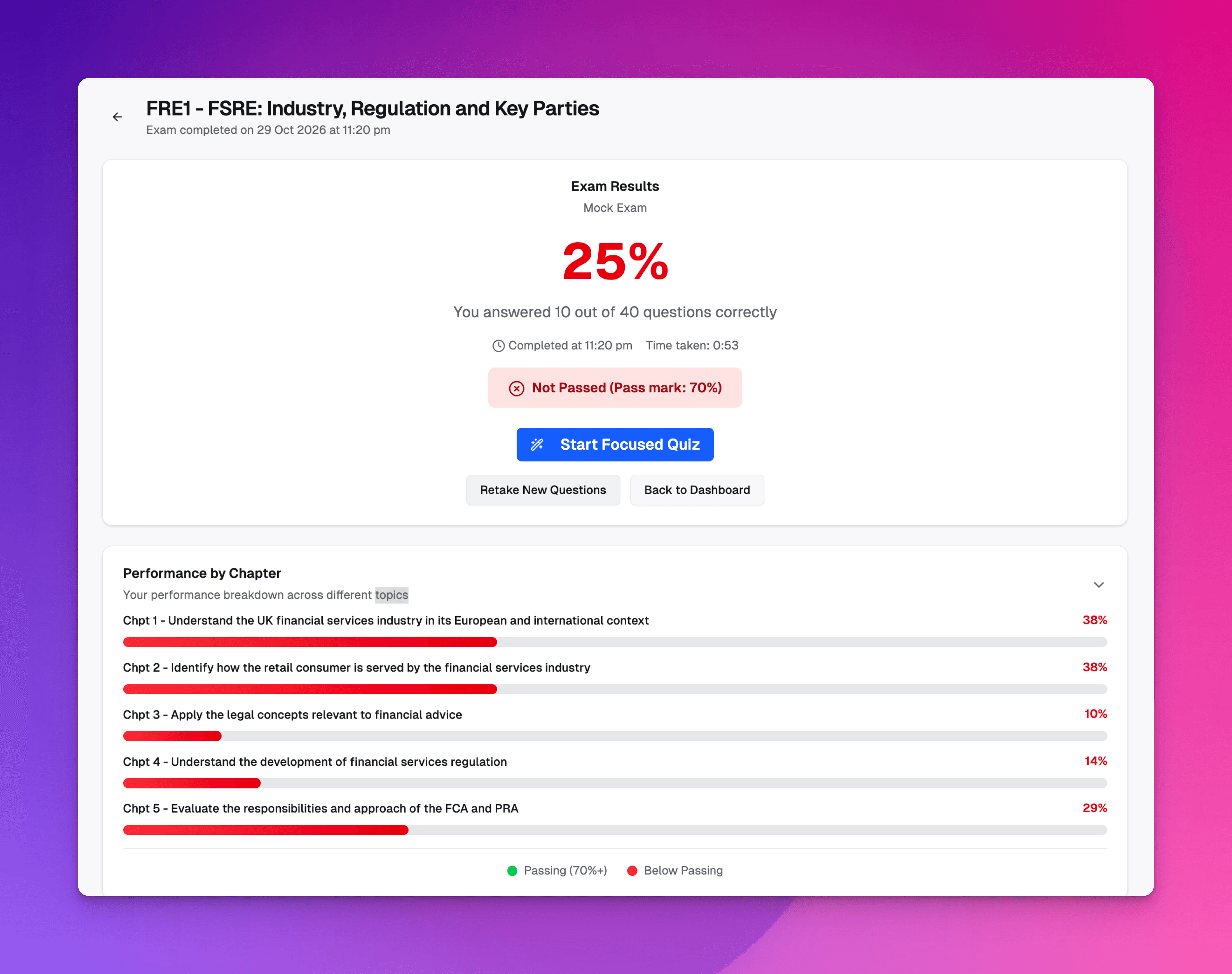
On ExamDen.uk, a timed mock shows your score against the 70% pass mark, and which chapters are below it
Step 3: Sit the Exam
How the on-demand exam works
There is nothing to book. Once your exam access is activated on Brightspace, the link is available for you to start at any time within your registration period. You can sit it at 9am on a Tuesday or 11pm on a Sunday — it's entirely up to you.
The exam uses remote invigilation:
- Before you start: you'll do a full 360° room scan with your webcam. Make sure your desk is clear and no one else is in the room.
- During the exam: your webcam and screen are monitored. You can't open other tabs or applications.
- No toilet breaks during the exam. For a 1-hour unit this is manageable; for the 2-hour CeMAP 3, plan accordingly.
- You can sit two units on the same day. Some candidates sit FRE1 in the morning and FRE2 in the afternoon, or MRT1 and MRT2 back to back.
What you'll need
- A laptop or desktop with a working webcam (tablets and phones aren't allowed)
- A stable internet connection — avoid work devices and VPNs, which can cause firewall issues. If you're on a corporate network, whitelist .learnosity.com and .atomicjoltappsie.com
- Photo ID — check MyLIBF for the current requirements
- A quiet, private room with nothing on your desk
⚠️ Corporate firewalls are the most common technical issue. If you're sitting the exam from a work laptop, test the Brightspace platform in advance and whitelist the domains above.
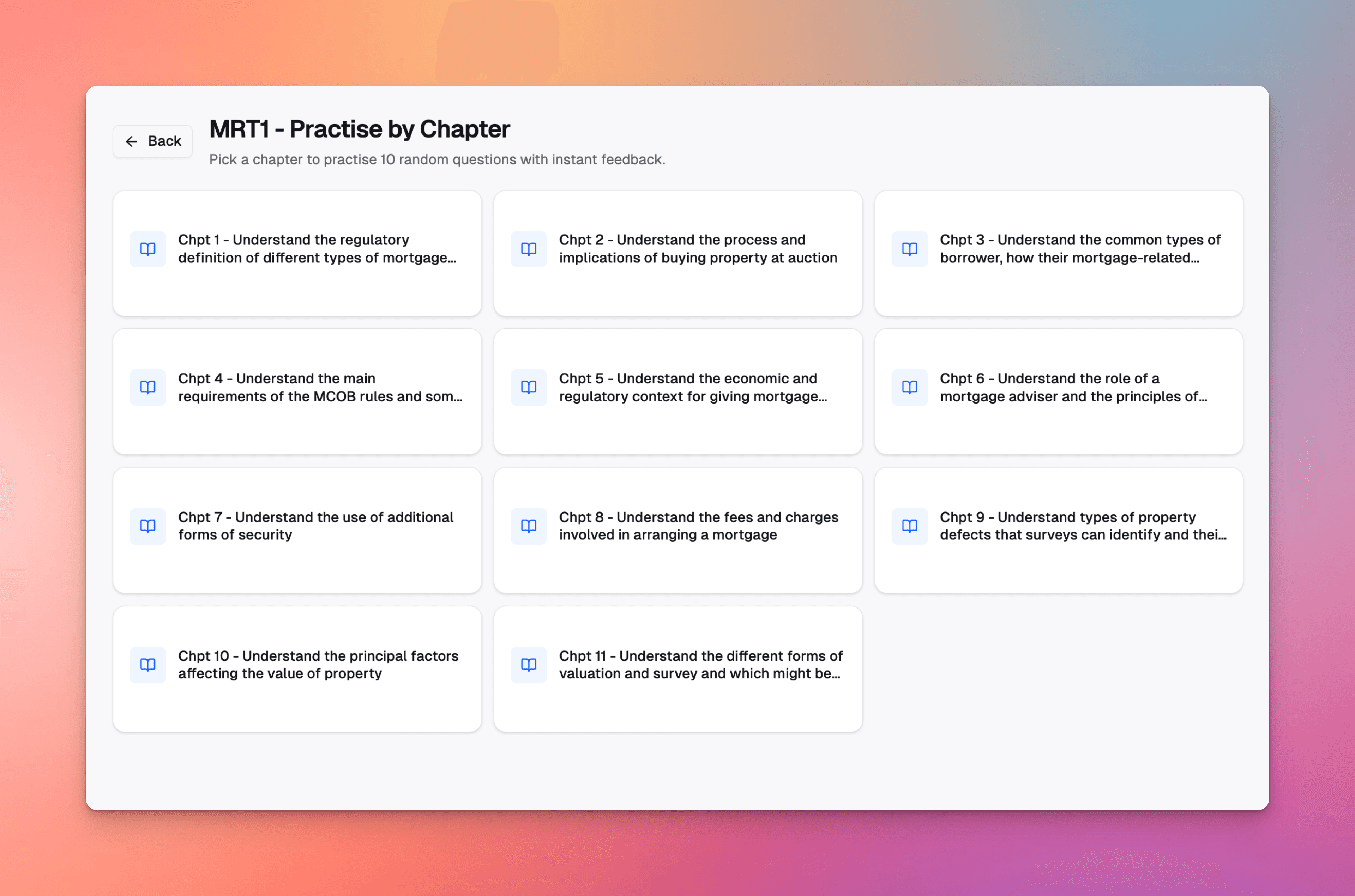
On ExamDen.uk, start with practice by chapter, then move to a full timed mock when you're ready
Registration Periods and Deadlines
| Registration type | Time allowed |
|---|---|
| Full CeMAP (all 3 modules) | 18 months |
| Single module | 12 months |
Since exams are on demand, there's no booked exam date creating urgency. This is convenient, but it's also the reason many candidates take longer than they need to. Without a deadline, it's easy to keep pushing the exam back.
Set your own deadlines. Decide when you'll sit each unit and work backwards from there. Many training providers recommend booking a target exam date in your calendar, even though you don't technically need to book anything.
How Long Does CeMAP Actually Take?
LIBF quotes a total qualification time of 250 hours. Here's what that looks like in practice:
| Scenario | Estimated timeline |
|---|---|
| Full-time study (30+ hrs/week) | 2–3 months for all 3 modules |
| Part-time alongside work (10–15 hrs/week) | 3–6 months |
| Employer-paid intensive course (per module) | 2-week course + 2–4 weeks revision |
| Very part-time (5–8 hrs/week) | 6–9 months |
Training providers commonly estimate 120–150 hours of actual study time, with 6–8 weeks suggested for CeMAP 1 alone. The remaining time in LIBF's 250-hour figure covers additional reading, practice exams and revision.
A realistic week-by-week plan
Here's a rough timeline for someone studying part-time (around 12 hours a week):
| Weeks | Activity |
|---|---|
| 1–6 | Study FRE1 material, start practice questions |
| 7 | Timed FRE1 mocks, sit FRE1 when scoring 75%+ |
| 8–12 | Study FRE2, sit FRE2 |
| 13–18 | Study MRT1 and MRT2 |
| 19–20 | Timed mocks for MRT1 and MRT2, sit both |
| 21–24 | Study CeMAP 3, practice case studies, sit ASEW/ASSC |
That's about 6 months. Some candidates do it faster, especially if they're already working in financial services and the regulatory content in CeMAP 1 is familiar.
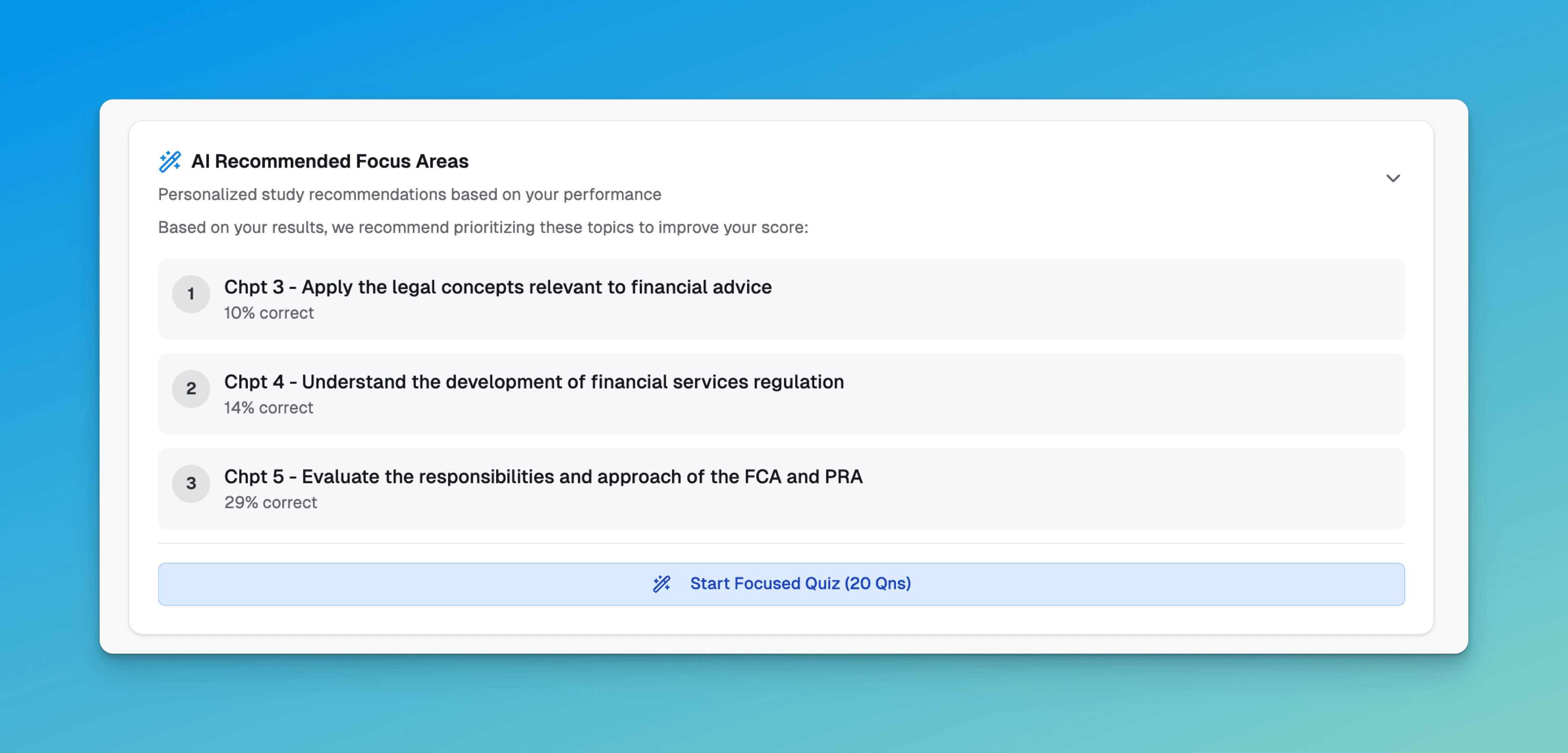
On ExamDen.uk, the focus list after a mock shows which learning outcomes to revise first
Exemptions and Transfers
If you already hold certain qualifications, you may be able to skip some units:
- DipFA (FSRE): a DipFA pass on the FSRE module counts as CeMAP 1. You won't need to sit FRE1 or FRE2.
- Old CeMAP passes: if you passed under the old structure, your results carry across. UKFR (ITFS + UKFS) maps to FRE1 + FRE2. MLPP + MAPP maps to MRT1. MAPC maps to MRT2. ASSM maps to ASEW/ASSC.
- RPL (Recognition of Prior Learning): available through LIBF for other qualifications. Apply through your MyLIBF account.
Note that MRPP alone doesn't carry credit under the new structure — it was redistributed across MRT1 and MRT2.
What Happens After You Pass
Once you pass all five units across the three modules, you receive:
- A digital certificate from LIBF
- MLIBF membership (Membership of the London Institute of Banking & Finance) while you're studying
CeMAP meets the FCA's education standard for mortgage advisers, so you're then qualified to give mortgage advice at a regulated firm.
CeMAP Booking FAQs
Ready to Put This Strategy Into Action? 💯
Build your confidence before exam day. Practise with timed CeMAP mocks and 500+ exam-style questions per unit.

The ExamDen.uk Team
ExamDen.uk builds exam-style question banks and timed mocks for CeMAP, Cert CII and CII R01–R05, helping UK professionals prepare for their financial services exams.